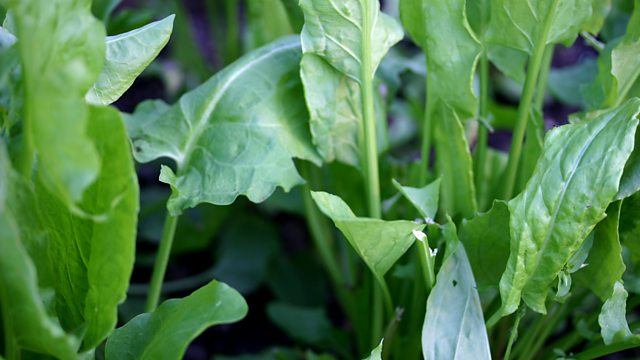
Salad leaves
Dan Saladino reports on the increasingly complex world of the simplest of foods, salad leaves.
It's boom time in the world of lettuce and salad leaves. More leafy greens were sold in the UK last year than ever before, and that upward trend looks set to continue - driven in particular by bags and bowls of pre-prepared leaves. In this edition of The Food Programme, Dan Saladino goes on a journey into this fast-changing world of leaves - from how they are grown and packaged, to the ongoing hunt for new leaves.
Dan discovers how one particular type of lettuce with roots in 19th-century America changed food forever, he encounters a man who travels the globe searching for the next 'hero leaf' - and learns secrets about preparing and growing.
Along the way he'll meet pioneering chefs René Redzepi and David Everitt-Matthias, US food writer Irene Sax, greengrocer Charlie Hicks, as well as gardener and writer Mark Diacono.
Last on

5 leaves from David Everitt-Matthias

5 Seasonal Leaves
Wild Garlic; Found at spring time in woodlands in moist conditions. They can be found near bluebells. Garlic flavour, young leaves are good raw, larger leaves are good wilted or chopped.
Cleavers; Again, a spring time leaf. They grow all over the place, near water , in longer grass on common land. The tips have a raw taste like freshly podded peas.
Ox-Eye Daisy; Found in summer time growing by the roadside or in meadows. They look like massive daisies. The leaves go great with beetroot in salads because of their earthy beetroot taste.
Wood Sorrel; Found in wooded areas and hedgerows in the spring, summer and autumn. The leaves have a wonderful kick of citrus due to the Oxalic acid. Great with fish and seafood.
Woodruff; Late spring and summer. You can find it in wooded areas.Wonderful, slightly almondy flavour when raw or used for infusing.
David is Chef Proprietor at The Champignon Sauvage in Chaltenham. He is also author of 'Essence'
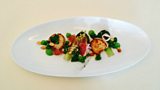
David's Baby Gem salad
Serves 4 People
2 Baby Gem Lettuce
50g Olive Oil
50g Unsalted Butter
1. Cut the little gems in half lengthways.
2. Heat the olive oil in a frying pan and place the lettuce in flat-side down.
3. Cook over a high heat until scorched. ( deep brown )
4. Remove from the pan. Place to one side.
5. Heat another pan with the water and the butter. Bring to the boil to create an emulsion and add the lettuce. Cook for 2-3 minutes until just cooked.
6. Season and serve.
At the restaurant we place the lettuce halves under vacuum pressure to remove some of the water. This makes for a more concentrated toasty flavour. I am sure if you are friendly with your butcher and ask him nicely he will 'vac pac' it for you. You'd then keep the leaves like this for 1-2 hours and then cook as above.
In the photo, we've used the lettuce as part of a scallop dish served with pea puree, peas and roasted peanuts. But is also goes very well with barely cooked and chopped oysters and fresh almonds.
Mark Diacono's Lettuce, pea and mint soup

Lettuce, pea and mint soup
Lettuce soup is one of those peculiarly little made recipes that once made becomes a regular. Delicious hot or chilled, it is infinitely adaptable to whatever's in season - broad beans and dill, courgette and basil etc in place of the pea and mint. It's also a belter to have to call on when too many lettuces are ready at once or if some are going to seed. Using a light stock or water allows the flavour of the lettuce to stay up front.
A generous knob of butter
4 spring onions - roughly sliced
400 grams of peas in the pod (or 160gms frozen peas) - podded
Head of one lettuce (just beginning to bolt if you like) or the outer leaves from 2 to 3 lettuce - washed and roughly chopped.
200ml or so of vegetable stock or water
4 or 5 mint leaves
Splash of cream
Salt and pepper
Method
Melt the butter on a low heat and add the peas, spring onion and lettuce, and cook gently until the lettuce has wilted well. Add the water or stock and continue cooking gently for around 10 minutes. Take off the heat, add the mint leaves and allow to infuse for a few minutes while the soup cools a little. Liquidise thoroughly and return to the pan, warm, season to taste. Serve with a splash of cream, a dollop of yoghurt or a swirl of good olive oil.
Mark Diacono grows unusual and forgotten food at his smallholding Otter Farm. He is the author of 'A Taste of the Unexpected'.
4 leaves from Mark Diacono. Reine de Glace...
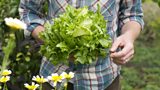
Reine de Glace – a really wonderful crisphead lettuce. Think of it like an elegantly ragged iceberg but with so much more flavour and refinement. Very green, very crisp and very beautiful iceberg heads that have never failed me. A very old variety (200 years+) and one of the best.
...Australian Yellow Leaf & Lingua di Canarino...
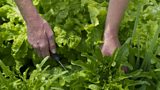
Australian Yellow Leaf (foreground) – A large, open-headed lettuce with gorgeous bright green/yellow crinkled leaves, looks fabulous, is slow to bolt and takes well to cut-and-come-again harvesting. The texture is superb – firm and crunchy – and the flavour sweet and fine. Grow it with the deep red, Really Red Deer Tongue for a fabulous visual and flavour combination.
Lingua di Canarino (background) – an oakleaf lettuce with a mild yet distinctive flavour, a good crisp texture and is very slow to bolt or turn bitter. A very hardy lettuce that does thrive into autumn and in cool areas.
...and Buttercrunch lettuce
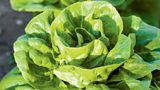
Buttercrunch, along with Marvel of Four Seasons, is my favourite butterhead lettuce.While the outer leaves are soft and loose, the centre is crisp, so it’s almost two lettuces in one. The flavour is gentle and buttery. It’s slow to bolt and drought resistant too. Try it with just olive oil and salt, or use it as the base of a mixed salad.
All leaves feature in A Year at Otter Farm, by Mark Diacono, published by Bloomsbury
Photography: Mark Diacono & Candida Diacono
Credits
| Role | Contributor |
|---|---|
| Presenter | Dan Saladino |
| Interviewed Guest | Rene Redzepi |
| Interviewed Guest | David Everitt-Matthais |
| Interviewed Guest | Irene Sax |
| Interviewed Guest | Charlie Hicks |
| Interviewed Guest | Mark Diacono |
| Producer | Rich Ward |
Broadcasts
- Sun 20 Jul 201412:32BBC Radio 4 FM
- Mon 21 Jul 201415:30BBC Radio 4 FM
Download this programme
Subscribe to this programme or download individual episodes.
Can comfort foods really make you feel better?

Yes they can, says Sheila Dillon.
Podcast
![]()
The Food Programme
Investigating every aspect of the food we eat