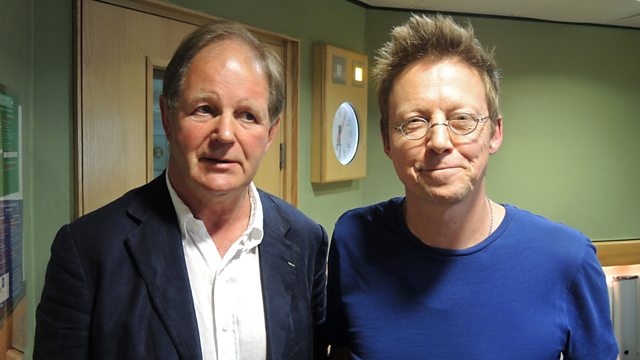
With Michael Morpurgo
Including an amazing Confession. Which isn't really a Confession but it doesn't matter. (See text below, get your hankies ready).
Michael Morpurgo tells us about his World War One Anthology.
And in Homework Sucks we find out if the Earth is heavier or lighter because of human activity.
Last on

Clips
![]()
Sanjeen's Confession
Duration: 08:34
![]()
Michael Morpurgo - Interview
Duration: 12:59


Music Played
![]()
a‐ha
Cry Wolf
- A-Ha - Scoundrel Days.
- Warner Bros..
- 6.
![]()
Paul Carrack
One In A Million
- Rain Or Shine.
- Carrack-UK.
- 1.
![]()
The Castaways
Liar, Liar
- Rhino.
![]()
Coldplay
A Sky Full Of Stars
- BBC Music Awards (Various Artists).
- UMOD.
![]()
Electronic
Getting Away With It...
- (CD Single).
- Factory Records.
![]()
Bryan Ferry
Virginia Plain (Glastonbury 2014)
![]()
The Full English
Awake Awake
![]()
Manic Street Preachers
Walk Me To The Bridge
- Futurology.
- Sony Music.
- 001.
![]()
The Platters
The Great Pretender
- The Platters Golden Hits.
- Phonogram.
- 5.
![]()
Sex Pistols
Pretty Vacant
- Sex Pistols - Never Mind The B******s.
- Virgin.
![]()
Joe South
The Games People Play
- The Hits Of 1969 (Various Artists).
- MFP.
![]()
Tears for Fears
Everybody Wants To Rule The World
- NOW That's What I Call The 80s (Various Artists).
- Now.
- 4.

Sanjeen's Confession
Dear Father Mayo and the Confessional Curia,
My story takes place over 30 years ago when I left the Home Counties to attend university in the glamorous city of Hull. Apart from the culture shock (my friends joked that maps simply indicated that in the lands above Birmingham that “There be dragons here”), life as an undergraduate in this fine city proved very enjoyable. Very enjoyable indeed!
Now, in case my children hear this confession, let me say that I spent my time as new undergraduate, diligently attending all my lectures & tutorials, studying hard in the library, abstaining from alcohol and ensuring I was in bed at a respectable hour every night. Well, not much of that is true, but these were heady days of student grants, cheap beer and plenty of joyful entertainment.
Now being a well brought up young man, I noticed that across the road from my Halls of Residence, there was a hospice looking after the elderly. Feeling a little ashamed of my several weeks of Bacchanalian debauchery, I went over and offered my voluntary services to help in any way that would of use to the nurses there. Appreciative of the offer, I subsequently found myself every Tuesday evening pushing a tea trolley around the common room and serving tea to the folks there.
They were a lovely bunch, but generally at fairly advanced stages of dementia which made for some unusual conversations. Being of Indian origin, occasionally I would elicit memories of their times spent in the sub-continent during colonial bygone days. Other times I would mistaken for their doctor and occasionally I would understand what made so called comedy shows, of that era, such as “Mind your language” so popular. Overall though, I began to enjoy these weekly visits, tempered by the realisation that the folks there were not there for long.
Now after a few weeks, on one cold Tuesday December evening, I noticed a new guest. She was elderly lady, body hunched from arthritis, who caught my eye as I entered the common room. What held my eye was her expression which went from uninterested, to puzzled, to recognition, to tearful joy. Getting up from her chair, her back straightened and she approached me and took my hands. “It’s you,” she whispered. “You came back. You promised you’d come back”. Being just 18, I was momentarily nonplussed and simply nodded. She then smiled and said “Shall we dance?” Again, not quite knowing what to do, I mutely nodded again. She then began to hum Johan Strauss’s “The Blue Danube” and we proceeded to waltz around the room. Her back was perfectly straight and she was looking at me with tears in her eyes repeating “I knew you’d come back.” Then with a look of mock disapproval she added “but you have forgotten how to waltz properly.” Finally, I led her back to her chair and said I had to go. “But you’ll come back, won’t you?” she asked and I promised I would.
Over the following weeks, every Tuesday evening, the same pattern repeated itself: Her look of puzzlement, replaced by joy, our waltz around the room and finally a promise that I would return.
The two things which did alter were firstly that I learned her name was Gill and secondly, courtesy of the Hull University Ballroom Dancing Society, I was (very) patiently taught how to dance the waltz, so at least I was eventually spared of that criticism!
Christmas came and I headed back home for several weeks of much deserved rest and lot of reading catch-up to complete. On returning in the New Year, that Tuesday, I went across the dark rainy street to resume my weekly tea serving duties. As I entered, one of the nurses called me over. “I am so sorry,” she said, “But Gill passed away over Christmas, but her daughter has asked me to give you this letter.” Later that evening, I sat down to see what the letter said.
“Dear Sanjeen,
The nurses have told me how you danced with my mother every week and if I may, I would like to offer an explanation as to these curious events.
During the first-world-war, my mother was a nurse in London far from home. Feeling lonely, she began to attend a weekly tea dance where she met a charming Indian soldier. He too was lonely and far from home. Before long a friendship blossomed. Every week they would meet, drink tea, dance the waltz and talk and talk and talk.
Before long, they began to fall in love, but before this love could take any substantive form, the soldier was posted overseas to a front line somewhere. Their last meeting in the tearoom was incredibly sad, but he promised that he absolutely would return.
Now, the truth is that he never returned from the war and broken hearted, my mother eventually met someone else, settled down, had a family and a long and happy life.
Anyway, I just wanted to thank you for being so kind and giving Gill such joy in her final weeks. I wish you well.”
So, Father Mayo, I am not really sure for what I seek absolution. Is it the sadness of a broken heart?
No, if I may, on this occasion, I would like to break with tradition and rather than seek forgiveness, I would like to ask for your collective blessings. Not for me personally, but indeed for all acts of random kindness. For as Iris Murdoch wrote in “The Bell” - “Our actions are like ships which we may watch set out to sea, and not know when or with what cargo they will return to port.”
In memory of Gill and her waltzing partner.
Broadcast
- Wed 2 Jul 201417:05BBC Radio 2
