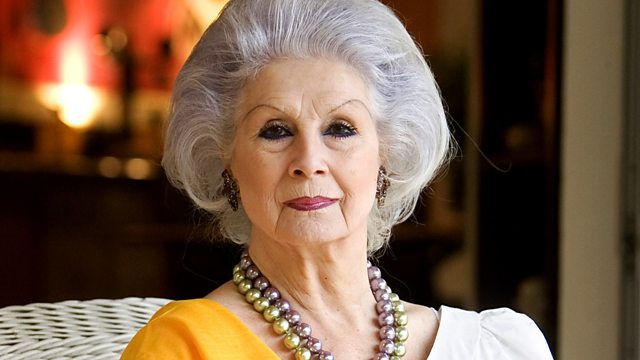
April Ashley; Wendy Holden; Born with a heart defect
Transgender icon April Ashley's new exhibition in Liverpool; Wendy Holden talks about letting go of your children when they go to university; Heart defects in babies - should we test all new-borns? Presenter: Sheila McClennon.
Last on

Chapters
Forgotten Rape Cases
Kim Worthy on trying to change the way that the US justice system treats rape victims
Duration: 08:07
Women-only areas in India
Is this a solution to prevent sexual violence against women or a step backwards?
Duration: 07:22
First Term at University
Author Wendy Holden talks about letting go of your children when they go to university
Duration: 08:43
Congenital Heart Defects
Should all newborn babies be tested?
Duration: 07:49
April Ashley
Transgender icon and former model April Ashley talks about her new exhibition
Duration: 08:58
April Ashley
April Ashley was born in Liverpool in 1935 as George Jamieson and grew up praying that each morning she would wake up a girl. In 1960 she became one of the first people in the world to undergo pioneering gender reassignment surgery. April’s life has often been in the headlines; a former Vogue model and actress she was ‘outed’ as transsexual by the Sunday People in 1961. Her divorce from The Honourable Arthur Corbett set a legal precedent for all transsexuals. This remained until 2004 when the Gender Recognition Act was passed to legally allow people to change gender. She’s been a campaigner for transgender equality and is still an inspiration to many people. Sheila McClennon went to meet April at the Museum of Liverpool at the opening of an exhibition which charts April’s life alongside the lives of others from the trans and gender communities.
April Ashley: Portrait of a lady runs from 27 September 2013 to 21 September 2014. It is a collaborative project between the Museum of Liverpool and Homotopia.
First Term at University
Dropping off children for their first term at university is a rite of passage for them but also for their parents. The University of Sheffield has this summer opened a boutique hotel next to its student halls of residence specifically targeted at those parents wanting to be as near as possible to their offspring whenever they visit. Are today’s parents worse at letting go, and how much parental distance is best? Sheila talks to Wendy Holden, author of ‘Gifted & Talented’ and to business owner and father of three, Stephen Falder.
Forgotten Rape Cases
Kym Worthy, the Prosecutor for Wayne County in Detroit, Michigan, is on a mission to investigate over 11,000 rape cases – some of which have been ignored for over 20 years. In 2009, whilst doing a routine audit of police property, Kym’s staff discovered thousands of unchecked and apparently disregarded rape kits containing forensic evidence that had seemingly never been properly reviewed. The Institute of Justice awarded Kym a $1.5 million grant to look in to every case, and she is now determined to change the way that the American justice system treats rape victims. She joins Sheila to explain how the campaign is going.Congenital Heart Defects
Congenital heart defects are the most common birth defect affecting up to six thousand babies each year. Currently, babies hearts are checked via ultrasound at 20 weeks in the womb and again, within 72 hours of birth using physical examination. Despite this, at least a third of babies with undetected congenital heart defects are still leaving hospital. Campaigners are calling for pulse oximetry, an additional test, to be made compulsory for all new borns and the National Screening Committee has now launched a public consultation to look further into extra screening. To evaluate the relative benefits, Sheila talks to Kirsty Patience about her experience when her son was born with half a heart and also to neonatologist Dr Andy Ewer.
The National Screening Committee
Women-only areas in India
In September Woman's Hour reported on the conviction of four men who raped and murdered a 23 year old student on board a bus in New Delhi. A number of Indian cities have responded to the Delhi bus rape by creating women-only areas; in parks, streets, public buildings and on transport. In a country where reported sexual violence is increasing are women-only spaces a welcome refuge from unwanted male attention or a step backwards to segregation? To discuss the issues Sheila is joined by Monisha Rajesh, journalist & author of ‘Around India in 80 Trains’ and by Veena Nayyar, President of Women's Political Watch in Delhi.
Credits
Role Contributor Presenter Sheila McClennon Interviewed Guest April Ashley Interviewed Guest Wendy Holden Editor Alice Feinstein Producer Kate Lowe Broadcast
- Fri 4 Oct 201310:00BBC Radio 4
Follow us on Instagram
![Follow us on Instagram]()
Get all the pictures, videos, behind the scenes and more from Woman’s Hour
Podcast
![]()
Woman's Hour
Women's voices and women's lives - topical conversations to inform, challenge and inspire


Related Content
