Equatorial Guinea Episode 1
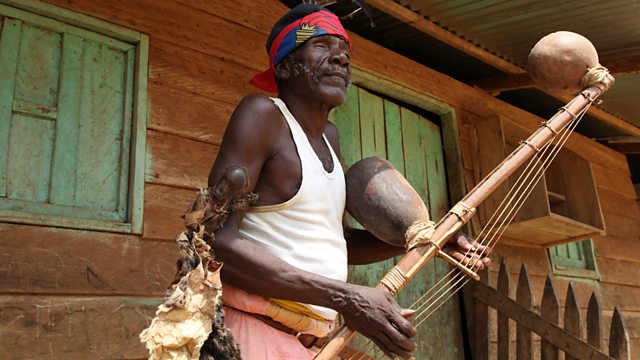
Lucy Duran visits Equatorial Guinea in central Africa to hear music of the Fang people. She meets Stanislav Bengono Nvo, one of the few remaining players of the mvet.
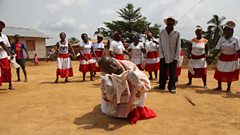
Lucy Duran heads to Equatorial Guinea in central Africa, with her guide Isabela de Aranzadi, to hear the music of the majority Fang people. She meets Stanislav Bengono Nvo, one of the few remaining players of the mvet, an 8 string harp zither. They head deep into the continental portion of the country to meet local artisan Felipe Osa and possibly for the first time ever record the Abakuya dance tradition, which has its roots in Nigeria, then Cuba and then Equatorial Guinea. In the forest Lucy goes in search of a man called Chacho who performs the Fang funeral tradition of Ndong Mbá, and back on the island of Bioko they hear the many xylophones of the Fang language Catholic mass.
Home to many different ethnic groups, the Fang, Bubi, Ndowe, Bisio, Krio and others, Equatorial Guinea is spread across a mainland portion, squeezed between Gabon and Cameroon, and a series of islands, the largest being Bioko and home to capital Malabo. It first cropped up on European maps when Portuguese explorer Fernando Po passed by the islands in the 15th Century; then, swapped for a bit of Brazil with the Spanish, it began its Spanish speaking history. The British had a go at moving their anti-slavery operations from nearby Sierra Leone to Malabo in the early 19th Century but the Spanish weren't giving up, and returned in 1843 to claim back Spanish Guinea, bringing Catholicism too. Independence came in 1968, followed by the 11-year reign of terror of first president Francisco Macias Nguema. He was overthrown by his nephew, Teodoro Obiang Nguema Mbasogo, who at 34 years in the job is now Africa's longest serving leader. Since the discovery of oil in the mid-1990s Equatorial Guinea has become an extremely wealthy nation, and is undergoing extensive infrastructural change.
Last on

Clip
![]()
World Routes in Equatorial Guinea
Duration: 05:17
Music Played
![]()
Stanislav Bengono Nvó
Mvet solo
Composer: Stanislav Bengono Nvó Performers: Stanislav Bengono Nvó (voice and mvet)
- BBC Location Recording.
- Ebiang, Equatorial Guinea.
![]()
Stanislav Bengono Nvó
Mvetoyeng
Composer: Stanislav Bengono Nvó Performers: Stanislav Bengono Nvó (voice and mvet) with the villagers of Ebiang
- BBC Location Recording.
- Ebiang, Equatorial Guinea.
![]()
Abakuya Performers
Abakuya
- BBC Location Recording.
- Ebibiyin, Equatorial Guinea.
![]()
Abakuya Performers
Calling the Nankue
- BBC Location Recording.
- Ebibiyin, Equatorial Guinea.
![]()
Silverio Ebáng Ngonga
Ndong Mbá - Anu Awá Mena
Composer: Silverio Ebáng Ngonga Performers: Silverio Ebáng Ngonga “Chacho” (voice) with the villagers of Bife Efák
- BBC Location Recording.
- Bife Efák, Equatorial Guinea.
![]()
Silverio Ebáng Ngonga
Ndomba - Anu Awá Mena
Composer: Silverio Ebáng Ngonga Performers: Silverio Ebáng Ngonga “Chacho” (voice) with the villagers of Bife Efák
- BBC Location Recording.
- Bife Efák, Equatorial Guinea.
![]()
Nfufub Benigno
Marta y Maria at the time of resurrection
Composer: Traditional Performers: Nfufub Benigno (chorus and mendzang ensemble) Francisco Esono (director)
- BBC Location Recording.
- Claretian church, Malabo, Equato.
![]()
Nfufub Benigno
Gloria
Composer: Traditional Performers: Nfufub Benigno (chorus and mendzang ensemble) Francisco Esono (director)
- BBC Location Recording.
- Claretian church, Malabo, Equato.
![]()
Nfufub Benigno
El amor que Christo noc tient amora todo el mundo
Composer: Traditional Performers: Nfufub Benigno (chorus and mendzang ensemble) Francisco Esono (director)
- BBC Location Recording.
- Claretian church, Malabo, Equato.

Broadcast
- Sun 19 May 201322:00BBC Radio 3
Featured in...
![]()
World Music Archive—World on 3
This collection features our choice of musical highlights from across the globe.