15. The Flag That Failed
Neil MacGregor on the problems in uniting Scotland and England encapsulated in a set of designs for a common flag. From 2012.
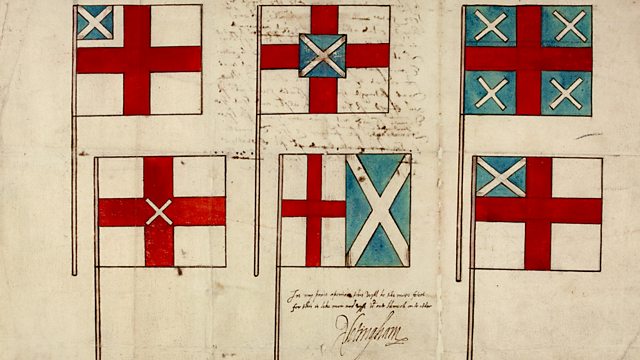
The problems in uniting Scotland and England and in creating a Great Britain are encapsulated in a set of designs for a common flag.
Object-based history series presented by Neil MacGregor, former Director of the British Museum.
Taking artefacts from William Shakespeare's time, he explores how Elizabethan and Jacobean playgoers made sense of the unstable and rapidly changing world in which they lived.
With old certainties shifting around them, in a time of political and religious unrest and economic expansion, Neil asks what the plays would have meant to the public when they were first performed.
He uses carefully selected objects to explore the great issues of the day that preoccupied the public and helped shape the works, and he considers what they can reveal about the concerns and beliefs of Shakespearean England.
Producer: Paul Kobrak
First broadcast on BBC Radio 4 in May 2012.
Last on

Flags for Great Britain
Date: 1603-1604
Size: H:290mm, W:425mm
Made in: Unknown
Made by: Unknown
Material: Paper
Making a nation can be difficult. When King James VI of Scotland became King James I of England, he found himself ruling over two countries with different political and legal systems, different established churches, different currencies, and a long history of mutual dislike and suspicion.
His central ambition was to unite these two countries to form a new unified state – a Great Britain. But turning this dream into public reality was quite another matter. As these early designs for the new British flag show, it’s incredibly difficult to get the balance right and please everybody.
This object is from the National Library of Scotland
Quotations
'Publish we this peace To all our subjects. Set we forward, let A Roman and a British ensign wave Friendly together.'
Cymbeline Act 5 Scene 5
Background
- The Treaty of Union proposed by James I in 1604 followed half a century of unbroken peace between Scotland and England (if you don't count the usual border skirmishes)
- As King, James I could force through the designs for a symbolic flag even if both parliaments were blocking the proposal itself
- Heraldry is set up to indicate hierarchy and precedence and it was in fact heraldically impossible to unite the two flags in exact equality
- The position nearer to the flag pole is better, as is being positioned at the top
- The union flag remained unpopular in both nations and it took until the 1800s for it to reach its current, modern, form.
More from Radio 4: The Discovery of England's Past
The Holinshed Chronicles collected the fragments of British History for the first time. But how much was based on political propaganda? Jonathan Bate investigates.
Broadcasts
 Fri 4 May 201213:45BBC Radio 4
- Fri 4 May 201219:45BBC Radio 4
- Fri 26 Oct 201214:15BBC Radio 4 Extra
- Fri 27 Mar 201514:15BBC Radio 4 Extra
- Sat 28 Mar 201500:15BBC Radio 4 Extra
- Fri 29 Jul 201613:45BBC Radio 4
- Fri 4 May 201814:15BBC Radio 4 Extra
- Sat 5 May 201802:15BBC Radio 4 Extra
- Fri 3 Nov 202307:15BBC Radio 4 Extra
- Fri 3 Nov 202312:15BBC Radio 4 Extra
- Fri 3 Nov 202317:15BBC Radio 4 Extra
- Sat 4 Nov 202303:15BBC Radio 4 Extra
Podcast
![]()
Shakespeare's Restless World
Neil MacGregor uncovers the stories 20 objects tell us about Shakespeare's world.