4. Life without Elizabeth
Neil MacGregor uses a 1571 painting of Elizabeth I to explore what life was like in Shakespeare’s turbulent world. From 2012.
A portrait was painted in 1571 to justify and celebrate Elizabeth I's position in the Tudor succession.
Yet by the 1590s, with no direct Tudor heir, this image had very different implications in Shakespeare's Restless World.
Object-based history series presented by Neil MacGregor, former Director of the British Museum.
Taking artefacts from William Shakespeare's time, he explores how Elizabethan and Jacobean playgoers made sense of the unstable and rapidly changing world in which they lived.
With old certainties shifting around them, in a time of political and religious unrest and economic expansion, Neil asks what the plays would have meant to the public when they were first performed.
He uses carefully selected objects to explore the great issues of the day that preoccupied the public and helped shape the works, and he considers what they can reveal about the concerns and beliefs of Shakespearean England.
Producer: Paul Kobrak
First broadcast on BBC Radio 4 in April 2012.
Last on

Transcript
Read a transcript of the programme: Shakespeare's Restless World / Life without Elizabeth
Portrait of the Tudor Dynasty
Date: c.1572
Size: H:1312mm, W:1840mm
Made in: Unknown
Made by: Lucas de Heere
Material: Oil paint on panel
In the 1590s, the nation was gripped by a constitutional crisis in waiting. As Elizabeth I drew closer to her three score years and ten, the question of who would succeed her to the throne became a pressing matter.
But the queen herself was a little tetchy on the subject. In 1571, she made it an act of treason to discuss the issue of succession, and in later years added further laws to guarantee silence.
If the issue couldn’t be spoken or written about in words, then it could be pictured. This portrait of the Tudor dynasty from 1571 (and a popular print version issued 20 years later) demonstrates the power of metaphor and allegory in exploring such sensitive subject matter. And on stage, Shakespeare too was exploring ideas of dynasty – but behind the veil of ancient Rome and historical England.
This object is from the National Museum of Wales
Quotations
'England hath long been mad, and scarred herself;/The brother blindly shed the brother's blood,/The father rashly slaughtered his own son,/The son, compelled, been butcher to the sire:/All this divided York and Lancaster'
Richard III, Act 5 Scene 5
Background
- The succession crisis in 16th century England spanned the reigns of Henry VII, Henry VIII and Elizabeth I
- Elizabeth famously refused to name a successor
- Shakespeare would not have been permitted to write about the specifics of the English succession but the general topic was acceptable and a regular feature of his plays
- The purpose of this painting is to assert the legitimacy of Elizabeth's reign and her place in the orderly succession of Tudor rulers
More from Radio 4: Legacy
How the monarchy has dealt with a series of dynastic crises, and a look at some objects that are being brought into the service of both Queen and country today.
More from Radio 4: The Tudor State
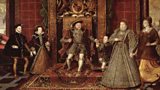
Melvyn Bragg discusses the role of the Tudor dynasty in reshaping the British state and whether their government of England laid the political foundations of our own age.
More from Radio 4: The Death of Elizabeth I
Melvyn Bragg and guests discuss the death of Queen Elizabeth I and its immediate impact, as a foreign monarch became King in the face of plots and plague.
Broadcasts
 Thu 19 Apr 201213:45BBC Radio 4
- Thu 19 Apr 201219:45BBC Radio 4
- Thu 11 Oct 201214:15BBC Radio 4 Extra
- Thu 12 Mar 201514:15BBC Radio 4 Extra
- Fri 13 Mar 201500:15BBC Radio 4 Extra
- Thu 16 Jun 201613:45BBC Radio 4
- Thu 19 Apr 201814:15BBC Radio 4 Extra
- Fri 20 Apr 201802:15BBC Radio 4 Extra
- Thu 19 Oct 202307:15BBC Radio 4 Extra
- Thu 19 Oct 202312:15BBC Radio 4 Extra
- Thu 19 Oct 202317:15BBC Radio 4 Extra
- Fri 20 Oct 202302:15BBC Radio 4 Extra
Podcast
![]()
Shakespeare's Restless World
Neil MacGregor uncovers the stories 20 objects tell us about Shakespeare's world.