The Space Shuttle
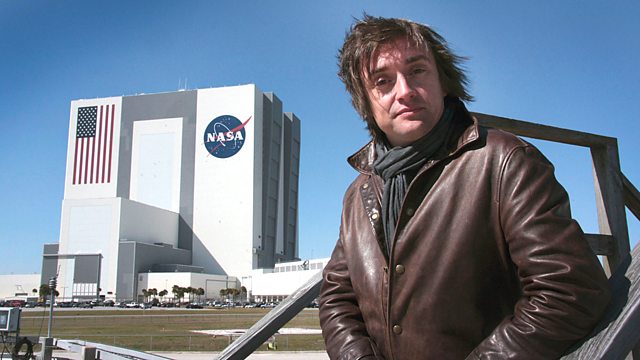
Richard Hammond visits the Kennedy Space Centre to reveal the engineering connections behind NASA's Space Shuttle, the first re-usable space craft.
Richard Hammond reveals the engineering connections in NASA's Space Shuttle - the world's first re-usable space craft. He goes backstage at Kennedy Space Centre, in Florida, to discover how an organ pump, tram tracks, a WWII anti-sonar device, a camera iris and a cannonball all helped create the most technologically advanced machine ever engineered by man. Conceived in the early 1970's as the successor to the Apollo Moon missions, the Shuttle is a delivery system, designed to transport payloads such as the Hubble Telescope, and most of the International Space Station, into orbit, and return for its next cargo. The delivery van is the Orbiter - what most people call the Shuttle - which is mated with a huge external fuel tank and rocket boosters which are all jettisoned. Surviving the huge destructive forces of travelling to space and returning in usable form called for ingenious engineering compromises. The Shuttle is a rocket for the first part of its life, then morphs into a plane for the return journey.
To achieve low Earth orbit, some 200 miles [320 kilometres] above the surface of the planet, it accelerates to 'escape velocity' - around 17,500 mph [28,000 kph] in just over 8 minutes. Producing the thrust calls for two different propulsion systems - liquid-fuelled rockets producing 37 million horsepower and solid rocket boosters - equivalent to twenty 747 engines. Richard sees how an ingenious cooling system protects the main engines from the 3000C combustion temperature by using the liquid fuel itself - stored at less than minus 200C. Using the same principle he makes a kettle out of chocolate ice cream - and successfully boils water without melting the kettle. He also demonstrates how NASA produce maximum thrust from the Shuttle's boosters by racing two rockets identical except for a tiny difference in the way the solid fuel burns. The power - and the noise - produced at launch damaged the very first Shuttle. To prevent any recurrence NASA has installed a huge water sprinkler system to absorb this destructive energy, discharging 1.3 million litres [300,000 gallons] in just twenty seconds. Richard shows the destructive power of noise - a pulse in the air - by blowing over a block wall with a 'vortex cannon'. A suitably placed wall of water protects the wall.
Once in orbit the astronauts unload the payload with a clever robot arm equipped with an 'effecter end' - a cunning arrangement of wires that grasps objects much better than the conventional claw - as Richard shows with his own version. In space if you nudge a precious cargo without securing it you may never see it again as it spins towards the furthest recesses of the universe. Cargo unloaded the Orbiter faces the most hazardous part of its journey - re-entry into the Earth's atmosphere when it could burn up - as Columbia did in 2003. A surprisingly un-aerodynamic blunt shape and some very expensive heat resistant tiles (more than half a million pounds each) keep the astronauts safe, and the Orbiter in shape for its next mission.
Last on

Credits
| Role | Contributor |
|---|---|
| Presenter | Richard Hammond |
| Presenter | Richard Hammond |
| Series Editor | Nick Metcalfe |
| Producer | Mike Slee |
| Producer | Mike Slee |
| Director | Mike Slee |
| Director | Mike Slee |
| Executive Producer | Tom Brisley |
| Executive Producer | Tom Brisley |


