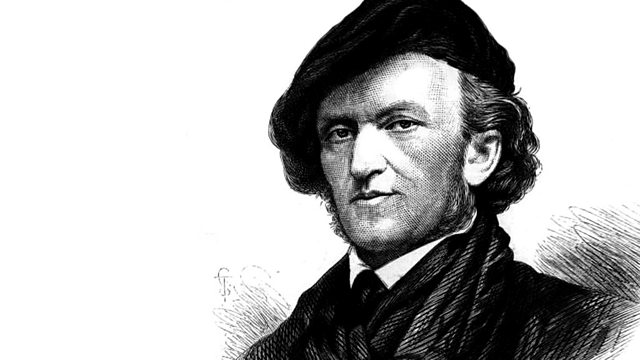
Uprising
Donald Macleod considers why Wagner shared the revolutionary spirit of 1830s Germany with its political, social, artistic and moral changes. Plus the revolutionary Tristan chord.
As his opera Rienzi is removed from the opera programme in Dresden, Richard Wagner takes to the streets and political storm clouds gather. Donald Macleod explores why Wagner shared the revolutionary spirit of 1830s Germany with its political, social, artistic and moral changes. Plus the almost nuclear force of the revolution Wagner detonated on the entire history of tonal music with his astonishing Tristan chord.
Last on

More episodes
Music Played
![]()
Richard Wagner - Der Fliegende Hollander: Overture
Performer: New Philharmonic Orchestra, Otto Klemperer (conductor)
![]()
Richard Wagner - Tannhauser: Excerpt from Act III
Performer: Venus: Waltraud Meier (soprano), Tannhauser: Peter Seiffert (tenor), Wolfram: Thomas Hampson (baritone), Hermann: Rene Pape (bass), Choir of the German State Opera Berlin, Staatskapelle Berlin, Daniel Barenboim (conductor)
![]()
Richard Wagner - Tristan und Isolde: 'Mild und leise wie er lachelt' from Act III
Performer: Isolde: Birgit Nilsson (soprano), Bayreuth Festival Orchestra, Karl Bohm (conductor)
![]()
Richard Wagner - Albumblatt (In das Album der Furstin M.)
Performer: Leslie Howard (piano)
![]()
Richard Wagner - Wesendonck Lieder
Performer: Julia Varady (soprano), Deutsches Symphonie-Orchester Berlin, Dietrich Fischer-Dieskau (conductor)

Broadcasts
- Tue 5 Oct 201012:00BBC Radio 3
- Tue 5 Oct 201022:00BBC Radio 3
Beethoven Unleashed – the box set

The complete set of Radio 3 Beethoven Unleashed podcasts, with Donald Macleod.
What was really wrong with Beethoven?

Georgia Mann and neurosurgeon Henry Marsh examine the composer's numerous health problems
Composers A to Z

Visit the extensive audio archive of Radio 3 programmes about Composers and their works.
Who knew? Five eye-opening stories from Composer of the Week

The production team reflects on 5 of Donald Macleod’s best stories from the last 20 years
Five reasons why we love Parry's Jerusalem

What is the strange power of Jerusalem which makes strong men weep?
A man out of time – why Parry's music and ideas were at odds with his image...
The composer of Jerusalem was very far from the conservative figure his image suggests.
Composer Help Page

Find resources and contacts for composers from within the classical music industry.
