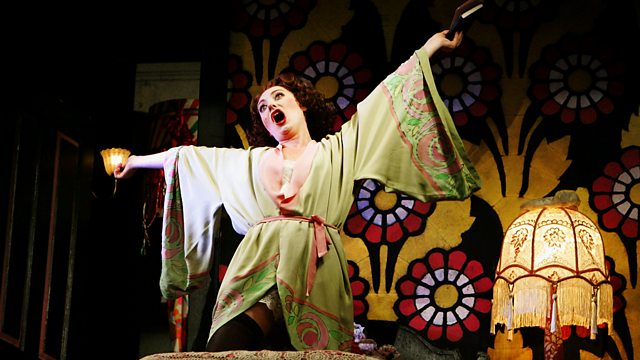
Episode 2
Donald Macleod explores Italian opera in the 1720s, focusing on the work of three giants whom history has treated differently - Alessandro Scarlatti, Vivaldi and Handel.
Continuing Donald Macleod's exploration of two centuries of Italian opera from Monteverdi to Rossini. The second programme focuses on a single decade, the 1720s, and the work of three giants of their day, whom history has treated rather differently: Alessandro Scarlatti; Antonio Vivaldi; and George Frideric Handel. Today Alessandro Scarlatti's reputation is outshone by that of his son Domenico, but he was one of the major musical figures of his time, with over 100 operas to his credit - of which very few are ever performed today.
Unlike Scarlatti, Vivaldi's operatic 'rehabilitation' is well under way, but despite his considerable output - he's known to have composed at least 50 operas, 16 of which have survived - he's still far better known for his instrumental music. Time has been kinder to Handel's operas, many of which are regularly staged today. Handel was German by birth, but he spent a good chunk of his early professional life in Italy, writing opera in the Italian language and the Italian tradition, and he carried on doing so after he settled in London in 1712.
It's a sign of the enormous international success of Italian opera that its leading exponent in the late Baroque, only a century or so after its invention, wasn't actually an Italian!
Last on

Music Played
![]()
Alessandro Scarlatti
Griselda – 'Sinfonia per lo sbarco', from Act 1, scene 6
Orchestra: Akademie für Alte Musik Berlin Conductor: René Jacobs
- Harmonia Mundi HMC 801805.07.
![]()
Alessandro Scarlatti
Griselda – Act 3, scenes 13 and 14
Performers: Dorothea Röschmann (Griselda), Lawrence Zazzo (Gualtiero), Veronica Cangemi (Costanza), Bernarda Fink (Roberto), Kobie van Rensburg (Corrado), Silvia Tro Santafé (Ottone) Orchestra: Akademie für Alte Musik Berlin Conductor: René Jacobs
- Harmonia Mundi HMC 801805.07.
Untitled
Music included: Terminate, o ministri; Chorus: Coronatevi di fiori
![]()
George Frideric Handel
Tamerlano – extract from Act 3
Performers: Nancy Argenta (Asteria), Derek Ragin (Tamerlano), Michael Chance (Andronicus), Nigel Robson (Bajazet), Jane Findlay (Irene), René Schirrer (Leone) Orchestra: English Baroque Soloists Conductor: John Eliot Gardiner
- Erato 2292-45408-2.
Untitled
Music includes: Scene 8 – Eccomi, che si chiede?; Padre, amante; Folle sei; Beva dungue la rea; E il soffrirete; Empio, per farti guerra; Signor, fra tante cure
Untitled
Scene 9 – ‘Vieni Asteria’
Untitled
Scene 10 (part) – Oh perme lieto; Fremi, minaccia; Si figlia, io moro, adio!; Figlia mia, non pianger, nò!; Tu spietato, il vedrai; Sù, via, furie, e minister
![]()
Antonio Vivaldi
Orlando Furioso – Act 1, scenes 3, 4 and 5
Performers: Marie-Nicole Lemieux (Orlando), Lorenzo Regazzo (Astolfo), Ann Hallenberg (Bradamante) Orchestra: Ensemble Matheus Conductor: Jean-Christophe Spinosi
- Opus 111 OP 30393.
Untitled
Music included: Scene 3: Recit.; Aria: Costanza tu m’insegni, e vuoi ch’io speri
Untitled
Scene 4: Recit.; Aria: Asconderò il mio sdegno
Untitled
Scene 5: Recit.; Aria: Nel profondo
Broadcasts
- Tue 4 May 201012:00BBC Radio 3
- Tue 4 May 201022:00BBC Radio 3
Beethoven Unleashed – the box set
![Beethoven Unleashed – the box set]()
The complete set of Radio 3 Beethoven Unleashed podcasts, with Donald Macleod.
What was really wrong with Beethoven?
![What was really wrong with Beethoven?]()
Georgia Mann and neurosurgeon Henry Marsh examine the composer's numerous health problems
Composers A to Z
![Composers A to Z]()
Visit the extensive audio archive of Radio 3 programmes about Composers and their works.
Who knew? Five eye-opening stories from Composer of the Week
![Who knew? Five eye-opening stories from Composer of the Week]()
The production team reflects on 5 of Donald Macleod’s best stories from the last 20 years
Five reasons why we love Parry's Jerusalem
![Five reasons why we love Parry's Jerusalem]()
What is the strange power of Jerusalem which makes strong men weep?
A man out of time – why Parry's music and ideas were at odds with his image...
![A man out of time – why Parry's music and ideas were at odds with his image...]()
The composer of Jerusalem was very far from the conservative figure his image suggests.
Composer Help Page
![Composer Help Page]()
Find resources and contacts for composers from within the classical music industry.




Related Content
