Mark Ronson: Seven things we learned from his This Cultural Life interview
Mark Ronson is a DJ, producer, songwriter and composer. His work on albums including Amy Winehouse’s Back to Black, and records like Bruno Mars’ Uptown Funk and Shallow from A Star Is Born, has won him 10 Grammys and an Oscar.
Now 50, Ronson has spent decades working in music. On this episode of This Cultural Life, he talks to John Wilson about a childhood spent around celebrities, his working relationship with Amy Winehouse, and the injury-prone life of being a DJ.
Here are seven things we learned.

1. His earliest memory is of being woken up by Robin Williams
Ronson’s father was a music publisher and his mother a socialite. They frequently held big celebrity parties. “I’d wake up… in the middle of the night and walk out to this crazy reverie going on,” he says. “There’d be, like, 50 people partying.”
“My earliest memory is being woken up by Robin Williams,” he remembers. “It was the era of Mork and Mindy. My mother knew I was a huge fan, and probably brought him back to the house from the club… He was leaving the room and I said, ‘Robin!’ and he knew exactly what I wanted as a little kid. He just turned around and said [his catchphrase], ‘Nanu nanu.’”
2. His parents’ marriage was glamorous but tempestuous
“They were good people but not good together,” is how Ronson describes his parents. “There was a lot of shouting. It was a volatile atmosphere in our house.” His parents divorced when he was very young.
“When my parents split, things were very different,” Ronson says. “My mum, a few years later, married my stepdad, a very talented musician from the band Foreigner. They also liked to party… but it was more jolly. It was a little less dark.”
3. His DJing passion started at a very young age
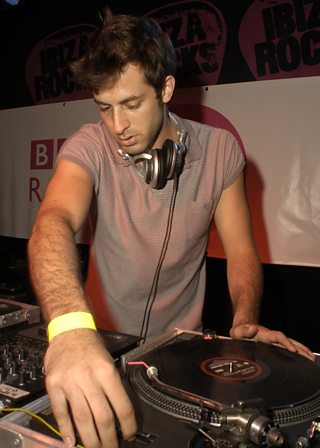
Ronson thinks his interest in music and DJing probably began with his parents’ partying – “I’m sure there’s some kind of link between the idea that night is fun; day maybe not so” – but it was really spurred by his stepfather, Mick Jones, showing him how to use his production equipment.
“As a nine-year-old, I had no business putting my grubby mitts on it, but he showed me how to do it,” says Ronson. “I loved being in the studio, making demos. [Jones] was on tour a lot, so he let me use the studio while he was away.”
Ronson started DJing as a teenager and quickly became hugely successful. “I loved it and I think I needed the validation, the ego,” he says. “I didn’t want people to just come and dance and have a good time. I wanted to bring them up into a ball of atomic energy until they were sweaty and there was no chance of anyone leaving the floor. I had this dogged determination to do that.”

Mark Ronson on producing Rehab with Amy Winehouse
A clip from This Cultural Life
4. His time with Amy Winehouse is a bit of a blur
She gave me a blank look and said, ‘I thought you were, like, an old guy with a beard.’Ronson on first meeting Amy Winehouse
One of Mark’s choices for This Cultural Life is his meeting with Amy Winehouse. “I met her in the spring of 2006, on the stoop of my recording studio in New York,” he says. “She said, ‘I’m going to meet Mark Ronson.’ I said, ‘Oh yeah, I’m Mark.’ She gave me a blank look and said, ‘I thought you were, like, an old guy with a beard.’”
The pair worked on Back to Black, Winehouse’s second album. “It was an amazing time,” he says, “but it was such a short time. It was a bit of a blur.” They were so in sync that Ronson remembers the title track coming together in less than 24 hours. “[One night] I came up with the piano… and a little bit of the percussion track. She heard it the next day, loved it, and wrote the lyrics in maybe an hour.”
5. He thought people might not like Back to Black
Amy Winehouse described the album Back to Black as “ten bullets in the chamber,” meaning every song was great. Even so, Ronson wasn’t sure how it would be received.
“I had never really made a hit record before,” he says. “It didn’t sound like anything else that was on the radio… It certainly didn’t seem like something that was going to be this huge commercial success. It just felt raw and honest.”
The album won Ronson and Winehouse six Grammys between them. It has sold over 20 million copies.

6. DJing can be hazardous to your health
Now in his fifties, Ronson still loves DJing but says it’s more physically demanding than people realise. After many nights of lugging around records, he says, “By my mid-twenties, I would be waking up the next morning and my neck wouldn’t move. There were so many emergency trips to the chiropractor.”
And it’s given him a permanent medical condition. “I went to the doctor and he was like, ‘I watched some videos of you on stage before you got here. You tap your foot while you’re playing. You’ve been doing that for 25 years, so you have synovitis (a form of joint inflammation).’ I like to call it ‘DJ foot’.”
7. Making Uptown Funk took seven months
Ronson had no idea 2014’s Uptown Funk, a collaboration with Bruno Mars, would become a worldwide smash.
“Maybe toward the very end [we knew it was good],” he says. “We’d been working on it for seven months. But even at that point, I remember the record company saying, ‘I don’t know if we should put "funk" in the title – it’s kind of cheesy. It’s over four minutes; we should get it down to 3:15 or the radio won’t play it.’”
Something, though, clearly told him it could be great. “There were probably 67 versions of that song,” he says. “[There had to be something in it] to make us believe it was worth finishing. But you never know if something will be a hit.”
More from BBC Radio 4
![]()
This Cultural Life: Mark Ronson
Listen to the full interview on BBC Sounds.
![]()
Nile Rodgers: Nine things we learned from his This Cultural Life interview
The influential American musician and songwriter talks about his inspirations.
![]()
Lily Allen: Nine things we learned from her This Cultural Life interview
The pop icon discusses growing up, her career and motherhood.
![]()
Soul Music: Back to Black
How the raw pain and sorrow of Amy Winehouse's music has helped so many young people.