Postcards: Better Than Your Selfie...
Postcards are in decline. Over the last 25 years, the number sent per year has dropped from 20 million to 5 million with only 2 percent of British people sending them. Only this week, the firm of J. Salmon, which has been publishing postcards since 1880, announced its closure. The rise of social media and selfie culture has been cited as the cause of the decline: however, as the recently-published collections by John Kasmin show, postcards occupy a special place in history and we might be losing something that we cannot replace.
The Postcard Craze
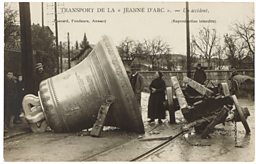
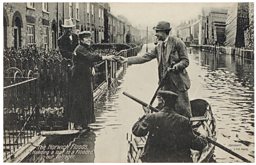
The first picture postcard was sent in 1840 by Theodore Hook to himself. While there is no confirmed reason as to why he did this, many have theorised that it was a practical joke. However postcards didn’t reach mainstream popularity until the turn of the 20th century. Postcards were cheaper to send than letters, and so were the method of choice for communicating about places you had visited. Photographers rushed to take as many photos as possible of pretty much anything and everything: to meet this whirlwind of demand, postcards became akin to single frame documentaries, used to record events or just the local population. Highlighting these are the following two images from Kasmin’s Wreck collection. They depict the dropping of the Jeanne D’Arc bell during its transportation from the Paccard Foundry in Annecy to Rouen, and the distribution of bread after the Norwich Floods of 1912, respectively.
Digital Revolution
In today’s world, the company J. Salmon has placed the blame for the decline of postcards mainly on the rise of the selfie. Digital culture focuses more on the individual than the location. The other area that the postcard loses out on is speed. Continuing the trend that began with the telephone, postcards are slower than other forms of communication. In particular, the instant nature of social media, along with it being free-to-use, enables it to be far more tempting than postcards. Shorter to create, quicker to share and entirely free? Against such competition, postcards barely stand a chance.
Snapshot of Life
The type of postcard so beloved by Kasmin reflected the life of the local community and gave the recipient an insight into the area that they wouldn’t receive otherwise. Consider the following two images:
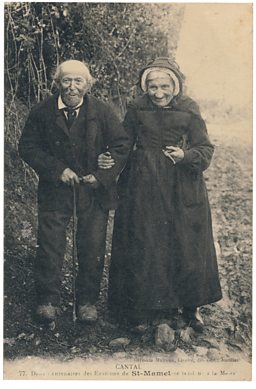
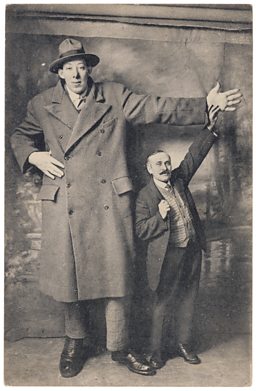
Both of these images come from the collections of John Kasmin, famous art dealer and avid postcard collector. The image on the left shows a couple who were happily married at 100 on their way to Mass. On the right is Ferdinand Contat, who was 2.35 metres in height and offered 1000 francs to anyone taller. These literal snapshots of life allow us a greater understanding of history – little bits of information that might have gone by the way side. Who are the couple? Did anyone take Contat’s 1000 francs from him? We don’t get the answer to our questions – in fact they raise more than they answer. The fleeting nature of the postcard allows room for speculation and mystery in a way that an Instagram of what you had to eat on your holiday doesn’t. It’s this that makes them truly special and worth finding. Even if it is just to wonder who the people depicted really were.
Free Thinking: Philip Dodd meets art dealer and postcard collector John Kasmin.
Further Listening on Radio 3
![]()
Breakfast with Petroc Trelawny
Radio 3's breakfast show, waking the UK up with the finest classical music in the best performances
![]()
Radio 3 Breakfast Carol Competition 2017
Here's everything you need to know about our competition for amateur composers.
![]()
Breakfast Music Box: Local Legends
A playlist of music inspired by composers with strong local associations.
![]()
Rattle at Radio 3 - Stravinsky
Sir Simon Rattle conducts The Firebird, Petrushka and The Rite of Spring. Listen now.