Boyz n the Hood at 25: Why this seminal story of black lives matters more than ever
1 November 2016
It was the explosive debut film that sent shockwaves across American society and helped to launch the career of a talented young filmmaker. WILLIAM COOK talks to Boyz n the Hood director John Singleton as the landmark hip hop movie celebrates 25 years with a UK re-release and a BBC Two screening.
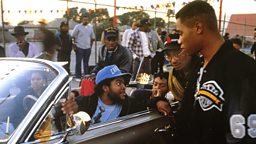
Back in 1991, a young African American filmmaker made a movie which showed the world what it was really like to grow up black and poor in LA. Twenty-five years later, Boyz n the Hood is back in cinemas, and the man who made it, John Singleton, is here in the UK to tell his remarkable story.
I met up with him in London to ask him about his brave and brilliant film, which forced Americans to face up to the tragedy of black-on-black homicide - a tragedy fed by drugs and poverty, and the indifference and prejudice of white America.
Singleton’s influences ranged from Mean Streets to The Bicycle Thieves, but his biggest inspiration was his own upbringing. "The picture is really just a reflection of my experiences at that time, growing up in Los Angeles," he says, over coffee in his London hotel.
"The first thing they tell you in college is 'write about what you know', so that’s what I did with that film." Boyz is not a gangland fantasy, but a raw and honest slice of life.
The picture is really just a reflection of my experiences at that time, growing up in Los AngelesJohn Singleton
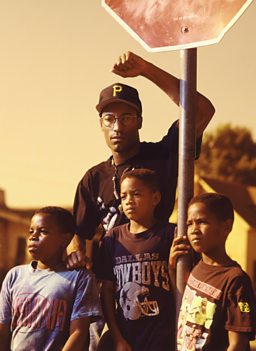
For anyone who hasn’t seen it (and if you haven’t, you’re in for a treat), his film follows three young black men growing up amid the street gangs of South Central LA.
"The film is a coming of age movie – it’s a teenage movie," says Singleton, a big bald man with a weathered face and a broad grin and the body of an athlete. "It’s a chronicle of my teenage life."
Singleton was only 23 when he made Boyz, fresh out of film school. "I knew nothing about making a film, so I was learning it as I was going," he says. "You see me, as a filmmaker, getting better and better as I go along."
Yet that naivety and innocence was what made Boyz so intimate. You really cared about these characters. You liked them. You feared for them. "All the right elements came together at the right time in the right place."
He got plenty of rejection letters before he finally got the go-ahead. He still keeps some of them, framed on his office wall. "It reminds me that none of them in Hollywood know what this is. They don’t know anything - they’re all guessing." It would have been much easier to get it made if he’d been willing to let someone else direct it, but he refused to compromise.
"So many pictures have been ruined by that – I had to do it." Even though that meant it might never happen? "That would have been fine with me."
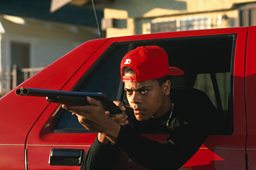
Singleton was right to hold out for what he believed in. Despite his youth and inexperience (or maybe, in a way, because of it) no-one could have directed Boyz like him. He brought out the best in all his actors, and his casting was inspired ("casting is 90% of the whole process").
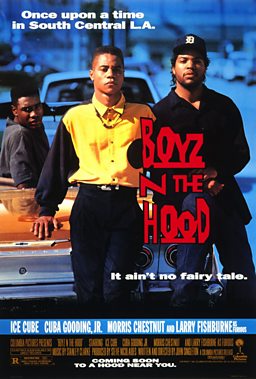
Morris Chestnut and Cuba Gooding Jr shine as Ricky and Tre, who try to escape the ghetto through sport and academia, but the stand-out star is rapper Ice Cube in his first film role, a role of immense humanity, as the tough and troubled Doughboy, who gets drawn into drug dealing and the violence that goes with it.
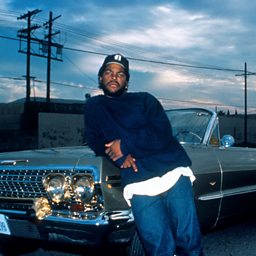
Singleton hadn’t seen Ice Cube act, but he’d seen him in the rap group NWA and that was enough to win him over. "He was a reflection of one of my best friends," says Singleton. "He embodied that dude - that dude on the block that was like the everyman."
Today gangsta rap is acknowledged as an important art form, but back then rappers like NWA weren’t recognised outside the black community.
"Pretty much everything that the music artists were doing wasn’t for mainstream white America – it was for black America. It wasn’t even meant for them to hear." The same went for Boyz. "I made this movie for black America," he says. He never imagined it’d become a crossover hit.
Boyz premiered at the Cannes Film Festival and received a standing ovation. Singleton was amazed. "I was only focused on making a film about LA – I had no idea that its experiences were universal."
It went down just as well in America. At the Oscars, Singleton was nominated for Best Director - the first African American ever nominated and the youngest ever nominee, even younger than Orson Welles. "It was surreal."
He was also nominated for Best Writer. He didn’t win, but that didn’t matter - it was an incredible accolade for a 23-year-old, making his first movie.
I was only focused on making a film about LA – I had no idea that its experiences were universalJohn Singleton
Boyz n the Hood stands alone as a great artwork in its own right, but it was also part of an explosion of African American movie-making in the 1990s. So what happened? "Hip hop had crossed over," explains Singleton. "The film business always reflects what’s happening within the culture."
Yet for young black men in LA, life is still just as tough as it was when he made Boyz. After all these years, African Americans still face an uphill struggle, not only in the movie industry, but in society at large.
Since Boyz, Singleton’s made numerous movies, from the critically acclaimed Rosewood to his remake of Shaft. He has his own Tupcac Shakur biopic in the pipeline ("I’m still very, very passionate about making that film,"he says. "I’ve written a script and I want to do it") but however many films he makes, he’ll never match the purity and spontaneity of his debut.
So many people have told him how much Boyz meant them, but one memory stands out. "I went to see the film in my neighbourhood," says Singleton. "This woman came out with her boyfriend. You could tell he was a gangster, you could tell he was a gang-bang dude, because the woman did all the talking."
She told Singleton how much she loved the film. She kept talking and talking. Her boyfriend said nothing. Finally, it was his turn to speak. "You made this movie?" the gangster asked him. "Yeah, man," replied Singleton. The gangster simply shook his hand, and then he walked away.
Boyz n the Hood is at BFI Southbank, London SE1, until 10 November, and at selected cinemas nationwide through November as part of the The British Film Institute's Black Star season.
The film is shown on Saturday 19 November, BBC Two, 22:45, introduced by the director, John Singleton.
Boyz n the Hood trailer
![]()
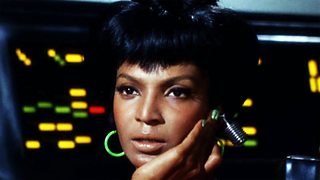
Star Trek at 50: Lieutenant Uhura teleports into London
Nichelle Nichols launches the BFI's Black Star season.
Black and British on the BBC
Black and British is a season of programming celebrating the achievements of black people in the UK and exploring the rich culture and history of black Britain.
More from BBC Arts
![]()
Picasso’s ex-factor
Who are the six women who shaped his life and work?
![]()
Quiz: Picasso or pixel?
Can you separate the AI fakes from genuine paintings by Pablo Picasso?
![]()
Frida: Fiery, fierce and passionate
The extraordinary life of Mexican artist Frida Kahlo, in her own words
![]()
Proms 2023: The best bits
From Yuja Wang to Northern Soul, handpicked stand-out moments from this year's Proms