Special feature: Edward Thomas - The Journey to War
A special feature by Alison Harvey, Archivist at Cardiff University.
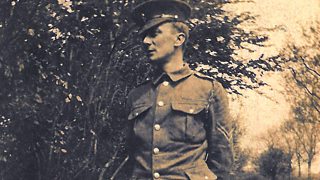
All images courtesy and copyright Special Collections and Archives, Cardiff University.
“I wonder how Edward’s getting on?” I think to myself. Then I remember: I’ve never met Edward, and what’s more, he’s been dead for 100 years.
Being an archivist is like that - spending hours in such proximity to a person’s belongings, privy to thoughts and feelings expressed only to their closest friends and family. By an accident of posthumous fame, private letters, notebooks and diaries are deposited in an archive, to be sifted through by a stranger: deciphered, described, and wondered over.
I’ve had the privilege of working with Edward Thomas’ archive for over ten years in my role as Archivist at Cardiff University’s Special Collections and Archives. Unable to be neatly boxed as a Georgian poet, a nature writer, a travel writer, or a war poet, Edward occupies a genreless grey area of the literary canon, which can make his work easy to overlook. His writing is best described by fellow ‘walker-writer’, Robert Macfarlane, author of The Old Ways and The Wild Places, as ‘imaginative cartography... longing and loss projected onto actual terrain.’
Edward Thomas’ work is imbued with the rhythms of the countryside and inflected by its language, featuring passionate descriptions of landscape, long-forgotten plant names, and snippets of local dialect. In his archive, I found diaries kept from the age of 17, meticulously recording weather conditions, flowering plants, and wildlife behaviour. These fragmentary notes were polished into prose, and his first work, This Woodland Life, was published when he was just 19.
His father, an autocratic and respectable Welshman, never gave up hope that his son would see sense, abandon writing, and join him in the civil service. Edward had other ideas. He sought a mentor and father-figure in the writer James Ashcroft Noble, who helped Edward find a publisher for his first book. Noble saw more in the young Edward than just literary ability, and encouraged him to take his wilful, bohemian daughter Helen out to explore the countryside she longed for. The two were well-matched: both anti-suburban and anti-establishment, and we can tell from the archive that they wrote long, passionate letters to one another several times a day. It wasn't long before Helen became pregnant, and the two planned to marry.
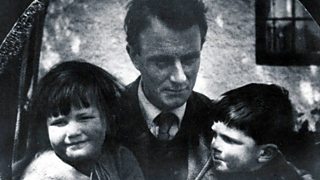
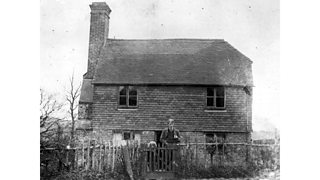
This was the moment. The fork in the path that would go down in history by biographers and critics as the reason for Edward’s lack of literary success in his lifetime. Without doubt, the couple struggled. By the time he was 32, Edward had three small children to support, and had turned to literary reviewing to pay the bills. His home life was disruptive and chaotic; the family moved repeatedly in response to their changing financial fortunes, one such move necessitated when their dangerously damp cottage was condemned. Helen had contracted tuberculosis and their baby Bronwen almost died of pneumonia. Crippled by depression and irritability, Edward would frequently leave home to stay with friends, abandoning Helen and the children in order to meet his reviewing deadlines. According to biographers, fatherhood ruined him, forced him to focus on financial concerns, and tore him from a life of literary pursuits.
In marking Edward Thomas’ centenary this year, I wanted to take a closer look at this version of events, which is simply not supported by the evidence in the archive. Edward suffered terribly from depression, but Helen was his port in the storm. His letters are affectionate, and do not cease during his absences from home. Her letters are stoic and brave, full of heartful love, and absolute conviction in his genius. Never does she write, either to Edward or privately to her friends, one word of complaint about their poverty, or her periodic abandonment. Helen grants him the space to leave, to think, to write.
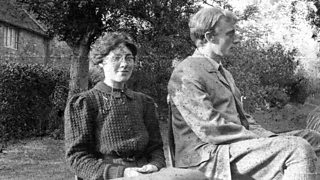
Likewise, we find evidence in the archive that the children should not be dismissed as annoying distractions to Edward’s creative process. In fact, they are central to it. In interviews recorded in 1967, we hear their youngest daughter Myfanwy recalling moments of her childhood, which would later be immortalised in her father’s poetry. Her mistaking of strewn cherry blossom for confetti became ‘Cherry Trees’; paddling with her father became ‘The Brook’; a habit of picking at a herb which grew outside their house became ‘Old Man’; and expressing a fear of the dark one night became ‘Out in the Dark’, written far from home in the trenches on the Western Front. Edward was inspired by his children’s expressive naturalness, and their everyday observations and activity directly fed his creativity.
When I’m not defending Edward’s family life, I’m often found discussing his untimely demise. He was killed at Arras on the first day of the Battle of the Somme, from a direct hit by shellfire. Aged 37, his was an entirely avoidable death. At his age, and with three children to support, there would have been no expectation on him to join the army. Having done so in 1915, he was posted to Kent to teach younger soldiers how to map-read and orienteer - an extremely appropriate task for someone who loved to walk long distances in unfamiliar country, and a perfectly respectable contribution to the war effort. But it was not enough for Edward, and he relentlessly pushed to be posted to France.
Did he have a death wish? I’m not sure it was as simple as that. Financial concerns were most likely at the core of his decision to go to the Front, as his pension would have been significantly increased. With Helen and the children’s future insured, something extraordinary happened. Edward seems to have started to enjoy life. Condolence letters sent to Helen from men he served alongside describe him as ‘the father of our happy family’, with a ‘spirit of quiet, sunny, unassuming cheerfulness’.
This is very different to the usual picture of Edward as a melancholy, shy, rather difficult man who sought the solitude of nature. The discipline of the army, the regular income, seems to have released him from a lifetime of anxiety, but this is only revealed in letters which have fortuitously survived to tell the tale.
I’m fascinated by the way in which archives can challenge received opinions, and would urge anyone seeking to find out more about this enigmatic man to visit the collection at Cardiff University.
If you can’t make it to Cardiff, take a look at the centenary exhibition or our image library at: https://www.flickr.com/photos/cuspecialcolls/albumsto explore these fascinating materials.
Alison Harvey