Jodie Foster on directing Black Mirror and her childhood dream
29 December 2017
Having worked with some of Hollywood’s top directors ever since she was a child, Jodie Foster went to “the most amazing film school of all time.” As her episode of Black Mirror drops on Netflix, she tells Front Row why her first love was always directing, not acting.
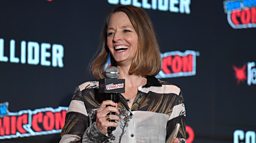
“I wanted to be a director by the time I was six,” says actor Jodie Foster. “I did a television show with an actor/director and I was just amazed that those two things could happen.”
Nearly 50 years on from that youthful revelation, the one-time child star has made her mark as a director emphatically – most recently taking the reins on Netflix's Black Mirror, the critically-acclaimed sci-fi anthology series from writer Charlie Brooker.
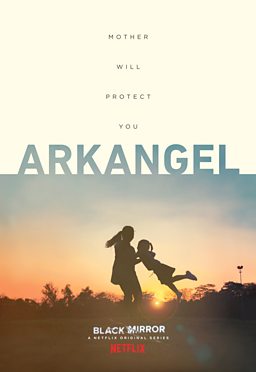
In her episode Arkangel, Rosemarie Dewitt stars as a mother who, growing paranoid about her young daughter’s safety, has her implanted with a new device that will track her at all times.
Every episode of Black Mirror deals with our relationship with technology, but other than that they are standalone stories, each with their own genre, setting and cast.
One of the latest episodes is a black-and-white survival horror tale featuring Maxine Peake, while another stars Jesse Plemons as a starship captain with a colourful 60s Star Trek vibe.
Foster's episode falls somewhere in the middle, as she explains: “This one’s tone is slightly different - it is incredibly grounded, very subtle, it feels more like an Ingmar Bergman movie than it feels like a sci-fi film. There’s an indie movie aesthetic and it’s really about the subtleties in the relationships between people.
“Yes, there is a device in the film and it is set in the near future, but it’s the very, very near future, maybe nine minutes away from us now.
"And I do think it is a film that anybody who has a parent or anybody who has a child can relate to; it is very specific to that interesting, complicated, twisted relationship between mothers and daughters.”

Of course, Foster's own childhood was far from typical. She has been acting for 52 years now, with her first role at the age of three.
I wanted to be a director by the time I was six.Jodie Foster
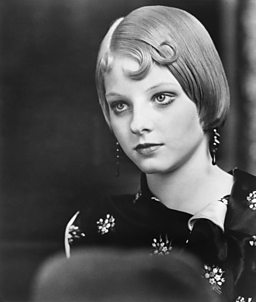
In 1976, when she was twelve, she performed in two of her most famous young roles: the controversial child prostitute Iris in Martin Scorsese’s Taxi Driver and as 1920s chanteuse Tallulah in gangster-musical Bugsy Malone directed by Alan Parker.
“By the time I got to making a movie with Martin Scorsese and Alan Parker in the same year, one after the other, I was looking at directors and really paying attention to what they were doing and the choices that they were making.”
In fact during Bugsy Malone, the 12-year-old was already more experienced than her director; “That was his first film, but that was my… I dunno, 12th, 13th, 14th movie?” she says.
Alan Parker would often joke that if he was hit by a bus, Foster was the only person he’d trust to take over as director.
It wouldn’t be for another twelve years that she’d get her wish; in 1988 she made her directorial debut on an episode of Tales from the Darkside, a sci-fi/horror anthology TV series created by George A. Romero - not so different from Black Mirror, though with a fraction of the budget.

She has directed several feature films since then: Little Man Tate (1991), Home for the Holidays (1995), The Beaver (2011) and Money Monster (2016). While generally being well received by critics, Foster has stuck to moderate budgets and ‘indie film’ sensibilities, perhaps at the cost of more mainstream appeal.
As an adult she was far better known for starring in high-profile movies including The Silence of the Lambs and Contact, and while she still loved the craft of acting, she continued to learn about directing from her film-making colleagues.
“It’s really been an incredible film school; whether it was Woody Allen or Claude Chabrol, Claude Lelouch or Neil Jordan... Robert Zemeckis, Adrian Lyne, Spike Lee… I’ve worked with so many amazing directors and I’ve taken something from all of them.”
Jodie Foster on Front Row
![]()
Listen again
The actor and director discussed her new Black Mirror episode on 21 December 2017.
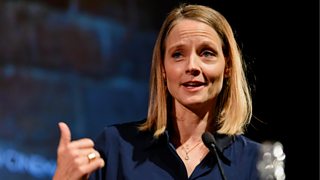
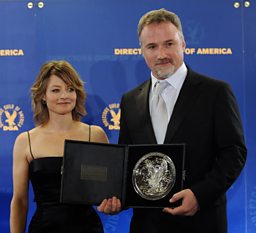
It was starring in 2002’s Panic Room that she worked with the man who has influenced her most:
David Fincher knows more about making films than anyone I have ever met.Jodie Foster
“David Fincher taught me more about film-making than anything I’ve ever done,” she says. Fincher is the director of (among others) Seven, Fight Club, and The Social Network.
“Fincher is a master film-maker. He is probably the most technically proficient director that we have in the industry and that we will ever have; he knows more about making films than anyone I have ever met.”
“He’s more specific and clear about his choices than anyone… it was the first time that I really worked with a director that was as disciplined and had as much rigour.”
David Fincher was also the driving force behind Netflix’s first original series, the hugely successful House of Cards, on which Fincher is an executive producer. Jodie Foster has directed several episodes of the series at Fincher’s invitation, and she has also worked on episodes of fellow Netflix show Orange Is The New Black.
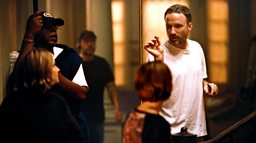
Her relationship with Netflix is likely to continue for a while; she is currently developing a show of her own with the streaming platform, and speaks very highly of her experience working on her episode of Black Mirror:
“I see the Black Mirror piece as a stand-alone feature that is just a little shorter than what I might do on the big screen… it says ‘we’re just gonna give you a movie, it’s gonna have a beginning, a middle and an end, and that’s gonna be the end of it,’ and for me, that is the best form.
“When you are doing an episodic show you are looking at character arcs that can last for ten seasons; and that has its beauty too, that’s the same beauty that a novel has.
"But I am less interested in that than I am with making the kind of meaning that comes from a feature length film. ”
The title Black Mirror refers both to the mirrored surface of a computer or phone screen that is switched off, but also because it grimly reflects our society’s worst behaviour, telling a series of bleak fables.
As a child Jodie Foster would binge-watch The Twilight Zone, her favourite show.
Because of this, it has often been called the spiritual successor to 1959 series The Twilight Zone, which was just as much a childhood influence on Foster as her experiences acting for Scorsese. In a recent Empire interview, she described binge-watching the show as a kid while her family would prepare Thanksgiving dinner:
“Every single year, it was like a 48-hour marathon; non-stop Twilight Zone. It was my favourite thing.”
For Foster, getting to direct an episode of its modern equivalent must surely be like two childhood dreams in one.
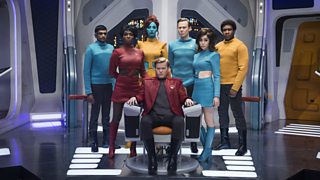
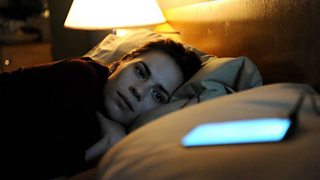
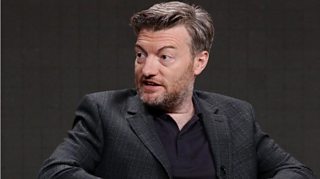
Jodie Foster's Black Mirror episode Arkangel is available now on Netflix; listen to her interview with Front Row about creating this new entry in the series.
More from Front Row
![]()
Shows within shows
The animated characters who watch other shows on TV.
![]()
Podcast transitions
Can your favourite audio survive a move to the screen?
![]()
Ready to rumble?
Seven times the art world grappled with wrestling.
![]()
Apocalypse now
Seven doomed futures from E3’s hottest games.

More from BBC Arts
![]()
Picasso’s ex-factor
Who are the six women who shaped his life and work?
![]()
Quiz: Picasso or pixel?
Can you separate the AI fakes from genuine paintings by Pablo Picasso?
![]()
Frida: Fiery, fierce and passionate
The extraordinary life of Mexican artist Frida Kahlo, in her own words
![]()
Proms 2023: The best bits
From Yuja Wang to Northern Soul, handpicked stand-out moments from this year's Proms