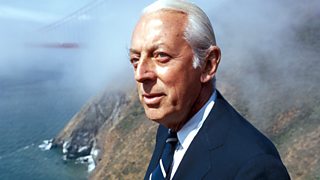
Isao Aoki, golfing hero
Bumper stickers on motorcars are an old American tradition. When they don't simply announce a citizen's political preference like 'Reagan for President' they offer a safety valve of facetiousness and ribald humour to the ordinary citizen who has no other public platform. Last time I was in California, I remember one addressed, in a general way, to tourists, 'Keep California Green. Bring your own dollars'.
Lately, the very general frustration with the apparent choice of presidential candidates has led to a rash of stickers suggesting such bizarre alternatives as 'Miss Piggy for President', 'Vote for Dracula, a red-blooded President' and 'Muhammad Ali for President of the World'.
In the past year or so, protest groups have taken to painting an extra word or so on public signs. Now, as you no doubt know, at any intersection of two American roads, there's always a big sign saying, simply, 'Stop' and even if there's no other vehicle anywhere on the landscape and you drive round a corner without stopping, some police car hidden in the foliage will come siren-ing out and pursue you and give you a ticket. By now, the 'Stop' signs carry underneath such simple, stark graffiti as, 'War' and, more commonly, 'Nukes'. 'Stop Nukes' means 'ban nuclear power plants', something that neither the Carter administration nor Governor Reagan nor Mr John Anderson has any intention of doing.
Pretty soon, I imagine, there'll be an epidemic of words under stop signs reading 'Stop Test Tube Babies', for this past week the United States Supreme Court handed down a ruling which was, when you looked at the fine print, a rather pedestrian technical ruling but on the face of it was a godsend to afternoon papers thirsty for a juicy headline and a boon to protest groups that have run out of causes. An educational foundation which had resisted the ruling greeted it with an ominous press release headlined, 'The Brave New World that Aldous Huxley Warned of is Now Here'. On the contrary, a genetic engineering firm in San Francisco triumphantly announced, 'The court has assured this country's technological future'.
Now what's this all about? Well, the nine judges of the court ruled, by the narrowest possible margin of five to four, that the present patent, or 'patent', law of the United States can apply to new forms of life created in the laboratory. Alarmists and doomsayers jumped at once to the inference that the court was approving any human egg fertilised outside the womb. One paper printed the wild headline, 'Court Okays Test Tube Baby'. Well, before that could happen, Congress would have to pass an approving law and then the court would be required by some third party to judge whether that law was constitutional.
No doubt, the day will come but for the present the court was considering whether to award or not to award a patent to a new bacterium that digests oil spills. Not to put too fine a point on it, this invention could help us all to get more mileage out of our petrol. The ruling, which is being called a landmark decision, is simply a legal first step in recognising the revolution in biological research that is known as bio-engineering, which is mainly the business of creating new strains of bacteria for use – and their use is already widespread – in farming, food processing, as well as the oil, chemical and pharmaceutical industries.
The issue before this court was whether you can patent a live agent, a new bacterium, and what the court had in mind as forms of life created synthetically, was such things as hormones, insulin, virus-fighting drugs, even protein and certain forms of sugar. The chief justice, in the majority decision, pointed out that the court was not being asked to approve a patent for the discovery of a natural law, like gravity or Einstein's theory of relativity, but for the result of human ingenuity and research and, in going with the majority, Justice Burger wrote, 'This bacterium is not nature's handy work but the inventor's own. Accordingly, it is patent-able subject matter.'
By which he meant patent-able under the present laws which did not foresee the engineering, so to speak, of human beings. The court, in fact, made it pretty clear that its ruling did not extend the patent laws. If that's to be done, to sanction the patenting of such advances as manipulating the genes of human beings, it would not be the business of the Supreme Court in the first place. As Justice Brennan wrote, 'It is the role of Congress, not this court, to broaden or narrow the reach of the patent laws.'
So, for now anyway, we can relax any fear that the court is whooping it up for Aldous Huxley's, or anybody else's, brave new world.
Last Sunday evening, the responsible television network that had carried the final day of the United States golf tournament, the Open Championship, put out the astounding news that 40 million people had watched the battle royal, not to say the battle interminable, between Jack Nicklaus, the modern master who is generally thought to have gone over the hill at the venerable age of 40 and Isao Aoki, the Japanese player who is almost unknown in this country but who, in his native land, is practically a candidate for emperor worship. He, incidentally, last year, earned more money playing golf than even little Tom Watson, the American successor, indeed, the world successor to Nicklaus as the best player alive.
Forty million viewers for a golf tournament is almost incredible. Last year, the American audience for golf on television declined by about 30 per cent and that was 30 per cent down from an already modest figure. Golf is not, by a long shot, the favourite sport of television watchers. It comes in audience rating well behind football – American football, that is – basketball, racing, baseball and even tennis and, even if it were way up there with football and basketball, intending sponsors would think twice about putting their money into televising golf because the costs of the mechanical operation itself are appalling.
Several sponsors who were once devoted to golf decided in a hurry, a few years ago, to become devoted to tennis simply because it requires two fixed cameras and a couple of commentators and the same, maybe three cameras for football. Their capacity to dart all over the field and see the players sweating or exulting in close-up is due entirely to the invention of the Zoomar lens but golf, being played on 140 acres or so, requires the erection of television towers above most greens, mobile cameras out on the course, miles, literally, and miles of cables linking everything up.
For many years, the networks stopped short of covering the whole course. They'd start their televising at, say, the 14th tee and show you, therefore, the play on the last five holes. You simply took the commentators word that some challenger or other had just birdied or bogeyed the tenth or the eighth. This year ABC went whole hog. In the footsteps of the BBC, they started at the first hole so that, at 2.35 on the last day, the two leaders and therefore the last pair in the field, were seen swinging and breathing and stretching on the first tee. They were announced like boxers: Jack Nicklaus of Dublin, Ohio! And, Isao Aoki of Tokyo!
For three rounds, they had rarely been more than two strokes apart and towards the end of Saturday afternoon Nicklaus took three putts on two greens while Aoki was knocking them in from every angle and all distances and they wound up on Saturday night all tied at six under par. I saw Jack Nicklaus shuffle into the press tent, a very melancholy and bitter man. With two or three decent putts on the last five holes, he could have been well ahead of Aoki and he knows better than anybody that if you lead a tournament for three days in a row, the pressure of anxiety, the presence of the crowd, the haunting spectacle of Aoki's automatic putts, would be certain to crush him on the last day.
However, as all the world now knows, it didn't. He played as majestic a round as we've ever seen in absolute control of his nerves and his great skill and, when he walked up the 18th fairway, the huge crowd bayed and shouted like a Cup Final crowd, like no golf crowd I've ever seen. And as he rammed in the final putt and broke the long tension, in an eruption of grins and outstretched arms, half a dozen golf records tumbled out of the books.
Next morning, a lawyer friend of mine who's been much troubled by our presidential choices, called me up and said, 'I've made my mind up. I'm voting for Nicklaus for President'. And so said several impromptu placards that exulting fans carried around the fringes of the famous course in New Jersey. One of them fell by the wayside but the name 'Nicklaus' had been crossed out and above it had been written, 'Aoki for President' and the man may be right.
Like no golfer I can remember, Aoki has given aid and comfort to the millions of golfing duffers around the world. He has a swing that would be radically corrected in the first lesson and, in the first putting lesson, the tyro is firmly instructed to place the putter along the ground, the entire base, and then take it back very low to the ground and very short and then stroke it through the ball along the line of the putt.
Aoki has evidently never had this first lesson. He grounds the putter on its heel. Most of it's in the air. He then swings the putter up with his wrists, another elementary crime, and gives it a fast zap or zong with that dreadful heel. You see this done by a hundred duffers on a hundred courses every Sunday afternoon but, unlike the duffers, Aoki zongs it into the hole. He also, with his wristy swing, loops and floats and curves the ball from impossible positions just where he wants it. My lawyer is right. If we can't have a pro for president, let's have an eccentric and highly successful duffer, like you and me.
By the way, you'll all be relieved to hear that Ronald Reagan has put out a promise that when he's in the White House, he will have the doctors give him regular examinations and then report not only about his physical condition, but his mental state.
A friend of mine says the mental report is redundant. As my friend says, 'You've got to be crazy to run for president and so, on principle,' he says, 'I shall refuse to vote for anyone running for president.'
This transcript was typed from a recording of the original BBC broadcast (© BBC) and not copied from an original script. Because of the risk of mishearing, the BBC cannot vouch for its complete accuracy.
Letter from America audio recordings of broadcasts ©BBC
Letter from America scripts © Cooke Americas, RLLP. All rights reserved.
![]()
Isao Aoki, golfing hero
Listen to the programme