Rising energy prices explained
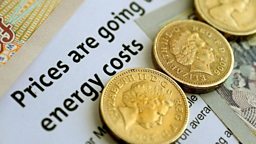
You may have heard in the news that energy prices are going to be increasing in 2022, but why are prices going up?
5 Live Money’s Sarah Corker says the reason for the energy price rise is down to “a couple of factors”, the first being the wholesale cost of gas soaring across the globe as economies reopened after lockdown.
The second reason is the Office of Gas and Electricity Markets (OFGEM) are increasing the retail price cap in April – that means companies will be able to charge customers more for their energy and could cause household bills to rise by £700, according to one estimate from Energy UK.
Why has the wholesale cost gone up?
“Global factors are at play,” she said. “It was an exceptionally cold winter across Europe last year, so that put pressure on supplies.”
“There has been an increased demand from Asia – especially China.
“Russia has also been accused of potentially withholding supplies. Russia has denied those accusations, but perhaps there are some geo-political factors at play.”
“There are also some UK-specific factors affecting prices and demand, we use a lot more natural gas than many other European countries, about 85% of homes in the UK use gas central heating.
“We have a shortage of underground gas storage, so all of this means that we are perhaps more exposed when there are these global shocks in the energy market.”
Are the oil and gas companies doing well out of this?
“Opposition parties are saying oil and gas firms are doing very well and actually should be part of the solution,” she said.
“In recent weeks Labour and the Lib Dems have been calling for a windfall tax, or a robin hood tax on energy companies.
“There are other things on the table the government is looking at, whether it’s cutting green levy on bills, the VAT being scrapped, which Labour are pushing for.
“There’s also the idea of extending existing support schemes, like the winter homes payment.
“Lots of options are on the table, but I don’t think any of these solutions are clear-cut.”
Who’s squeezing the supply?
Sarah says: “We know there has been a squeeze on global supply, and Business Secretary Kwazi Kwarteng has been having discussions on an almost daily basis with those involved in the industry to find a way forward.
“If you look at what’s happening in terms of the rapid recovery after lockdown in economies across the UK, perhaps the recovery was faster than many expected,” she said.
“There was all of a sudden, a huge demand – especially from Asia, then add in the UK-specific factors and that combined has helped to push up the price.
“Certainly in the UK, there is a lot of debate about the impact come April, as National Insurance contributions will be going up at the same time, inflation is at a 10-year high - it’s above 10%, and we’ve heard from the Bank of England that these inflationary pressures are going to be more permanent – we’ve got to get used to the inflation.
“We’ve had the retailer Next warning just last week they expect prices to go up 7% over the course of the year, hospitality businesses are struggling to get chefs, workers and the cost of raw ingredients are going on and all that inevitably gets passed onto customers.
“People are feeling the pinch and this is the backdrop – we’ve talked a lot about what’s going on in the energy market but that’s one bill for everybody that’s going up."
What can consumers do to cut costs?
“There are some things you can do in terms of more straight-forward tips, for example turning your thermostat down by one degree you can save £55 a year,” she said.
“If you turn the standby off some devices you could save money, and switching to LED lightbulbs can save you £30. You could also draught-proof your home to make further savings.
“So there are measures people can take, but it’s just whether it makes a big enough difference given bills could be going up by £700 on average.”