Andy King-Dabbs director of Simon Rattle: the Making of a Maestro explores the changing face of Birmingham
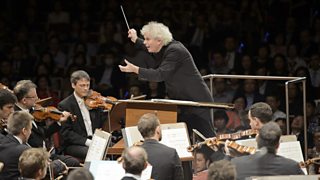
In 1980 few outside the world of classical music had heard the name Simon Rattle. Then, aged 25, he was appointed Principal Conductor of the City of Birmingham Symphony Orchestra. By the time he left, 18 years later, he was a household name. In less than two decades he not only transformed the orchestra into a World-class ensemble but was also the catalyst for the urban change that resulted in the building of Symphony Hall and the remodelling of the Birmingham City centre.
Whilst we were editing 'Simon Rattle: the Making of a Maestro' we chanced upon a wonderful film in the BBC's film archive. Made in 1964 and called "Homes for Heroes" it included some beautiful, extended, black and white 16mm film sequences of the city as well as a wonderful performance of a folk song "I can't find Brummagem". Naturally we used a little of the material in our film to help tell the story of Simon’s dramatic effect on Birmingham – but the editor, John-Martin White, and I couldn't resist cutting an extended sequence utilising some of the old film and allowing a little more of this evocative song to be heard. You can see the film here - it starts off with a sequence from the main Simon Rattle film but soon develops a life of its own and wanders off down the canals and byways of bygone Birmingham.
This process of Birmingham transforming itself has been going on since the Industrial Revolution – every couple of decades the city seems to remake itself – and this is a phenomenon I’ve seen for myself. When I was a teenager in the late 70s I lived in nearby Kenilworth so Birmingham was always the favoured destination on a Saturday afternoon. A chance to pick up the latest punk singles from Swordfish Records prior to having a pint or two in a friendly boozer. Of course this was before Simon Rattle – “ Pre-Rattle-ite” as it were - so for me Brum’s music was Steel Pulse, UB40 and, above all, Black Sabbath.
Twenty years later I went back to Birmingham for the first time. It was 1991 and I was now TV director making a film about Bhangra. I was amazed at how the city centre had changed - almost out of recognition. This was, I guess, the Simon Rattle effect. Then two or three years ago I returned to Birmingham again. This time I was making a documentary about Opera director Graham Vick and the Birmingham Opera Company's production of Verdi's 'Otello'. Once again twenty years and passed and once again the city looked wildly different – and very photogenic. The time-lapse shot at the end of the little film comes from this trip.
This urban reinvention is of course also the subject of "I can't find Brummagem". It was written by a music hall comedian called James Dobbs, who first performed it in 1828 at the long lost Theatre Royal in New Street – apparently where Boots and Bella Italia now are. The narrator returns to the city after 20 years away and “Every place is altered so / Now there's hardly a place I know / Which fills my heart with grief and woe / For I can't find Brummagem.” The melody would have been well known at the time – nearly thirty years before Robert Burns had given it the lyric ‘Can ye play me Duncan Gray ?’ and even Ludwig van Beethoven had made an arrangement of it.
The recording we used was taken direct from the "Homes for Heroes" soundtrack - the BBC's gramophone library no longer has a copy, even if they ever did - and so John-Martin and I pieced our own version together from several different sequences. So who were the performers ? I’m pretty certain that the concertina player is Alf Edwards. One of the legends of the British Folk scene in the 50s and 60s you can see and hear Alf playing his concertina on the deck of the Pequod in John Huston’s 1956 film of ‘Moby Dick’. But I don’t think that Alf is singing on this recording. One suggestion is that it was Dave Phillips, the guitarist from Ian Campbell’s Folk Group, but if anybody knows the answer to this one or has any further information about this lovely performance I’d be fascinated to hear it.

