To catch an orangutan
Crouching in the dirt, bloody and sweaty from 4 hours of scrabbling through the tangled forest, straining to keep the camera steady and pointed skywards, the thought occurred to me: what if the rescuers get it wrong… what if the 40 kilo orangutan falls from its branch 20 metres above us and lands on me?
I was on my knees beside four Indonesian men who held the corners of a small square net and they were all staring upwards, constantly shuffling – two paces right, one step back – as the woozy orangutan shifted its weight in the branches above. This was the HOCRU team – the Human Orangutan Conflict Response Unit – and they had just fired a dart loaded with sedative into the body of the mother orangutan. Their intention was to remove the orangutan and her infant from the fragment of forest we were in (where they were vulnerable to hunters and had no chance of meeting other orangutans) and release them into a large national park nearby.
It was taking forever – the vet who filled the darts with the sedative was erring on the side of caution and administering small doses. The heavier the orangutan, the bigger the dose required to knock it out, but it’s not always easy to judge the weight of an orangutan as it swings through the canopy tens of metres above you. She had already taken two darts and might require a third: she was looking woozy and confused, but every time her grip loosened she’d swing another limb up and take a fresh hold. Aware that I now seemed to be staring directly up at her, I shifted my own position, and the team adjusted the net too.
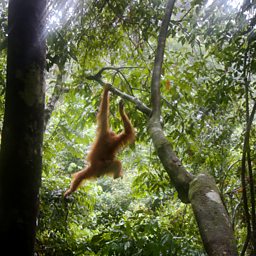
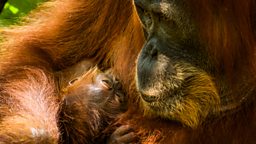
Finally, the drug took effect and the orangutan let go her grasp… but she was firmly wedged in the crook of the branch and didn’t fall. We would have to wait for her to wake up and move into a smaller tree before we began the process all over again. Her adolescent youngster was nowhere to be seen, but he surely hadn’t gone far: not just because the bond between mother and infant is so strong, but because this small patch of forest was surrounded by oil palms: trees with no branches to support an arboreal ape; and Sumatran orangutans never travel far on the ground due to an innate fear of tigers.
Palms tend to be planted on newly-cleared forest land, rather than abandoned agricultural land, despite the availability of large amounts of suitable cleared areas. As palms do not begin to produce a crop for five years after the area is planted, the ability to sell the timber to subsidise these first non-productive years is attractive.2007 UNEP/UNESCO report
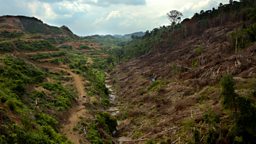
On the drive to this rescue site I had seen for myself the dramatic impact that the rapid expansion of palm oil plantations has had on the landscape of Sumatra – the IUCN lists this transformation as one of the “major threats” to the now “critically endangered” Sumatran orangutan. Now, as we waited for ‘our’ orangutan to wake up I took the opportunity to quiz Panut Hadisiswoyo – founder of the Orangutan Information Centre in Sumatra, the organisation that runs HOCRU – about the threat to these animals. Perhaps rather surprisingly, he is not anti palm oil – he recognises that the plantations offer jobs and prosperity, and points out that oil palms are by far the most efficient producers of vegetable oil compared to other oil crops. He claims that the reason rainforest is still being cut down to make way for palm plantations is not a lack of alternative land, but because the hardwood timber from the forest can be sold to help finance the establishment of the plantation. His claim appears to be substantiated by a report published in 2007 by the United Nations Environment Programme and UNESCO.
The orangutan has woken and is on the move again. The fierce tropical sun has been shrouded by a veil of grey and the slight drop in temperature is welcome as we thrash our way through the undergrowth once more. Eventually one of the marksmen fire a third dart into the orangutan but by the time the drug takes effect, the rain is thundering down and if I were to point my camera to the heavens the drenching would cause irreparable damage. Frustrated, I watch on as the orangutan falls into the net, and then her infant is also relocated and caught.
It’s a long drive to the release site, and on the way Panut points out the entrance sign to a large oil palm plantation – the inscription on the board claims that this is a “sustainably managed” plantation. This is what Panut believes offers some hope for orangutans: some palm oil producers (together with concerned NGOs) have formed the Roundtable on Sustainable Palm Oil (RSPO) and committed to only plant their palms on land that was already cleared before the RSPO was established in 2005. Since my trip I have been noticing an increasing number of products in my local supermarket that are labelled “made with sustainable palm oil” – a sign that some manufacturers are willing to pay a premium for RSPO oil in return for the assurance it has been responsibly sourced.
We reach the release site just half-an-hour before dark. It’s a recovering forest: despite being within the boundary of the national park, the land had been cleared and oil palms planted illegally. When Panut reported the infringement to the government his team were given the authority to cut down the palms and re-plant native trees; now he’s returning orangutans to the fledgling jungle.
The crate containing the mother and infant orangutan is carried to the base of one of the larger trees. The instant the crate’s door is lifted, the two apes tumble out and straight up the tree trunk into the canopy above. As I watch them, my frustration at not yet having the footage I came for subsides and I enjoy sharing the team’s obvious delight as the two orange apes melt into the jungle – thanks to the dedication of the HOCRU team, at least these two orangutans have a much brighter future.
Additional Information on Palm Oil
- Palm oil is obtained from the fruit of the oil palm Elaeis guineensis, which originates from Africa.
- Oil palms produce more oil per hectare than any other crop in the world.
- From several million tonnes in the 1960s, palm oil production has grown exponentially: doubling every 10 years.
- South East Asia produces over 85% of the world’s palm oil - with Indonesia producing over 23 million tonnes of palm oil every year.
- The RSPO (Roundtable for Sustainable Palm Oil) was created in 2004 in Zurich, with the first boatload of RSPO-certified palm oil arriving in Rotterdam in November 2008.
Changes to labelling of palm oil in the UK
Until recently, palm oil wasn’t always easy to detect in lists of ingredients as it could be listed simply as ‘vegetable oil’. New food labelling regulations will come into force in the UK from 13 December 2014, which make it mandatory that the type of vegetable oil used must be stated on the packaging.

