Not bog-standard art: Creating a masterpiece on a toilet roll
2 February 2018
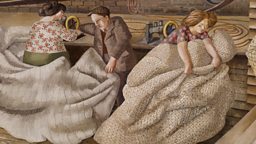
Stanley Spencer’s 1941 painting Riveters is one of the key works in the V&A's latest exhibition, Ocean Liners: Style and Speed. On Sunday, BBC Four has two documentaries about this talented, but complex, painter. Arena focuses on his family life and Lachlan Goudie explores his time painting WW2 shipyard workers, which we take a closer look at below.
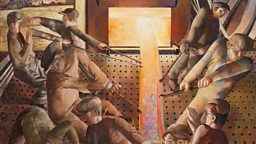
Stanley Spencer wasn't a conventional man; he would be spotted pushing a pram full of paint around gravestones in his home village of Cookham in Berkshire. And his eccentric practices traveled with him wherever he went, even to a noisy World War Two shipyard.
His series of eight remarkable paintings of war work in Port Glasgow did not begin life in a sketchbook but on long lengths of toilet paper.
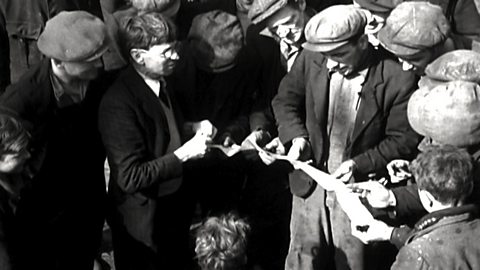
The ever resourceful Stanley Spencer
The 20th century's greatest artworks began as a doodle on a roll of cheap toilet paper.
My family worked in those yards and Spencer captured the conditions they worked in. I’m so impressed by them.Sir Alex Ferguson on Stanley Spencer
Spencer worked on the banks of the River Clyde at Lithgows Shipyard in Port Glasgow.
In 1940 he was commissioned by the Ministry of Information to show the intense efforts that went in to the production of merchant shipping vessels, ultimately producing a series of eight paintings entitled Shipbuilding On The Clyde.
The backbreaking and skilled work behind these vast vessels has been recorded for posterity in Spencer's images. The paintings have fans beyond the traditional art community – ex-Manchester United manager, and former shipbuilder, Sir Alex Ferguson is an admirer.

Lithgows Shipyard, Port Glasgow
The once thumping heart of British shipbuilding, Lithgows Shipyard in Port Glasgow.
Welders was the second of the panels to be commissioned and shows the workers arc welding. This was a relatively new technique and one which was significantly less labour-intensive than riveting.
Spencer included a self-portrait in the scene, suggesting he saw himself as part of the process rather than just a detached observer.
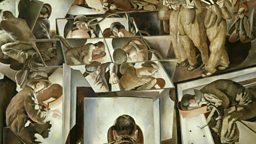
Spencer was fascinated by the components and machinery of the shipyards as well as the skill of the people who used this equipment. Together they create a vision of well coordinated teamwork.
Riveters was the third painting of the series. It did not meet the full specifications of the War Artists Advisory Committee – it lacked a larger centre section – and his fee was reduced from £300 to £200.
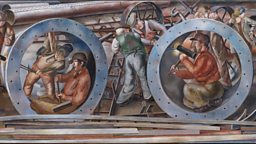
Riggers showed the cables and tarpaulins being prepared and took Spencer nearly three years to complete.
Spencer found the watching the workers made him feel as if he was standing in a church, saying: "I was as disinclined to disturb the atmosphere as I would a religious service... there seemed something in the very work itself that made me feel for the respect and peace."
More on Stanley Spencer
![]()
Arena: Stanley and His Daughters
Exploring the relationship of Spencer's daughters, Unity and Shirin, as they try to understand their father. (BBC Four, 22:00, Sunday 4 February)
![]()
Stanley Spencer: The Colours of the Clyde
The colossal portraits of Scottish shipyard life created by a painter most associated English countryside. (BBC Four, 23:15, Sunday 4 February)
![]()
Scottish engineering ‘right at the heart’ of V&A Dundee exhibition
Stanley Spencer’s 1941 painting Riveters will be in the first exhibition at Dundee’s V&A Museum.
![]()
Of Angels and Dirt: Stanley Spencer’s village people
How Spencer’s problematic and colourful private life informed his highly personal art, with canvases focusing on the tranquillity of rural life.

More from BBC Arts
![]()
Picasso’s ex-factor
Who are the six women who shaped his life and work?
![]()
Quiz: Picasso or pixel?
Can you separate the AI fakes from genuine paintings by Pablo Picasso?
![]()
Frida: Fiery, fierce and passionate
The extraordinary life of Mexican artist Frida Kahlo, in her own words
![]()
Proms 2023: The best bits
From Yuja Wang to Northern Soul, handpicked stand-out moments from this year's Proms