Main content
Boulez at the BBC
The visionary conductor and composer Pierre Boulez (1925-2016) was associated with the BBC for nearly 60 years: from an appearance at the Concert Hall of Broadcasting House in 1957 for a performance of his Le marteau sans maître with his Domaine Musical ensemble from Paris, to a full-blown 90th-birthday tribute season at the 2015 Proms, featuring many of his most important and influential works.
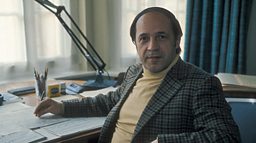
Boulez's association with the BBC developed further when he gave his first concerts with the BBC Symphony Orchestra in 1964. He made his BBC Proms debut as a conductor the following year, but his music had arrived three years earlier in a partial performance of Le marteau sans maître conducted by John Carewe.
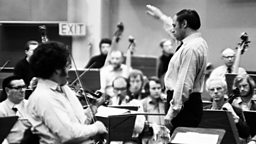
William Glock, the BBC's Controller of Music (1959-1972) was a keen supporter of Boulez, who became a regular guest artist, bringing his cherished 20th-century repertoire to the Proms and the Royal Festival Hall, often with studio sessions following for CBS records. In 1967 Boulez made the first of several films for BBC Two television, introducing a wider audience to his own music and to that of Berg, Stravinsky, Varèse and others. In 1971, Glock appointed Boulez to the post of Chief Conductor of the BBC Symphony Orchestra, noting that 'I was influenced by... my admiration for him as a composer, as a man of brilliance and imagination, and as a human being. Someone wrote of him that he is a clairvoyant observer of everything around him, and his judgements can certainly be violent at times. But there is nothing small in his behaviour; any more than in his conducting.' Boulez is seen above rehearsing with violinist Itzhak Perlman at Maida Vale in November, 1972.
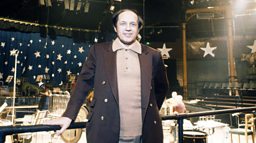
In 1974, Boulez extended his remit by presenting and conducting a series of four concerts of 20th-century music at London's Roundhouse, a former engine shed turned into a centre for contemporary arts performance. Each concert comprised a premiere, a revival, and a masterwork introduced by a distinguished British composer. Boulez poses for the camera at the Roundhouse.
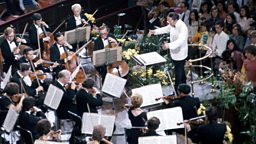
In the concert hall, Boulez was able, with Glock, to devise unusual programmes, for example Bach's Brandenburg Concerto No. 6 (in which he played harpsichord), Berg’s Lulu suite, his own Éclat, and Debussy’s Images all in one 1966 Prom. It was also at the Proms that he conducted Mahler for the first time: the Fifth Symphony, in 1968. The following year he brought his Pli selon pli to the Proms, with the BBC SO, to which he then entrusted the world premieres of his Éclat/Multiples (1970) and Rituel (1975), by which time he had become the BBC Symphony Orchestra's Chief Conductor. He is pictured here conducting the BBC SO at the 1972 Proms.
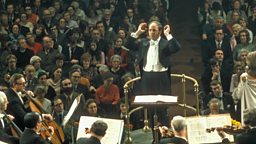
During his time as Chief Conductor, Boulez's Proms commitments increased (though never to include the Last Night), as did his repertoire, embracing such unlikely works (for him) as Beethoven’s Missa solemnis (opening the 1972 Proms). His visits became much less frequent after 1975, though there was a Boulez Prom with the BBC SO most years through the next three decades, often involving a work of his own. In 1982 he brought the Ensemble Intercontemporain from Paris to present his first IRCAM project, Répons, at the Proms (in 1970, President Georges Pompidou had asked Boulez to set up a research centre which became the Institute for Research and Coordination Acoustic / Music); in 1989 he conducted the BBC SO in a retrospective of his music at the Barbican. The picture shows Boulez conducting a concert at the Royal Albert Hall for the BBC's 50th anniversary.
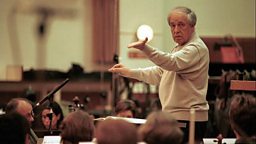
Boulez's last appearance with the BBC SO was to conduct an all-Janáček concert at the 2008 Proms, but his music continued to be featured: Daniel Barenboim brought a Beethoven/Boulez series to the 2012 Proms, the BBC SO mounted a 'Total Immersion' day at the Barbican in March 2015, and several works featured in a 90th-birthday tribute as part of the 2015 Proms season.
Photographs © BBC. Text by Paul Griffiths and Graeme Kay