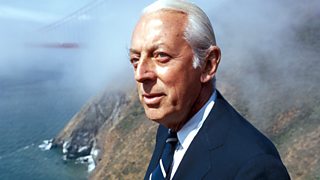
John Glenn and the presidency
For several years in the 1960s, I belonged to the board of editors of an encyclopaedia. We were not your humdrum nine-to-five editors compiling articles on everything from adultery to zoology. We had the rank of 'special advisers'. Our duties were light and agreeable. We were required to write one article a year for the encyclopaedia's year book and to prepare for this painless ordeal we were whisked off, usually in September, to some pleasant resort in Puerto Rico, Bermuda, Northern California, to brush up our companionship and talk things over.
Each of us had been chosen for alleged knowledge of some specialty. Thus, the late Lester Pearson who'd been president of the United Nations General Assembly and was to become Prime Minister of Canada, he was our house expert on world affairs. Mr James Reston, the New York Times' top Washington correspondent specialised in American affairs. Isaac Asimov, the non-stop author of, by now, over 200 books on everything from microbes to the joy of interplanetary flight was our science expert, a very affable man, that we came to miss because, after two meetings, one in Chicago and another in New York, when it was announced that the next meeting was to be in Bermuda, a 90-minute flight from New York, he quit. He couldn't go by train, the sea journey scared him and he wouldn't fly anywhere, ever. Hated it.
The rest of the board was made up of an economics expert, an education wallah, the incomparable Red Smith on sports and yours truly on something called 'the arts' – a portmanteau phrase which allowed me to talk about music, movies, theatre, painting, practically anything with which I had a passing acquaintance from Bach and Botticelli to Buster Keaton and The Beatles.
For the Bermuda meeting, a new member of the board had been appointed to talk on space and who better than the colonel of marines who'd just circled the earth three times in Friendship 7, the first American to go in orbit, name of John H. Glenn Junior. Excitement was, as the Cup Final writers used to say, 'high' when we met at our hotel by the aquamarine sea and were introduced to America's new hero. Excitement was embarrassingly higher every time we strolled with him through the hotel lobby or went out to dinner. Michael Jackson, today, could not cause more instant hullabaloos than those that erupted wherever John Glenn appeared.
One evening we took off for a hotel dining room which had some sort of floor show and when the floor show started, the poor crooner couldn't get his act in motion for the tidal wave of cries of the diners chanting, 'We want Glenn!' He had to get up and say something and we left to allow the performers to earn their keep. On the way home, a dazed Glenn asked, 'Where do I go from here?' 'Why not,' somebody jokingly suggested, 'the presidency'.
Well, in time, after other astronauts had not only circled the earth, but stayed up there, the general adoration of Glenn cooled down into simmering but constant admiration. Several years later, Mr Lester Pearson was replaced in international affairs by Monsieur Paul-Henri Spark, the Belgian statesman. On his first two appearances, one in Puerto Rico, the next in Pebble Beach, California, his luggage disappeared both times for good. He shuffled around in the semi-tropical climate in an old suit and a couple of new shirts he'd had to buy. So that for the third year, the directors of the encyclopaedia compassionately decided we should come to him for once, as close to his home as possible where he could enjoy the luxury of wearing his own clothes.
He lived on the French Riviera and that year we assembled at Beaulieu, not too far from the borders of Monaco and the glitter of Monte Carlo. Now there were two, and only two, golfers on the encyclopaedia's board – Reston of the New York Times and Cooke of The Guardian and the arts.
We both knew, also, a little more about politics than the rest of the double-dome board and for many years we had no trouble when, in the closing session we had to pick the next year's rendezvous, we had no trouble in faking a desire to meet in Chicago or Detroit or some other place than which the staff editors of the encyclopaedia would sooner have journeyed to Wigan. We would paralyse them with fright at our mad obsession with keeping the meetings close to the American heartland and then, with even more cunning reluctance, suggest some island or coastal paradise where we knew, but they didn't, there was not one, but two or three gorgeous golf courses.
They fell for it every year. And when we got to Beaulieu, Reston and I instantly started to clean our irons and pick the old grass from our spikes for, at the top of the Corniche, teetering perilously over Monte Carlo about two miles below, was a course known as Mont Agel. The Corniche, at that point, is a slanting precipice of boulders with little tufts of grass and a few saucy flowers defying the general, grim geology, the last place you'd think it possible to build a golf course, but it came out that a regiment, stationed there at the end of the First World War, was a Scottish regiment and once the fighting was over, what else was there to do? Over these rollicking boulders and rocky swales, they somehow laid out a course.
The first day when Reston and I were saying, 'All set? Shall we go?' Who should approach us but this slim, wiry character with a prison haircut so fine that you had to peer close to recognise him as a redhead. His balding dome looked like a... like a halibut that had been dipped in breadcrumbs. It was John Glenn. He wondered if he might join us. We were delighted, we didn't know he played. He didn't but he had, he said, something on his mind. He'd enjoy the walk. Fine!
We drove off and went snaking up the winding Corniche and picked up a couple of caddies who, for a hole or two, were so agog with reverence and admiration that they had to be reminded that a putter is not a driver. So what was on his mind?
Well, along about the fourth hole, Colonel Glenn said, without any guile at all, 'Tell me! How do you go about getting into politics?' We cackled, not rudely but just instinctively at the notion of a great astronaut thinking of descending from the imperium of universal admiration to shiver outside factory gates and pump hands on rainy corners and keep on chanting till he'd chant it in his sleep, 'I'm John Glenn. I'd like you to vote for me!'
What sort of politics, we wondered. He had in mind the Ohio state legislature, so we putted out and, jogging along throughout elementary suggestions that no politician needs to be told about but which never figure in the recipes for Utopia recommended by professors of political science or, even more, by intellectuals who explain at length what ought to be done to rid the world of deficits, war and nuclear threats.
First, we said you'd better get acquainted with the fat cats in your state. Not just the industrialists and the businessmen and the regional bankers who are going to have to be called on for loans, but the union leaders – corn growing is big in Ohio. So, go after the corn growers' association, not to mention the potato growers' cooperatives, the farm banks, the state chairman of your party!
Glenn was, still is, a Democrat. Then, all the county chairmen. Get invited – not difficult for him – to their monthly or whatever lunches. Get used to smacking the lips with relish over chicken buffets on plastic plates. Never turn down dishwater coffee every stop it's offered. Memorise the ratio of factory workers to farm workers, to union and non-union labour.
And drop in, in sequence, at Sunday services with the Catholics, the Episcopalians, the Methodists, the Lutherans. If there's a big Irish-American population in some sizeable town, don't be missing on St Patrick's Day. Same with the Italians on Columbus Day. Poles – watch out for the Pulaski Day celebrations.
Well, no more was said about it for several years when one day my telephone exploded with the thunderbolt of a call from James 'Scotty' Reston. 'What do you know?' he said, 'John Glenn's running for the Senate!' The Ohio Senate? No sir, the Senate of the United States. And so it was. That was in 1974.
A senator – two senators from each state – a senator is elected for a six-year term. Glenn has been there ten years. He's been a good senator. He has learned the ropes. He has taught the ropes to some members of the committees on, as you can guess, space and defence.
He's what we now call a centrist. We used to talk about conservatives and liberals in both parties, but since the anti-liberal revolution proclaimed by that old Roosevelt liberal, Ronald Reagan, the liberals in both Houses, in both parties, appear to be scared stiff of calling themselves liberals. It suggests that they believe in public works and job training for the unemployed and détente with the Russians. Not to mention – God wot – deficit financing, a Roosevelt nostrum that would be death at the polls, especially if you were running against Ronald Reagan, who is so dead set against deficit financing that he disdains to bring up the fact that since he became president, America has the highest deficits in its history.
Well, as you may have heard, John Glenn's ambitions spread and grew wings. This year he decided he'd like to be president, along with seven other Democrats and last Tuesday they met and fought each other in the first of the primaries in New Hampshire, which invariably votes Republican and is a small state with few votes, but because it's the first beauty contest, its primary election has taken on a ludicrously exaggerated, a fateful symbolic, meaning.
And there, the great, the inevitable front runner, Walter Mondale, took a brutal beating. One Gary Hart of Colorado came in first with 40 per cent of the vote. Mondale was second with 29 per cent and the old hero, John Glenn, got 12 per cent. He's about $3 million in debt. The outlook is dim. He may have the right stuff in the stratosphere, but here on earth, he is respected, but still Glenn, the old astronaut. Remember?
On that memorable afternoon above Monte Carlo, he would have done better to ask how you get not into politics, but into golf!
This transcript was typed from a recording of the original BBC broadcast (© BBC) and not copied from an original script. Because of the risk of mishearing, the BBC cannot vouch for its complete accuracy.
Letter from America audio recordings of broadcasts ©BBC
Letter from America scripts © Cooke Americas, RLLP. All rights reserved.
![]()
John Glenn and the presidency
Listen to the programme