Rizz, skibidi, IYKYK: exploring the language of social media
Do we write and talk differently when we’re on social media? Do our personas change, depending on the platform? And, are we witnessing the death of the email?
For Radio 4's Word of Mouth, Michael Rosen talks to Dr Andreea Calude, author of The Linguistics of Social Media: An Introduction, and associate Professor in linguistics at the University of Waikato in New Zealand, about her research into how language is used on Facebook, TikTok, LinkedIn, Twitter/X and more.
What is social media?
The term social media relates to specific online platforms, including well-known ones like Facebook, Twitter/X and LinkedIn – but many others too, like Snapchat or Tinder. Even Wikipedia and Tripadvisor count. Crucially, what makes these platforms different to other websites is that consumers are also producers, explains Andreea: “You can consume content there, as well as produce and contribute content of your own.”
Social media language is a hybrid of written and spoken language
For a lot of social media platforms, the main medium of communication is written language. This is because we access it through a screen: on a phone, tablet or laptop. But there are a lot of informal phrases, as well as tech speak, abbreviated forms and non-standard language that we might otherwise encounter in spoken language. So, it’s a kind of hybrid.
Then there’s TikTok, which was initially designed for sharing music videos, and this is mostly oral. This largely distinguishes it from the other forms of social media.
Using social media
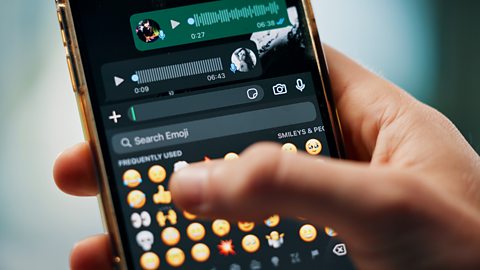
Emojis, acronyms and slang...
Each social media platform will have its own “norms”
A lot of the time on social media we dispense with the formal rules of written language, but not always. On LinkedIn, for example, many of us are connected with colleagues, potential employers and contacts that we would otherwise use formal language with, so we’re unlikely to use slang.
We create different identities depending on who we’re connected with on different platforms.
“There are basically norms just like there are in other channels of communication,” explains Andreea. Language is all socially constructed, and we follow the norms that the group has for that particular genre. “We follow spoken norms in certain spoken situations, and written norms in others, and then on LinkedIn there will be LinkedIn norms and on Facebook there will be Facebook norms.”
This can result in us creating different online personas: “We create different identities depending on who we’re connected with on different platforms.”
It’s a job to keep on top of the latest abbreviations
New abbreviations are constantly emerging on social media. Here are a few popular ones:
IMO – In my opinion
IMHO – In my honest (or humble) opinion
IFAIK – As far as I know
IYKYK – If you know you know (which has just been added to the Cambridge online dictionary)
LOL – Laughing out loud (which can even become a noun when we pluralise it with LOLS)
Hashtags help us add emotions or subtext
“In written language you don’t really get to see people’s faces and emotions, but you can use hashtags almost like a subtext or an extra layer,” explains Andreea. (Eg. #concerning.)
The hashtag has even moved into speech. We might say something like, “You were late, hashtag casual!” This demonstrates how these language spheres are feeding into each other, in often ironic ways.
“We like to think of the different language activities in our lives as being neatly packaged, in their own little lanes, but they’re not like that,” states the linguist. “We often have leakages between them.”

New words, created on TikTok, are being banned in schools
There are words originating on TikTok, which have embedded themselves into children’s vernacular around the world.
For children up to the age of five, if the majority of the input comes from social media, 'this is really problematic for their literacy.'
Rizz – This comes from “charisma” and the Riddler character in Gotham. “Those two concepts have merged into this kind of quite shady character, often male, and with sexual connotations,” explains Andreea. A “rizzler” is someone who is able to attract romantic partners.
Skibidi toilet – This comes from an animated series on YouTube where humans with toilet heads were fighting toilets with human heads. It went viral and “skibidi” is now a “discourse marker” used by kids – though it doesn’t really mean anything.
Sigma – This comes from the Greek alphabet. For kids aged 8 to 10 this is positive and signifies a leader. Like the alpha male, though not gendered, it’s something to be aspired to. For older children it’s more of a derisive term, mocking people who seek to be leaders but aren’t really.
Some schools in Australia and the United States have been trying to ban these terms from written assignments and spoken language in the classroom. “Of course… there’s nothing like banning something to increase its street appeal,” states Andreea. “Regulating language just doesn’t really work, so what will happen is children will just take it elsewhere.”
Unlimited exposure to social media could damage a child’s literacy
“The term social media has been around for a long time but the actual platforms and the kinds of addictive behaviours we see today, they’re relatively new,” explains Andreea. This means research into the effects is still in its infancy.
The research we do have shows that for children up to the age of five, who are acquiring their first language, if the majority of the input comes from social media, “this is really problematic for their literacy.” This includes their word knowledge, not just their ability to read and write. “This is because, in those first few years, there are some really crucial developmental stages that we want children to hit,” explains the linguist. They’re not just learning about sounds, words and grammar, they’re also learning gestures and emotions “and in order to really acquire a language you need feedback.”
Research suggests we need to limit social media in those early years and, at the very least, make sure children have access to a real human to talk to.

We would rather message than pick up the phone
“Calls are kind of premium now,” says Andreea. If it’s a close friend or family member we might pick up the phone, but we’re increasingly likely to just type messages instead.
“We’re not just happy with constantly tapping away, and sending these written messages to and fro, but we’re also increasingly ok with communicating asynchronously,” she states. When we’re in a text conversation with someone, there might be hours or even days in between messages.
“It’s weird that many of us are connected to so many people online through these platforms and yet, at the same time, surveys indicate that people are quite lonely.”
The function of email is changing
“For the older generation, that didn’t grow up with internet, email is something they’re very used to,” says Andreea. However, the younger communicators, who grew up on the internet, don’t really use email. “They don’t know how to write a good email, they don’t have any need for it, and they see it as this old-fashioned kind of thing that the old people do!”
We still use emails, but the function has changed. It used to be seen as a quick alternative to a letter but it’s now seen as this “cumbersome thing”: they’re longer, they have greetings and sign-offs, we send attachments. Now, if we want to be quick, we send a message or a WhatsApp. “The function of email is changing and it’s becoming a bit more formal.”
We’re also changing how we sign off
With an email, we’re more likely to sign off with a “best wishes” or “kind regards”, because they tend to be more formal.
With a text conversation we might not sign off at all. “I just leave people hanging I’m afraid!” admits Andreea. Michael favours a “C U L8R.”
“The French just write ‘biz’, which is kisses,” says Andreea.
Listen to Word of Mouth: Rizz, skibidi, IYKYK: exploring the language of social media. Michael Rosen in conversation with linguist Dr Andreea Calude.

More words from Radio 4
![]()
Word of Mouth
Radio 4's popular series exploring the world of words and the ways in which we use them, with Michael Rosen.
![]()
Women and words: why language matters
Nikki Bedi and Professor Deborah Cameron explore how sexism is reflected in the English language.
![]()
Dropping the mic and jumping the shark
Shedding light on the surprising origins of some modern-day phrases,
![]()
Are you grammatically gormless or a punctuation perfectionist?
Apostrophes have caused more arguments, disputes and unfettered violence than every family event put together. Test your knowledge with our popular apostrophe quiz!