Whitehaven
Mark Steel shares his observations about the Cumbrian village of Whitehaven
Whitehaven is on an edge of the country, one of those edges that is mostly forgotten, and you imagine at some point an official in Whitehall will find some old papers down the back of a sideboard and mutter "Oh Lord, there’s a town in Cumbria that’s not been on our records since 1965. We’d better send four of our best men up there to see if anyone’s still alive".
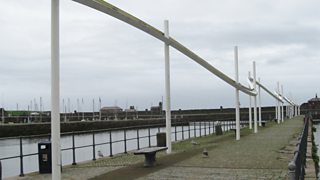
I’d never been and I dedicate most of my time to finding places like this. So it was a thrill to trundle down the coast from Carlisle, above the rocky beaches that are impossible to get to from land or sea, where there are almost certainly caves full of communities that have learned to communicate with cockles. And nearly two hours after leaving Carlisle you arrive at Whitehaven, with nowhere for the train left to go, except the mythical lost city of Barrow.
But there is one institution that hasn’t forgotten it, which is the nuclear industry. The Sellafield plant, a few miles south, dominates Whitehaven, employing most of the town and sponsoring the rest of it, including sports clubs, the swimming pool and the theatre where we recorded the show.
It’s possible to visit the plant, as long as you make a request in advance, so we did that, and received the following reply: “Unfortunately we are unable to help you with this as the purpose of your visit does not align with protocol.”
This is the response you might expect if you wrote to Davros and asked to be shown round a regional HQ of the Daleks, but seemed a little inhuman coming from a human.
But they did agree we could meet the plant’s PR man, called Karl. So we went to the café, awaiting whatever clipboard-laden consultant they despatch to people whose purpose doesn’t align with protocol, and in came a jolly and endearing Cumbrian, who started by telling us how Bono had once protested against the plant, and as a result his records were never played again in the disco at Egremont.
He then ran through the figures of how many the plant employs, and why British Nuclear Fuels consider it safe. Then he folded up his clipboard and said “But there’s no point in me telling you any of that, because I know you’ll do exactly what Ross Noble did when he was here and take the piss out of us all night for glowing in the dark.” Karl, I contend, is the future of PR.
I had a trip round the delightfully decaying rugby league ground, that gives the impression there could be ten unbroken years of unprecedented scorching drought across Cumbria, and the pitch would still be a field of squelching mud.
And I met the delightfully, initially grumpy but infectiously enthusiastic Michael Moon, who runs the Michael Moon Book Emporium. “I suppose you’ve come to mock us have you Mister Steel”, he said, without looking up. But then he spent the next hour reciting a thorough history of the town, while three potential customers came in, chose a book, stood for a while gazing out of the window, gave up and left.
The most useful book I found in his Emporium was Sellafield Stories, a series of accounts from people who have worked at the plant, some of which were part of the show. Of those we couldn’t fit in my favourites were from Dick Raaz, described as “One of the American bosses at the plant” who said, “The good news about radioactive waste is it self-destructs. Some of it disappears by itself in seconds, and some of it takes 27,000 years, but it all goes.”
And there was Patrick Gordon Duff-Pennington, ex-Eton and Oxford, who lives in Muncaster Castle, which is Cumbria’s only stately home. The castle has been in the family since 1200, and Patrick’s mother-in-law decided to raise money by entertaining visitors with wild animals. There were already some bears and then, he said, “We were given a blue and gold macaw from Millom. Well the Millom people have a pithy way of expressing themselves. The day after it came, two old women were coming back down the drive after visiting the grounds, and they were saying ‘It’s awful, what an awful bird’. So I went in the grounds and the bird was saying ‘**** off you. Go on **** off.”
There’s a view I’ve heard of that part of Cumbria, that it’s so dependent on the nuclear industry that it’s highly defensive on the issue. And it’s often said that anyone expressing a liberal outlook, that may contain an opposition to nuclear power, will be looked down upon. But that wasn’t my experience, and maybe it’s more complex than that. The people I spoke to were all willing to join in what Michael Moon would call the ‘mocking’ of the plant, and you can understand even the most liberal types there being concerned about Bono being reintroduced to the disco playlist.
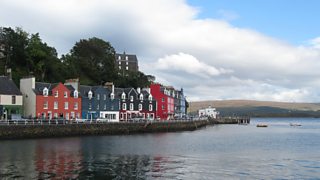
But most importantly, the producer, Sam Bryant and I, have established two traditions for after each recording. The first is to raise a drink to the next destination, which was made easy when our hotel, as if by magic, had one malt whisky on sale, the relatively obscure 'Tobermory'.
And then, the next morning, we aim for a masochistic swim in the open water, which this time meant the sea I’d declared the night before was irredeemably radioactive. In around twenty years, if Sam and I are both frothing uncontrollably and turning an alarming shade of fluorescent green, we’ll probably be disappeared without trace, in alliance with protocol.
The most appropriate music to end the show, we thought, was Kraftwerk’s Radioactive.
But should it have been something else? Now’s your chance to waste as much as time as we did on this, and let us know…