Five unique organs from around the world
Unique organs from around the world by Chris Taylor
Organist Wayne Marshall told me in a recent interview that he used to collect organ specifications. As a child he was fascinated by these detailed lists of stop names, organ divisions, player accessories and even wind pressures, that can often be found in organ articles or programme notes or CD booklets. OK, I’ll admit it. This was a bit of a hobby of my own, too. If you were lucky, you might even discover a diagram of the console, or a note about which pipes and features were added in the latest rebuild. For the aficionado, these documents offer a little extra insight into the DNA of each unique musical instrument.

Every organ is unique. That’s one of the things that makes them so fascinating. And that individuality goes far beyond the technical details of a few stops and features, or even its sound. An organ’s history, nationality, setting and connection to a particular composer or performer, the music it was designed to perform and the audience it was designed to serve - all these things and more make every instrument an inimitable creation to be cherished.
Here are some instruments that we think are particularly fascinating.
Cathedral of Notre Dame de Valère, Sion, Switzerland
Organs have a history that reaches back into antiquity.
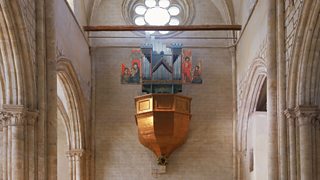
The very first organ is attributed to Ctesibius, an Alexandrian engineer who lived in the 3rd century BC. Alas, only written descriptions and pictures survive of that instrument.
The earliest organ pipes we can actually hear belong to the Cathedral in Sion, Switzerland. To be honest, this historic organ has been rebuilt so many times it no longer even slightly resembles its earliest incarnation. Nevertheless, some of the oldest pipes survive and are thought to date from 1380 (or possibly the early 15th century). That’s mind-mindbogglingly ancient.
It’s awe-inspiring to hear the sound of this instrument, to feel the vibrations it makes in the air, and wonder at the twenty or more generations of worshipers, performers and organ admirers who’ve done the same.
Here is an extract from Hofhaimer’s Salve Regina. The organist is Guy Bovet.
The image for the clip is supplied courtesy of:
Basilique Valere: twinpix / Rosace Orgue Valere: Valais Cantonal Museum.
Walt Disney Concert Hall Organ, Los Angeles
I still get a buzz of excitement when entering an unfamiliar church, or concert hall for the first time.
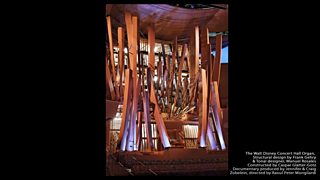
Yes, I want to take in the space, the architectural features, the interplay of light, texture and colour; but what I’m really looking out for is the organ, and hoping to be thrilled. The unique character of each organ extends to their visual appearance and organ designers are often out to impress, even before we’ve heard a single sound. I still remember my first encounter with the dramatic open-plan pipework of the Royal Festival Hall, and turning a corner at Worcester Cathedral to be faced by the giant, ornately painted pedal pipes of the transept organ.
One of the most impressive organ cases of modern times has to be the design created for the Walt Disney Concert Hall Organ in Los Angeles. By all accounts, it was a challenge for organ designer Manuel Rosales to reconcile the practicalities of crafting a real, working instrument with some of the wilder ideas of architect Frank Gehry, who also designed the hall itself. Many concepts were considered and discarded (including pipes hanging from the ceiling!). The riotous finished design is still astonishing. If you look carefully, you’ll see that many of those large external pipes are curved, a complex technical feat in itself. The builders point out that the visible pipes only represent 2% of the full instrument.
Here is an extract from Soler’s The Emperor's Fanfare, arranged by E. Power Biggs.
The organist is Wayne Foster.
The image is a photograph by Ron Belanger. With many thanks to the documentary-makers of The Walt Disney Concert Hall Organ, who supplied the music clip and the image.
The Walt Disney Concert Hall Organ,
Structural design by Frank Gehry & Tonal designer, Manuel Rosales.
Constructed by Caspar Glatter-Gotz.
Documentary produced by Jennifer & Craig Zobelein, directed by Raoul Peter Mongilardi.
The bamboo organ at St. Joseph Parish Church in Las Piñas City, Philippines
Father Diego Cera was an unusual and talented priest.
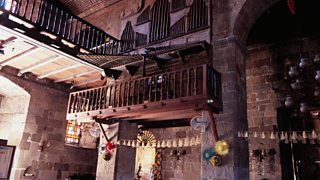
Originally from Spain, he was sent to Las Piñas in 1795 and charged with establishing a new church. No church existed at the time, so he started building one himself. When it was nearly complete, almost 20 years later, he undertook the construction of an organ too. He found that standard organ-building materials were hard to come by locally, so he opted to use bamboo which was ubiquitous and easily available. His organ was completed in 1824 but was almost immediately ruined by a series of earthquakes. Father Cera set about restoring his creation and continued to maintain it against earthquake, typhoon and flooding until his death in 1832. After that, the instrument gradually fell into decline until it was properly restored in the 1970s. The organ now forms the centrepiece of a long running music festival at the church.
It’s a physically large instrument, 3.5 tons, boasting fierce "Spanish" horizontal trumpets (in metal) which augment the rather sweet, mellow sound of its bamboo pipes.
Here is an extract from 8 Pieces On Filipino Folk Tunes (Sarong Bangui), written especially for the Bamboo Organ at Las Piñas. The organist is Guy Bovet.
6 Organs at the Basilica of the Palace of Mafra, Portugal
Most large organs actually consist of several smaller organs ("divisions") combined into one integrated instrument.
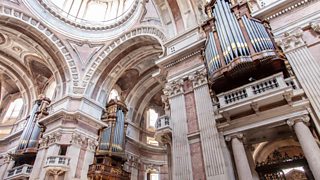
Each keyboard, or "manual", controls a separate division and each division can usually function as a stand-alone ensemble as well as in combination with the other parts of the organ.
Sometimes divisions can be physically separated from the main instrument case. Perhaps an "echo" division might be hidden high up in the church tower. The famous state trumpet of St. John the Divine, New York is placed more than 500 feet away from the main case, creating a stunning antiphonal effect across the cavernous nave.
The prize for taking such spatial considerations to their furthest extreme must go to the Portuguese builders António Xavier Machado e Cerveira and Joaquim António Peres Fontanes, who between them simultaneously constructed no less than six complete organs throughout the space of the Basilica at Mafra Palace, between 1806-7 (two in the Chancel, two in the Northern transept and two in the Southern transept). They were designed to be performed together and their existence stimulated a small and unique body of repertoire for organ sextet!
The organs quickly fell into disrepair following Napoleon’s invasion of Portugal and the subsequent Peninsular War. They have only recently been restored and no commercial recording yet exists – so here we’ve provided an example of music for just two organs – performed at Salamanca Cathedral.
Here is an extract from Soler’s Concierto no. 1 in C major (Andante). The organists are Peter Hurford and Thomas Trotter. They play the Epistle Organ and the Gospel Organ at Salamanca Cathedral, Spain.
The organ at Birmingham Town Hall
The new town hall in Birmingham, cast as an imposing Roman temple, set the mould for monumental civic centres across the country.
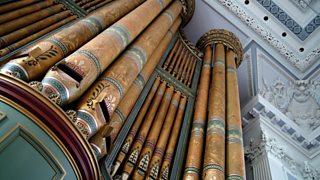
It was, and remains, an assertive statement of municipal pride and confidence. The majestic organ that is the hall’s crowning glory is no longer a record breaker. It has long been surpassed as the country's largest organ. Those imposing towers of 32-foot bass pipes that so impressed citizens in 1834 were only unique in Britain for a short time. Bigger, louder, even more grandiose instruments followed as a golden age of Victorian organ building, that this instrument helped inspire, took hold.
However, sheer size is not actually what makes this organ so special. The city fathers furnished their instrument with a rich selection of exciting and colourful sounds. Many stops imitate real instruments and the organ is particularly suited to performing orchestral transcriptions, bringing classical music to the widest possible audience. The post of City Organist was created, and popular weekly recitals started in 1844. They continue to this day.
It's that public purpose that makes this organ different. It feels so treasured, so embedded in the character and aspirations of the city. Organs can often seem a little remote, aloof even. But this is a truly accessible, approachable instrument; a friendly landmark, created by Birmingham for its people. All that warmth, enthusiasm and ambition still resonates through every pipe.
Here is an extract from Wagner’s The Ride of the Valkyries. The organist is Thomas Trotter.
Related Links
Contact Us
Please tell us about any unique organs you've come across around the world. Send us pictures, and your thoughts on what makes them unique.
To contact us email: [email protected]. We will publish some of the comments online. No personal information will be kept or divulged.
Readers' Suggestions
How about this instrument for your collection of strange instruments from around the world - the Heldenorgel in the fortress of Kufstein in the Austrian Tyrol. I had the privilege of giving one of the daily lunchtime recitals on this instrument in 2010.
- Anthony
I think on the programme you asked for suggestions on instruments to feature, so here are a couple of suggestions in no particular order of merit:
St. Ignatius Loyola, New York City: This instrument was built in 1993 by Mander Organs of Bethnal Green, London, and is one of many examples of how British organ builders seem to have had more opportunities in the last 40-50 years to build significant instruments overseas compared with the opportunities at home. As well as being an aural marvel, this large organ is also visually stunning and a significant architectural feature in this fine Upper East Side Church.
Hallgrimskirka, Reykjavik, Iceland: This instrument was built by Klias in 1992 or 1993 and is of a similar size to St. Ignatius, but a different style, but both instruments very well suited to their homes and music programmes. I heard this one for the first time in the flesh in August.
- Roger
You ask for suggestions of unique organs to feature. May I put forward the Father Willis organ in the Beacon Methodist Church, Nethergreen, Sheffield? Very few Father Willis organs remain in their original specification and this one has not been altered other than removing from a bombed church, fortunately leaving the organ very little damaged.
Another interesting Father Willis exists at Whitchurch Methodist Church, near Aylesbury. This one is only a two manual and pedals chamber organ built originally for the Duke of Wellington at Apsley House. This organ has been modified in the past but restored to its original specification now, even including tracker action.
- Keith