Ten Questions From Ten Pieces
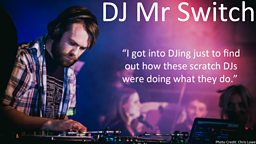
We caught up with DJ Mr Switch, the soloist of 'Concerto for Turntables and Orchestra', in between his regional concerts.
1) What are you up to at the moment?
At the moment we’re just starting off the Ten Pieces tour so we’ve just played in Birmingham… we’re doing a lot of concerts most of the main UK cities which the local schools can come along to. We’ve just done Nottingham and Birmingham so we’ve probably performed to about 5000 schools so far. We’ve got another 12 to 15 shows covering Cardiff, Glasgow, Manchester and lots of other cities and it’s been really good fun.
2) Have you always been interested in music? Did you study music at school?
I did keyboard lessons outside of school, I only did music for a couple of years, not as a specialist thing at school per say but I've always had an interest in it, I think I didn't feel as inspired by learning music within school as I did by finding out about these other types of music that was out there. Garage was a genre that interested me, I started buying records and then I got into drum and bass and then I got into hip hop. From hip hop you can discover all these other genres, for example, classical music, Latin samples, random bits of everything, from there I was drawn into trying to discover music in general.
3) Do you come from a music family? Did you have any musical influences from your parents?
I played guitar and keyboard when I was quite young, I think like 7 or 8. I don’t remember asking to play either of them, I think my mum and dad wanted me to have a go at playing an instrument. I enjoyed the keyboard more than the guitar but I only got to Grade 3 I think before I fizzled out. My dad is, I don’t think he’ll mind me saying, is a bit tone deaf, but he loves his classical music and if you’re playing a piece he’ll know which composer and the recording as well, he’s quite an expert, and my mum plays guitar and keyboard herself as well, so I have the playing side and the knowledge side from my mum and dad. Then when I started secondary school, there was music in the charts with DJs being prevalent so that got me into trying to give turntables a go.
4) How did you come across the turntables?
Around the 2000 kind of time, I was listening to the charts and there was a lot of garage music around that really ticked the box for me. That was the type of music I heard that dealt with rhythm more than anything else and did interesting things rather than illustrate a thought or beat or something. There were also rock bands like Linkin Park and Limp Bizkit who had DJs as part of their setup and they were doing scratching as part of their tracks so that really interested me. So I expressed an interest and my parents lent me their turntables that I could go on. Then I watched ... my dad got me a copy of the DMC UK DJ Championships which is sort of like the Olympics of DJing, it’s a specialist scratching competition, as soon as I saw that I was instantly hooked.
5) How and when did you begin your career in music?
I got into DJing just to find out how these scratch DJs were doing what they do. I got turntables when I was about 11 and I don’t remember thinking this could be a career. When I came home from school, I’d do all of my work and I was quite good academically but I still always spent most of the rest of my time practicing/scratching and mixing music. I got my first play gig when I was 16 after I’d won my first UK championship. I won my first championship in 2008 while I was at university, there I was studying engineering, mechanical, so fixing cars and oil rigs and big tyres, things like that. Then gradually as university went on I worked more on championships and started to do more and more gigs and then I finished university and carried on DJing. I guess it kind of became a career without particularly planning it to be, especially when you’re a DJ you tend to make your name by producing tracks more than anything else, there are a couple of other routes like having a radio show or being a DJ with a certain singer or a certain band or something or you can make your name if you’re successful in these competitions - that route is particularly how people heard of me.
6) Can you play any other musical instruments? If, yes how long have you been playing and why did you choose that particular instrument?
Well a recorder aside, I did a bit of recorder, and I did a bit of guitar and keyboard – I think keyboard I must have done for a good three or four years. I did enjoy the keyboard and I still play it, I use it when I’m putting ideas together… no other instrument other than that really. I would like to try my hand at drums.
7) What kind of music do you like and how has it shaped your musical career?
It’s difficult answering this question because I think a lot of DJs have an aversion to the word ‘eclectic’ which essentially means ‘I like everything’ and I do kind of like everything. There aren’t many genres I don’t like, I mean as far as normal DJ sets go I play lots of different genres. I also specialise in electric swing DJ sets which is kind of a remix of old jazz tracks. I’ve done some classical music raves sets and there’s some Sci-fi DJ sets I’ve done. I like having different challenges as far as performing goes and I tend to go more on scene than actual genre. I like playing house, garage, drum and bass, blues, rock, reggae, salsa, Latin music.
8) When you decide to compose a piece of music how and what steps do you take to make a composition? (i.e do you use maths etc)
In competition you come up with these routines where you take a piece of music and you remix it in a live analogue way. So DJs will take a track and play around with it to actually make it into a different tempo like using scratching and actually doing it live making musical copies. Actually when I was learning a lot of it was actually quite maths based. When I build my routines I will always either choose a track that has a good pattern to it, in fact the three, four kind is a trick I use quite often in my routines where you can make the records become a different time to match your tempo thanks to its own structure, it lends itself to being transformed and that’s something that the original writers and composers and musicians haven’t thought of themselves. We tend to call that beat juggling so that’s certainly what I do a lot in the full length ‘Concerto for Turntables and Orchestra’, the whole concerto explores a different technique in each movement. Beat juggling is one of the most creative and fun things for me really.
9) Who is your favourite musician? And why?
Oh this is a really difficult question, I’m going to pick a couple of different categories because I listen to so many types of music and it’s impossible to narrow it down to one person. In terms of DJs, I would say DJ Qubert - if there was any DJ that could be called virtuoso it would be him. In terms of other musicians, I always get swept up with people I've seen recently and I really enjoy Klavikon. Klavikon plays a piano that has been electronically augmented to play techno, so it’s a piano mashed up with electronics and wiring with bits and bobs, and he can play a techno piece of music just from that one piano, so he’s quite fantastic.
10) Apart from ‘Concerto for Turntables and Orchestra’ what is your favourite of the Ten Pieces and why?
This is a great question because in honesty the Ten Pieces that the BBC have chosen are fantastic, it’s such a great mixture of styles and also the age of the composers, you have two composers who are still alive and that’s something that’s quite a rarity in classical music, certainly from my perspective who is a relative newcomer to classical music. It feels quite out of the ordinary that the composers can comment on their own work and how it’s performed is quite rare, and you have Bach and Mozart who have been passed away for quite a while. I would have to say that the piece that has become my favourite is Shostakovich. I mean the other pieces are great but that is actually the piece that I look forward to hearing every time because it has such an amazing flavour and hits so many variations, it is a quite dark piece, it’s dramatic, it’s tense, it’s fearful and it’s dramatic.