Breaking Camp, 24 July
Have you ever thought about how amazing light switches are? I’m fairly sure that I hadn’t ever really appreciated them until two days ago when we got back to the town of Ilulissat.
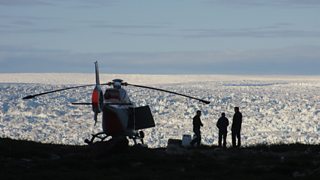
The helicopter at the glacier camp.
After three weeks of camping on a rock in 24 hour daylight, walls and duvets and showers are nicely novel (and I’m very grateful for them). But light switches seem completely alien. I was genuinely excited today when it got dark enough to use one.
It was a bit sad when we packed up the last bits of our camp. The kitchen tent, the washing up buckets, the water containers and the generator disappeared into boxes and weren’t home any more. While we waited for the helicopter to transport the last bits and pieces, we attempted some cricket with a plank as a bat and some cardboard boxes as a wicket. That lasted until one of the cameraman hoicked the ball enthusiastically over the cliff and we couldn’t find it again. Our parting gift to Store glacier might be a broken tennis ball covered in gaffer tape.
It’s not really a fair exchange. We’ve lived with this glacier for three weeks, been kept awake at night by the sounds of its stressed ice breaking free, watched it change shape before our eyes and marveled again and again at the beauty and variety it has to offer. Before this trip, I hadn’t really appreciated the extent of the processes that go on as all that ice marches forward. And I hadn’t appreciated the fact that the glacier isn’t solid. It’s riddled with a network of cracks and tunnels, all conduits for the vast amount of meltwater that forms as the 24 hour sun beats down on the ice surface. Even better, when those cracks fill up and then the meltwater freezes in the winter, the newly frozen ice is a startling bright blue. When you see an iceberg up close, you can see both the cracks it had as it left the glacier, and also intense blue scars from cracks it had in the past.
So, our campsite is associated with many happy memories, and I’ll miss having the freedom to set out on a hike over the peninsula to see what our local world of ice is up to. I won’t miss the mosquitoes.
Now it’s time for the next adventure to start. We’ve seen the start of an iceberg in a fjord and now it’s time to go and see one out in the open ocean. In a few hours we’ll start loading the Neptune, the ship we’ll be on for the next two weeks. It’ll take a day and a half to get across the Davis Strait to the Canadian side, where there’s an unusually large tabular iceberg. This will be the focus of the next programme. Why has it lasted so long and what are the most important processes helping it break up or melt? I’m really looking forward to getting stuck in to the next part of the project.
Time to switch the light off and go to bed. Light switches. Brilliant. Click.

