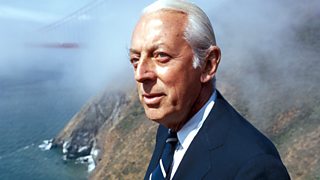
James McGill Buchanan
This is the week of the year when, if you were a visitor from another planet and were able, with your superior technology, to fly between a hundred American cities in one evening, you'd be bound to assume that the people of the United States had just come through a successful revolution.
The crisp, silver fall has given way to the golden Indian summer and in all the cities, you'd see people out on the streets on these hot nights, small huddles round taxi cabs, families out on their stoops, surging crowds in the lobbies of airports and hotels, in the cities, in the mountains and the western desert, thousands of bars and saloons, packed with cheering customers.
Only in Boston, on Tuesday and Wednesday nights would you have seen the eerie spectacle of 30,000 people in a stadium sunk in gloom, evidently the counter-revolutionaries who failed.
In other words, it's been the week of the World Series, the national baseball championship, the finale of the most tense and subtle of all team games. The tension was always there if you knew the game and even if you were up against the night sky on the back row of a stadium looking down on a diamond spotted with midgets, but the subtlety was never disclosed to the many millions of watchers until baseball got on to television.
Then and now, you see the whole field of play but only in rare long shots. The visual staple of the coverage is the close-ups of the pitcher adjusting his cap, licking his lips, tweaking his ear or adopting any one of the variety of signals every pitcher gives to the catcher. Then cut to the dug-out and see a manager sniffing or dropping his head or taking two paces – another signal to the pitcher, and the field. Then cut to the infield, if that's where the pitch is designed to be hit. And then the play.
Now that's only the most elementary, crude description of the uninterrupted movement of the game. While the good commentators guess, more often correctly predict, that the next ball pitched will be either a curve ball or a screw ball or a knuckle ball or a slider, a sinker, a fingertip ball or a palm ball.
I hear some dedicated cricketer saying, 'Wait a minute! Are you telling me that a ball which is always a full toss is always thrown through the air and doesn't touch the ground, can have seven different flights?' That's what I'm saying. I never really believed it myself until about 15, 20 years ago when they introduced the instant reply in slow motion, so the pitch was filmed from behind the pitcher's arm and you could see, by the very hard-earned magic that pitchers have to practise and practise all through the winter and spring training, you could see a ball thrown from six o'clock, veer out to eleven o'clock and duck to one o'clock. Or go in a high loop from five o'clock and staying high until, suddenly, a yard short of the batter, it drops like a stone over the plate.
Those are only two of the repertory of amazing trajectories that good pitchers can manage through the short stretch of air between them and the batter. The nightly revelation of this magic to riveted millions across the country is the gift of one American to his fellow men and women.
A few years ago – I don't believe it can be more than four years – I did a talk about the annual awards of the Motion Picture Academy of Arts and Sciences, the Oscars. There came up to the rostrum the usual dazzle of radiant and weeping stars, blessing their managers and agents and studios, and jerking random tears from the theatre audience with their heartfelt tributes to all the people who'd intimately helped them to glory, including the husband or wife and mother and father and three little children.
That particular year, I was most taken with an old man, not a sprinkle of glitter about him, in a homely suit and a crinkly, modest smile. A man so likeable on sight that you shared his slightly uncomfortable feeling that he didn't know what he was doing amid all this glitz and hype and mascara and spidery eyelashes. He was being given a special award for his lifetime contribution to the cinema. He took it gratefully with a nod and a few words of thanks and was gone.
A few weeks later, I was delighted to have a letter from him which I've kept. It was a letter of thanks, as simple and genuine as you might get from a carpenter you'd congratulated on doing a good job on your new bathroom doors. It seems that some friend of his in Mexico had heard the talk, taped it, copied out the relevant sentences and sent them to him.
His is a name which rates in all the best guides and encyclopedias of the movies only a few lines, if it's there at all. The name is Joseph Walker. He got his award for cinematography but I don't believe they detailed the innovations he was responsible for, most of all for the device which passed over to television and made our actual view of events so eerily intimate, of political rallies, of revolutions, of terrorist attacks, protest marches. Most of all, carried our eyes in a flash from 50,000 spectators in a stadium to the drops of sweat on the brow of a soccer player, a tennis player, a golfer and, in baseball, helped us see in menacing close-up the index fingers and the thumb on the ball that a pitcher was about to throw. The miracle invention was the zoom lens and its inventor was Joseph Walker.
He died last year, I think, in his middle eighties and I never watch a golf tournament or a tennis match and now, for several nights on end, the World Series, without thinking of Joe Walker and blessing him.
Well, this is also the time of the year when I don't suppose quite as many people get worked up over the award of the Nobel Prize for Economics. I have to say I always begin to twitch with curiosity when it's coming up because in a field, a specialty, which affects every human on earth – money – the prize always goes to somebody who has enunciated a theory about money that sounds like, and usually is, an abstruse theorem in mathematics: here's a winner who has finally discovered the deflationary-inflationary cycle in retarded interest accumulation.
One year a man got it for something called monetarism. Another man for telling us that the engine of a nation's economy, which used to be freight loadings, was the GNP – the Gross National Product. Whenever the economics prize is announced, I find myself sadly lisping, but how about us?
Well, last year, the Nobel Awards Committee seemed to come down to earth, to the pocketbook of you and me. It was given to one Dr Frederico Modigliani, for a method of finding out whether a company's financial worth is what it says it is and, also, for his original work in discovering when people save money and when they don't. That doesn't offhand sound like original work. Go and look at the man's bank account!
But there must be more to it than that, I realised, when I remembered a Yorkshireman I knew on a fellowship at Yale and on the never-to-be-forgotten day of 4 March 1933, the day the money stopped when the banks were frozen, my friend never batted an eyelid. He simply lifted up his mattress. There was the bank of Croesus. He told me it was an old Yorkshire custom.
Well now, this year, the prize has gone to an economist who, until now, has been even more obscure to the general public, even to economists, than most of the recipients. His name is James McGill Buchanan, a man from Tennessee who's been slogging along with a theory that most of his professional colleagues either ignored or spurned, because his theory runs foul of a belief that is held by roughly half the population in any country whose politics sets conservatives against socialists.
Capitalists act in their own self-interest and expect the rewards of their labour to pour down, or trickle down, on the people, whereas the true politician, the public servant, certainly the socialist, acts primarily to serve the people. Right?
Wrong, says Dr Buchanan. Politicians of any party, he says, act primarily to promote their own self-interest in the sense that they vote for things that will get them re-elected, just as markets work through what consumers choose to buy for themselves. He says this public choice theory explains government deficits. People don't want deficits but they want somebody else to reduce them.
We had a startling example of Dr Buchanan's theory in practice as the 99th Congress rushed, last week, to adjourn and die. They were tacking on essential expenditures to a mammoth spending bill. What is essential?
Well, there's a trainer airplane in the works called the T-46A. The air force has no use for it and doesn't want it but if $2 billion were saved by cancelling it, 1200 people on Long Island who work on the plane would lose their jobs. Senator Barry Goldwater, the chairman of the Senate's Armed Services Committee, who comes from Phoenix, Arizona, kept saying that the air force doesn't need and doesn't want it, but the two New York senators, one conservative, one liberal, forgot their ideology and lobbied madly to keep those 1200 jobs and, incidentally, their own. They got it.
Now, let's see where somebody else can cut his spending. It's the old American maxim, 'Don't tax you, don't tax me, tax the man behind the tree!'.
By an odd coincidence in my bedtime reading, I came on this passage written by a passionate Russian revolutionary, for a time. He wrote it in 1897, 20 years before the Communists took over his country and the Marxian Utopia was about to be realised. This is what he wrote: 'Even if what Marx predicts were to happen, then the only thing that would happen next would be that despotism would be transferred. Now the capitalists are in power. Then the workers' bosses would be in power. The main misjudgement, the main error of Marxist theory, is the supposition that capital will pass out of the hands of private individuals into the hands of the government and from the government representing the people into the hands of the workers. It is a fiction, a deception, that the government represents the people.'
I forgot to mention the author's name. He was Leo Tolstoy.
This transcript was typed from a recording of the original BBC broadcast (© BBC) and not copied from an original script. Because of the risk of mishearing, the BBC cannot vouch for its complete accuracy.
Letter from America audio recordings of broadcasts ©BBC
Letter from America scripts © Cooke Americas, RLLP. All rights reserved.
![]()
James McGill Buchanan
Listen to the programme