The Czech and the Chieftains: How the Māori community turned the tables on colonial art
18 April 2018
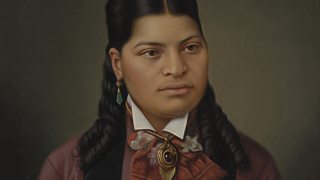
In episode eight of Civilisations: The Cult of Progress, historian of Empire David Olusoga explores how Western artists captured the likenesses of indigenous peoples. Czech artist Gottfried Lindauer was commissioned to document New Zealand's vanishing people but to his surprise his work was enthusiastically embraced by the Māori community.
Lindauer
Artistic reaction to imperialism in the 19th century.
In 1847 the Czech artist Gottfried Lindauer travelled to New Zealand. He arrived after the country had experienced decades of violent conflict, where the Māori had lost much of their land to the colonial government.
For his Māori patrons and their families Lindauer’s paintings began to assume an entirely new level of meaningDavid Olusoga
Lindauer fast found himself in high demand, commissioned to paint portraits of Māori men and women by European settlers, who were keen to preserve the culture of what they saw to be a dying race.
In fact by the 1890s the Māori population was on the increase.
Olusoga says: "They were absolutely determined to forge a new future in which their culture, their traditions, their language and the memories of their ancestors were all to be kept alive and kept vibrant."
One of the ways they did this was to co-opt the talents of Lindauer and commission him to paint their portraits.
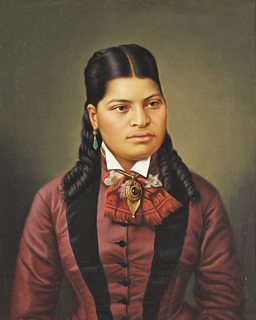
These portraits for Māori clientele were to be on their own terms and to their tastes.
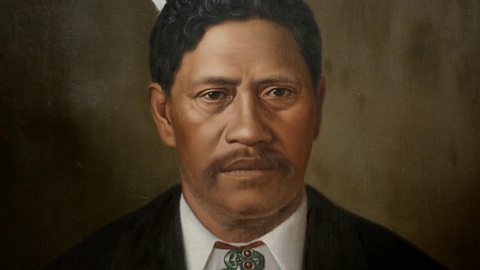
When he painted for European customers the subjects were usually wearing traditional costume but many Māori customers wanted a hybrid of European and traditional dress, such as suits paired with Māori jewellery and feathers. We were a people, they were saying, who can move freely between cultures.
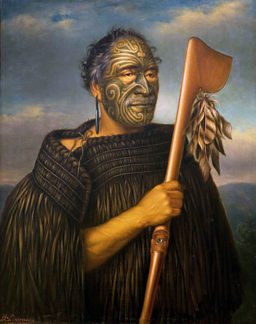
Olusoga says: "For his Māori patrons and their families Lindauer’s paintings began to assume an entirely new level of meaning. As a people who had always venerated their ancestors many Māori came to regard the portraits of Lindauer not just as memorials to their ancestors but as almost living icons that kept their spirits alive in the present."
While many of the portraits are scattered across the globe, several portraits have remained with the subject's family, handed down from generation to generation.
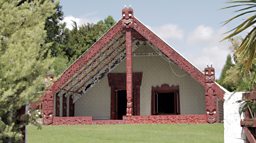
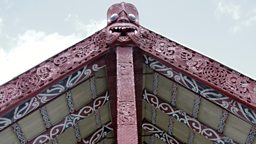
The portrait of Te Rangiotu, a Māori chieftain and businessman, has stayed within his family, and now takes pride of place within the clan's meeting house, a sacred space in Māori culture.
Gottfried Lindauer grew to consider New Zealand his home, becoming a citizen in 1881 and only journeying back to Europe three times during the rest of his life.
It is estimated that Lindauer painted over 400 portraits during his lifetime. However a large amount of these are unaccounted for. In 2016 the Auckland Art Gallery in New Zealand began a search for his Māori portraits, encouraging people to feature the artworks in a major exhibition of his artistic canon, The Māori Portraits: Gottfried Lindauer’s New Zealand. Works by the Czech artist had previously turned up in people’s attics and under beds.
Two of Lindauer’s Māori paintings featured in the news last year when a robbery took place at the International Art Centre in New Zealand. A van smashed through the building in the early hours of the morning and two Lindauer paintings were stolen: Chief Ngatai-Raure and Chieftainess Ngatai–Raure. A listing for the first painting, Chief Ngatai-Raure, appeared on the dark web in November, asking for £500,000.
Neither artwork has been uncovered since the theft.
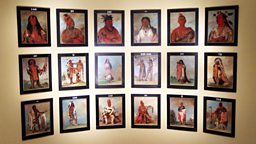
For many Native Americans they are troubling, romanticised images of the vanishing Indian.David Olusoga
Lindauer wasn't the first artist to paint portraits of indigenous peoples. During the 1830s in America artist George Catlin met and painted the portraits of hundreds of Native American men and women, over the course of five trips to what was then the Western Frontier. It formed a unique collection he called the Indian Gallery, which he toured around the country and later the world.
Unlike other artists Catlin took time to accurately name his sitters and his paintings demonstrated the different Native American nations. Olusoga says: “Yet for many native Americans they are troubling, romanticised images of the vanishing Indian that Catlin put on display for white, fee-paying audiences.”
More from Civilisations
![]()
Hue knew? Five surprising facts about colour
Colour is a complicated and, at times, controversial topic.
![]()
Explore masterpieces of European painting
Five of the most significant paintings in the history of Western art.
![]()
Order a free poster from the Open University
OpenLearn, the OU’s home of free learning, helps you explore the art of different civilisations of the world.
![]()
Digital innovations
Explore artefacts using the augmented Reality (AR) app and 360 degrees videos, plus storytelling collaborations with UK museums and galleries.
![]()
The Czech and the Chieftains
How the Māori community turned the tables on colonial art.
![]()
9 fascinating facts from The Civilisations Podcast
Viv Jones' audio companion to the BBC Two series is taking us on some intriguing tangents.
![]()
The Inside Story
Mary Beard and Simon Schama reveal the inside story of writing and presenting the BBC Two series Civilisations.
![]()
Civilisations: Box set
Watch all nine episodes of the series on BBC iPlayer.