Sikhism - Values for living
Themes: Stories about Guru Nanak: 'The Milk and the Jasmine Flower' and 'Duni Chand and the Silver Needle'; deciding what's important in life; being welcoming.
Summary: This assembly considers what we value in life and the reasons for what we choose to value. It doesn't aim to tell children what they should value, but to help them to think more deeply about how we decide what to value.
Resources: The assembly begins with an activity comparing the value of various items - you'll need to be ready to display the gallery images available on the right.
Key links
![]()
Assembly framework (pdf)
Print out the assembly framework ready for use
![]()
Gallery - What is valuable?
Click to display the gallery images for the introductory activity.

The video:
There is always room in the world for more holinessGuru Nanak
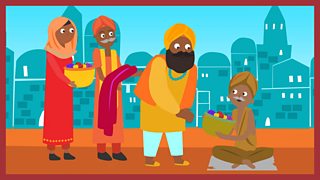
The video begins with a short introduction to the Sikh religion and its holy book, the Guru Granth Sahib. Two stories follow. In the first, Guru Nanak and his friend Mardana travel to a city where they are refused entry but Guru Nank is able to show that there is enough space for everyone. In the second, Guru Nanak visits the home of a rich man called Duni Chand. Guru Nanak gives Duni Chand a needle and asks to have it back in the next life. Duni Chand realises that he will not be able to take the needle - or his riches - with him when he dies and uses his wealth to help the poor.
Duration: 3' 11"
End of speech: '...and help poor people for the rest of his days.'
Story questions
Who started the Sikh religion and when?
The Sikh religion dates from over 500 years ago and its founder is Guru Nanak
What is the Sikh holy scripture?
The Guru Granth Sahib
How do the holy people of the city welcome Guru Nanak?
With a full bowl of milk - to indicate that there is no space for Guru Nanak and his friend to enter
What does Guru Nanak do to the bowl of milk?
He floats a jasmine flower on the top without spilling any of the milk - to indicate that there is space in the bowl and space in the city
What does Guru Nanak give the rich man called Duni Chand?
A silver needle from his turban
What does Duni Chand learn from Guru Nanak?
That his wealth will be of no use to him when he is dead and thus he should do good deeds to help the poor and hungry while he is alive - 'Only good deeds can go with us into the next life'
Suggested framework
| Content | Guidance |
|---|---|
| 1. Entry music | A song about money and wealth - eg 'Money, money, money' by ABBA. |
| 2. Introduction | Display the gallery 'What is valuable?' which includes images of objects that have different values, including those which are valuable in a non-monetary way. The images show money, a toy, rubbish at a dump, a fast car, a pet, a child and grandparent, two friends. Ask children to show by a 'thumbs-up' or 'thumbs-down' vote whether they think the things shown are valuable. At the end ask them to suggest which is the most valuable. Explain that today's story(ies) come from Sikhism - and help people to see what's really valuable in life. Think about what these things might be as you watch the stories (in the first story - holiness / being welcoming; in the second story – using what you have to help other people / valuing money for the right reasons / treating others well). |
| 3. The video | The video starts with a short introduction. The first story, 'The Milk and the Jasmine Flower' starts at 0' 46" and ends with the words '...and welcomed Guru Nanak and his friend into the city.' The second story follows immediately at 1' 45" and ends with the words '...to feed hungry people and help poor people for the rest of his days'. |
| 4. After the video | Use the story questions to help children recall the events of the stories. |
| 5. Time to talk | Ask children to decide the things that Sikh people value from these stories - and what they teach about what's important In life. |
| 6. Opportunity to sing | An opportunity to sing your chosen song. Suggestions from BBC collections below. |
| 7. Opportunity for reflection | 'We've been thinking today about what's important in life... We've thought about what's important to Sikh people... And we've thought about the things that we value in our own lives (name some things you've talked about during the assembly). We've also thought about the importance of being welcoming to others, as Guru Nanak taught... I wonder what we could do to make our school even more welcoming..? Maybe you'll think of some ideas back in class...' |
| 8. Opportunity for prayer | Use your normal form of address ('Dear God' etc) and: 'We thank you for the many different things that we value - in our families, in our school and in life. Help us to remember that every person in our school community matters - and help to make our school a happy and welcoming place to be. Amen.' |
Suggested songs
| Song | Collection | Significant words |
|---|---|---|
| 'Welcome' | Come and Praise: Beginning, no 15 | 'Welcome, welcome / From each and everyone' |
| 'Hello' | All about our school, no 1 | 'Hello and welcome from us all / We're very glad you came' |