Making Waves: Anna Karina on Jean-Luc Godard
29 January 2016
Together they formed one of the most memorable auteur-muse partnerships in cinematic history. Actor Anna Karina and New Wave director Jean-Luc Godard worked together on eight of his films and were for a time partners both in their personal and creative lives. BBC Arts met with Karina, now 75, in London ahead of the BFI's Godard retrospective. In a series of four short films she discusses her life and work with one of cinema’s most revered directors, while SPIKE GEILINGER writes about their unique collaboration.
Filmed by Spike Geilinger and Cinestre Films for BBC Arts.
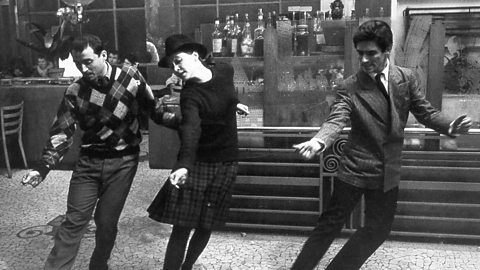
Karina on Godard: Dance
Anna Karina discusses the dance sequences in Vivre sa vie and Bande à part.
Vivre sa vie (1962) and Bande à part (1964) are both films in which Anna Karina is the pivotal character. In Vivresa vie she plays a shopgirl who slowly slides into prostitution to pay her rent while in Bande à part she is a wide-eyed language student befriended by two young classmates intent on seducing her and breaking into her aunt’s house to steal a stash of money she has discovered hidden in the lodger’s wardrobe.
Her infectious smile and good-natured innocence come to the fore in the dance sequences that she talks about here. A behind-the-scenes report for a French TV station filmed on location when the scene was shot reveals that they were originally dancing to John Lee Hooker's Shake It Baby.
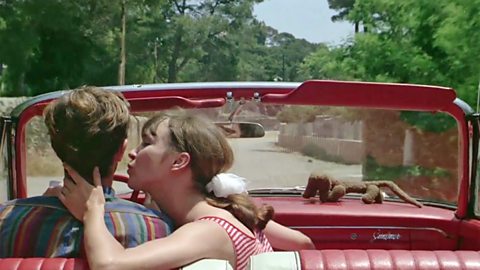
Karina on Godard: Madness
Anna Karina discusses the spontaneity that arises from working without a script.
Jean Paul Belmondo plays a Paris businessman who takes off with the family nanny on a chaotic road trip to the Riviera coast. Anna Karina frequently mentions the lack of a script when working with Jean-Luc Godard. Sometimes it was a great nuisance, but sometimes it could bring about the kind of spontaneity that results in a memorable scene like this one in Pierrot le Fou (1965), when Godard suggested they should drive the car into the sea.
The car is American, a Ford Galaxie Sunliner, the same model driven by the gangsters at the end of Vivre sa vie. Today the stringent safety requirements of movie-making would ensure a great deal of planning, harnesses and lifebelts, but Jean Paul Belmondo just turned off the road, bounced across the beach, and launched the car into the Mediterranean.
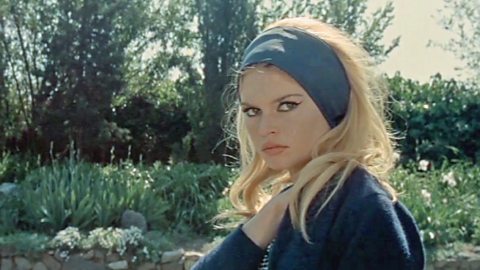
Karina on Godard: Contempt
Karina dismisses the idea that Contempt is based on her relationship with Godard.
Le mépris (1963) - Contempt in English - is widely assumed to be based on Jean-Luc Godard's relationship with Anna Karina, though she dismisses the idea in this interview.
A screenwriter played by Michel Piccoli is hired by an American producer, Jack Palance, to rework Homer’s Odyssey for a Hollywood style 'sword and sandals' epic. His wife, portrayed by Brigitte Bardot, is to play Penelope but he has misgivings about the project, and about her love for him. The film director is played by the legendary German Expressionist Fritz Lang. The central sequence features a lengthy argument between the couple where the camera follows them around their apartment in a beautifully choreographed row.
Bardot wears a wig that perfectly matches Karina’s haircut in Vivre sa vie, while Piccoli is dressed in Godard's trademark suit and trilby. Watch out for fleeting appearances by Godard himself in the movie sequences playing the assistant director, marshalling the performers for a take.
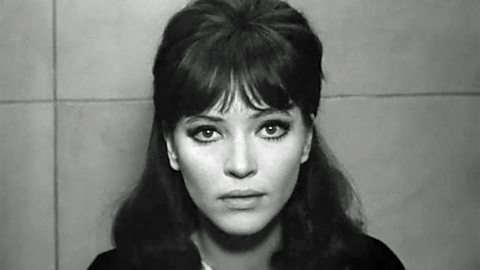
Karina on Godard: Alphaville
Anna Karina tells how Jean-Luc Godard shot his only sci-fi film in Paris at night.
Jean-Luc Godard's only sci-fi picture, Alphaville (1965), is a film noir set on a planet where emotion is forbidden and the life of the inhabitants is controlled by the harsh, rasping voice of the supercomputer Alpha 60.
Eddie Constantine plays Lemmy Caution, a secret agent from the 'Outlands' who falls somewhere between gumshoe and gangster. Posing as a journalist, his aim is to destroy Alpha 60. He meets Natasha Von Braun, played by Karina, daughter of the man who built the computer, and falls in love with her. This emotional response throws her into turmoil and ultimately leads to the success of Caution's mission.
Godard's genius, as Anna tells us, was to shoot the film in Paris, at night, with no special sets or sci-fi tropes other than Brutalist architecture and oppressive darkness. To pull this off he used a new high-speed black and white film stock for the first time, giving the movie a high contrast otherworldly look.
The auteur and the muse
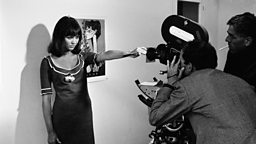
In 1959 Jean-Luc Godard, the enfant terrible of French New Wave film making, tried to cast the Danish model Anna Karina in his debut feature Breathless but she turned him down.
He wanted her to play the role finally taken by Jean Seberg but she wasn't prepared to take off her clothes. When he tried again, this time successfully, a few years later she was still too young to sign a contract and her mother had to travel to Paris from Copenhagen to give her imprimatur.
The films they made together in the ensuing five years are arguably the most intense collaboration between an auteur and a muse in cinema history.
With the help of his cinematographer, Raoul Coutard, Godard used her close-ups as dramatic punctuation in a series of intriguing films that gradually moved away from conventional narrative cinema to explore images and ideas in ways that had never been tried before.
Karina is not ashamed to admit that she was often as confused as anyone by what she was doing but her ability to inhabit her characters never faltered, whether she was the emotionless citizen of a planet run by a super computer in Alphaville, or the gun-running nanny of a wealthy Parisian family eloping with her employer in Pierrot le Fou.
Two Parisian films feature dance sequences that gave Anna the chance to crystallise a new kind of French cool, using borrowed American themes from the Hollywood films that Godard, the uber-film buff, exploited perfectly.
There is cinema before Godard and after GodardFrançois Truffaut
In Vivre sa vie Anna drops a coin in a juke box and sinuously moves around a pool table with a smile of sheer pleasure to a simple tune by Michel Legrand.
In Bande à part she enlists her two admirers, played by Sami Frey and Claude Brasseur, to line dance a version of the Madison, clicking fingers and stamping their feet - emphasising their camaraderie on the eve of their planned robbery. But when the music stops she finds herself deserted, as she will be again the following day when the burglary fails.
The scene from Bande à part has been widely imitated - Roger Michell's Le Week-end features an homage and Quentin Tarantino quoted it as inspiration when John Travolta and Uma Thurman win a dance contest in Pulp Fiction. Tarantino also named his production company Band Apart but in recent interviews has rather churlishly described his admiration of Godard as youthful infatuation.
Godard and Karina were married in 1961 and two years later Godard made the film Le mépris, suffused with her presence but in which she did not star. The part that she is widely assumed to have inspired, the screenwriter’s wife, is played by Brigitte Bardot. This most visually ravishing film, with a powerful score by Georges Delerue, is at once melancholy and painfully destructive.
By 1965 the marriage was burnt out. They worked together one last time the following year, on Made in U.S.A, but the atmosphere on set was acrimonious and Raoul Coutard had to admonish Godard for the way he spoke to Karina.
When we spoke to her, older and wiser, she plainly enjoyed reminiscing about the films they made together, but if the questions got too difficult she had a faultless excuse: “You must ask Jean-Luc about that.”
"The cinema is not an art which films life: the cinema is something between art and life. Unlike painting and literature, the cinema both gives to life and takes from it, and I try to render this concept in my films. Literature and painting both exist as art from the very start; the cinema doesn't." - Jean-Luc Godard
Jean-Luc Godard at the BFI
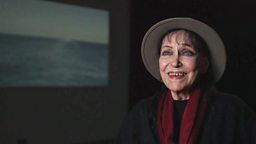
The BFI's Jean-Luc Godard season celebrates not only his feature film work, but also his lesser known short films, self portraits and experimental television productions. In addition there are a number of talks from experts on Godard's talent as an experimental film maker, sound artist and the use of architecture in his films. As part of the season Godard's classic Le Mepris was re-released in cinemas across the UK in January. Events run until March 2016.
Related Links
More from BBC Arts
![]()
Picasso’s ex-factor
Who are the six women who shaped his life and work?
![]()
Quiz: Picasso or pixel?
Can you separate the AI fakes from genuine paintings by Pablo Picasso?
![]()
Frida: Fiery, fierce and passionate
The extraordinary life of Mexican artist Frida Kahlo, in her own words
![]()
Proms 2023: The best bits
From Yuja Wang to Northern Soul, handpicked stand-out moments from this year's Proms