Radio 3 and BBC Arts Opera Passion Vote
On Thursday 19 October, opera companies from across the UK will come together with the BBC for #OperaPassion, an unprecedented day of live streaming. As part of the day, Radio 3 is offering you, the listeners, the chance to vote for the opera you would most like to hear broadcast that evening. Here are the choices, from recent performances by the Royal Opera. Voting remains open until 4pm on 19 October.
Four celebrity opera advocates want to bend your ear... Listen to James Naughtie, Shelley von Strunckel, Harriet Harman and Stephen Fry make the case for their favourite operas.
Gounod: Faust
In Gounod’s version of the Faust legend, the struggle between good and evil is writ large in music of power and passion, with moments of occasional delicate tenderness.
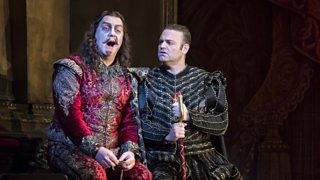
Faust’s pact with Méphistophélès restores his youth and enables him to meet and seduce the beautiful and innocent Marguerite, whose subsequent abandonment and descent into madness and infanticide finds a form of redemption in death at the end, but not before Méphistophélès’s manipulations have also allowed Faust to kill her brother Valentin, who dies cursing her.
Faust requires a large cast and the supernatural elements demand a spectacular production; the expense of putting it on has led to its losing ground in the repertoire list, where it appeared at number 35 in a recent survey.
While Marguerite’s role offers the "King of Thule" ballad and the famous "Jewel Song", they say that the devil has all the best tunes: in Faust, one of them is Méphistophélès’s "Golden Calf" aria, and since the opera’s premiere in 1859, many famous bass-baritones have performed it, including Edouard de Reszke, Feodor Chaliapin, Sam Ramey and Bryn Terfel.
Dating from April 2014, this Royal Opera production stars Joseph Calleja as Faust, Bryn Terfel as Méphistophélès and Sonya Yoncheva as Marguerite.
Mozart: The Magic Flute
If The Magic Flute were to be composed today, we’d say it offers "something for everyone".
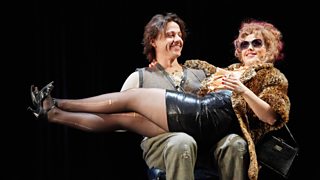
For children, there’s the appeal of the mysterious bird-catcher, the ladies who rescue the hero, Tamino from the serpent at the beginning, the angelic chorus of three boys who intervene at various points, and the cartoon-like baddies of the Queen of the Night and her henchman, Monostatos. More adult themes include the Enlightenment spirit of the search for wisdom and virtue professed by a noble brotherhood, and the trials of fire and water.
The fact is that Mozart wrote Die Zauberflöte (The Magic Flute) for the suburban Theater auf der Wieden, drawing on the magical spectacle and earthy comedy of vernacular Viennese style to create an absorbing and entertaining Singspiel, a popular form that included both singing and spoken dialogue.
Prince Tamino promises the Queen of the Night that he will rescue her daughter Pamina from the enchanter Sarastro. He begins his quest, accompanied by the bird-catcher Papageno – but all is not as it seems… Tamino and Papageno discover Sarastro to be a wise and kind leader. They undergo three ordeals. By the end they are united with their true loves: Tamino with Pamina, and Papageno with his Papagena.
The cast of this April 2015 Royal Opera production includes Pavol Breslik (Tamino), Christiane Karg (Pamina), Markus Werba (Papageno), Lauren Fagan (Papagena), Anna Siminska (Queen of the Night) and Georg Zeppenfeld (Sarastro).
Puccini: Tosca
Dubbed a "shabby little shocker" in a 1950s critique, Puccini’s Tosca, after a shaky start at its Rome premiere in January 1900, quickly became a firm audience favourite, and has remained a staple of the repertoire ever since.
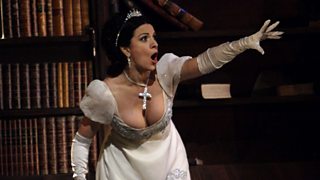
It’s not hard to understand why: a passionate affair between an artist and republican, Mario Cavaradossi, and a beautiful, fiery singer, Floria Tosca, is pitted against the lustful designs of an evil, royalist chief of secret police, Baron Scarpia. When Cavaradossi is arrested, tortured and condemned to death, Tosca agrees to surrender herself to Scarpia in exchange for a free pardon. After Scarpia authorises a mock execution for Cavaradossi at Rome’s Castel Sant’Angelo, Tosca stabs him to death. A spectacular posthumous double-cross (spoiler alert!) leads to Cavaradossi’s execution for real, and Tosca’s dramatic suicide by flinging herself off the battlements of the castle.
The Royal Opera’s 2011 production stars Angela Gheorghiu as Tosca, Jonas Kaufmann as Cavaradossi and Bryn Terfel as Scarpia.
Wagner: The Flying Dutchman
In Wagner’s opera, the Flying Dutchman has been cursed for eternity.
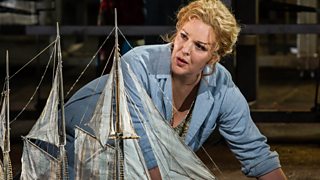
Once every seven years he is allowed to come ashore to seek redemption from the curse, which will be found in the form a woman’s true love. Sea captain Daland’s daughter Senta, a woman who harbours an obsession with the Dutchman of legend, might offer such a prospect. Senta accepts the Dutchman's offer of marriage. But the Dutchman wrongly suspects her of infidelity. He leaves to resume his endless voyaging – claiming faithfulness until death, Senta jumps into the sea: the curse is broken, and both ascend to heaven.
The salty score of Wagner’s first mature opera brings the stormy Norwegian seascape vividly to life, in the throaty choruses of Daland’s sailors and the supernatural presence of the Dutchman and his ghostly crew. This contrasts with the prosaic nature of the coastal town where the girls sing their "Spinning Song", spiced with "Senta’s Ballad" and the pleadings of her abandoned suitor, the hapless Erik.
Egils Silins (The Dutchman) leads the cast of this 2015 Royal Opera production, with Adrianne Pieczonka as Senta, Peter Rose as Daland, and Michael Konig as Erik.