Dan Snow's History of Congo
Producer and director Robin Barnwell tells of the challenges of making a film exploring the vast and inaccesible Democratic Republic of Congo.
Our Toyota landcruiser had slowly slid off the muddy track into a deep rut onto its side, the presenter, Dan Snow, had just fallen into a ten-foot ditch, the rain was continuing to fall. We were in one of the most remote places on earth, deep in Congo's rainforest. Reaching a safe place to stay for the night seemed a distant possibility.
We were making our way back from Gbadolite, a surreal town in the north of the Democratic Republic of Congo. We had taken the gamble of trying to get to this place as it stands as an extraordinary symbol of some of what has gone wrong in Congo – one of the potentially richest countries on earth, which has become the poorest.
This was where President Mobutu blew hundreds of millions of pounds of his country’s money, building and running palace complexes in the second half of his three decades of rule, when he was one of the West’s key Cold War allies in Africa.
A former bodyguard of Mobutu’s whom we met, tellingly remarked that the buildings were so lavish that when inside them you forgot death existed.
During the time of Mobutu's father, Gbadolite was just a small village. President Mobutu put the place on the map with a palace complex - dubbed Versailles in the jungle – a substantial international airport that hosted Concorde and a developed town with its own hydroelectric power station.
Today, Gbadolite is a shell of its former self: the airport has no aircraft; a family is squatting in the dilapidated presidential terminal, the satellite dishes are defunct, the traffic lights don’t work and the population is consumed by a nostalgia for the ‘good old days’ under Mobutu.
Time almost stopped still here when Mobutu fled in 1997. The jungle has seized back the land. Roman style columns now protrude through trees, enormous vases lining an ornamental lake have been wrapped in vines and the multi-tiered swimming pools are filled with green larvae.
Vast fortunes have been made in Congo throughout history but the money has often vanished, either being taken abroad or wasted in the country, leaving the Congolese people with nothing.
Our journey back from Gbadolite had gone beyond an enjoyable adventure, as Dan, myself and the production team desperately struggled to upright our car hundreds of miles into the jungle.
It can take several hours on a plane to cross the world’s second largest rainforest and I’ve often sat on aircraft wondering what was going on thirty odd thousand feet below. We were just visitors, but the Congolese daily have to deal with one of the world’s worst infrastructures.
At independence in 1960, Congo had roads, railways and river-craft that were the envy of much of Africa. There are now only 1700 miles of paved roads in the Democratic Republic of Congo, a country the size of Western Europe. Few countries in the world have experienced such catastrophic infrastructure decline.
On a four-week shoot that ambitiously took in the four corners of the country, from the mouth of the Congo river to its heart and on to the Kivus and Katanga, logistics was our greatest challenge.
Having eventually dug our vehicle out of the mud several more times and reached a safe place to sleep, we were forced to brave Congo’s airlines.
For a television producer on a tight budget and schedule, this is nerve shredding, not just because of the thought of them falling out of the sky but also because some of the places we went were only served by planes once every five days and unscrupulous operators abuse passengers by overbooking seats.
The result is pandemonium at small airports ahead of departure, as ticket holders plead desperately with airline staff, begging for a seat. The process goes on for hours, the pleas turning to hysteria.
If you don’t join in the drama, you won’t stand a chance of getting onboard. By the time you have won a hard fought victory by getting a seat, any safety fears have become irrelevant. Relief sets in as the engines scream on take-off, the aircraft hauling itself in torrential rain past bolts of lightning above the unbroken rainforest that stretches as far as your destination.
One of our journeys by plane was to the Equator town of Mbandaka, which is five hundred miles by boat to the capital; there are no roads. Our next challenge was to find one of the extraordinary Congo river boats that make the journey of over three weeks from Kisangani in the east to Congo’s capital, Kinshasa. This stretch of the Congo river is a thousand miles long and navigable by large boats all the way.
This was the route taken by the explorer Henry Morton Stanley in 1877 whose journey with a support team of more than two hundred – mainly Africans - opened up the interior of central Africa to Europeans.
The Congo river here is dramatic, stretching up to miles wide and is the deepest on the planet – over two hundred meters in places. It is stunningly beautiful and should be enjoyed by tourists, but very few outsiders venture to these parts.
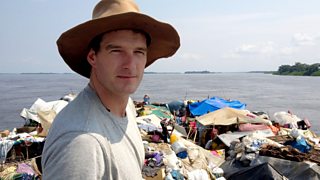
Congo’s river boats resemble oversize Thames barges, which have become temporary home for hundreds of people, animals and cargo, taking on the appearance of large floating refugee camps. Tales abound of these structures and their occupants being stuck for weeks on sand banks in remote stretches of the river.
For us the challenge was to find, then board and film on one of the vessels - a task made more complicated by the fact that Congolese people are often amongst the world’s most resistant to being filmed even after attempts at negotiation.
Maybe it’s no surprise given the way the Congolese have been exploited by outsiders through their history. The area around the Equator, on this stretch of the Congo, was where some of the worst atrocities were committed by Belgian King Leopold’s colonial regime a little over a century ago.
Leopold’s private colony is another part of Congo’s amazing history that I had started researching from London ahead of filming. At the time I had made a call to an eminent academic and Congo expert.
I sent him some thoughts and questions on email in advance and was astonished to be told that I already knew too much when I telephoned him.
He suggested that Congo could be distilled down to the words ‘Blood, money and joy’:
Blood, because Congo’s tale is about the often forgotten deaths of millions and millions caused by outside intervention and unscrupulous Congolese.
Money, because staggering amounts of cash has been generated and continues to be made by a few from Congo’s enormous wealth of mineral resources with little going to the Congolese people.
And joy, because in spite of all the suffering and trauma suffered by the Congolese they are among the most joyful and vibrant on earth.
Dan Snow and I have had an extraordinary adventure putting together this documentary, but the programme is not another tale about white men battling through Congo.
Little airtime is devoted to one of our planet’s most important countries and although some people might think that it is excessively ambitious to try and tell the epic story of Congo in an hour, I believe that drawing the key themes of Congo’s history together will lead to a much better understanding of why Congo is facing tremendous problems today.
As someone who has lived and worked in Congo for more than a decade told me, the Congo is very much a creature of its past, but by understanding how things got so messed up, it is possible to help Congo realise a more positive future. But for now, unhappily, that future seems a long way off.
Related Links
![]()
This article is from Dan Snow's History of Congo
Dan reveals how Congo became one of the world's poorest countries despite its many resources.
![]()
More from This World
Read more articles from the producers and directors of This World.