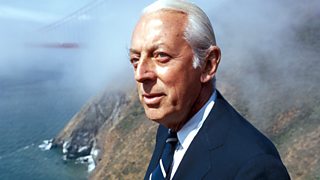
Alan Greenspan
A devastating report has just appeared about the general knowledge, or general ignorance, of the average American high school student. The sample was small, but it was a true statistical sample and can be taken as applying to a general average.
What has come out of it as a general finding is that geography and modern history seem, nowadays, to be as rarely taught or rarely absorbed as Latin. We have something like 50 per cent of the pupils unable to identify either Joseph Stalin or Winston Churchill. More than 40 per cent with only the haziest notion of where the countries of Europe stand on the map in relation to each other. Toronto was placed as an island in the Caribbean.
As for Nicaragua, which since that Beirut magazine blew the gaffe on the Iran arms deal in November has been in the American news more than any other country on earth, an actual majority of high school students didn't know where it was, how it was governed and whether the United States was on the government side or the Contra side. I must say, after watching a good deal of the congressional select committee hearings into this stupendous foul up, I don't blame them.
Well, just when we were reading this report and sitting back and tut-tutting about the rising of bonehead generation, a face, not recognisable, appeared on the tube and, next day, on the front pages of hundreds of newspapers and, within another day or two, on the cover of news magazines in America, in Europe and Asia.
And when we heard or read that this genial owl of a man, with the crinkly brown eyes magnified by horn-rimmed glasses, was suddenly the second most important man in America, when the cover editorial of an English magazine flatly declared him to be 'the most important economic policy maker in the world', it was inevitable that even the most superior of us should feel a rush of guilt. So that you may share this tingling feeling, let me simply pronounce his name – Alan Greenspan. Who else?
If Ronald Reagan, labouring away at those heroic B-films never dreamed of being President of the United States, what do you suppose was the life ambition of this 61-year-old economist, 43 years ago, when he was 18?
He had studied music at New York's famous Julliard school and was off on his career, playing clarinet and saxophone in a touring dance band. However, he abandoned music as a career and, for the next eight years, devoted himself to Columbia University and the study of economics. And then, just as abruptly, he abandoned university life and joined a financial consulting firm. Many such consultants stop there if they can prove that they can tack through the winds of economic change and keep their clients on a prudent course.
In Wall Street and beyond, Alan Greenspan picked up some powerful corporation clients not because they felt comfortable with his reputation as a conservative and with his faith in the free market, but because he was, at his best, as a non-ideological analyst, as a man who took to reams of statistics the way other men take to baseball records.
He loved a tangle of contradictory reports. He became known as a man who neither parroted the conventional wisdom nor made a point of defying it. He discovered trends – a dangerous occupation – but more often than not he was right. Most notably, when the entire motorcar industry, in the early 1950s, assumed that their production was bound to be stifled or sidetracked by the Korean war. Mr Greenspan looked through all their figures and forecasts. Not so, he concluded. And he was right.
One friend gave us a sharp glimpse of, to me at any rate, a peculiar sort of mind by saying, 'Alan is the kind of person who knew how many thousand bolts were used in a 1964 Chevrolet car and what it would do to the national economy if you took out three of them'. His name made, I should guess, its first headline about 20 years ago when he hinted at the probable cause of a coming, whopping, federal deficit – not merely that under President Lyndon Johnson the Vietnam war was the first war in American history not paid for in increased taxes, but that Johnson's administration had fudged its budget figures, quite legally, to hide something like $10 billion spent exclusively on the war.
Mr Greenspan then retreated into the cosy, backroom fame of his consulting firm. He surfaced again as chairman of the president's council of economic advisers under President Ford. Two years later, Mr Ford was beaten by Mr Carter and Greenspan went back to his firm. But he began to write at large on the social and political issues to be deduced by him from all those weird statistics.
He is articulate and soft spoken and is one of the very few economists who can make clear his brand of sense for a general audience. So he began to be used by a television network to straighten out the intricacies and the arguments about inflation, the Latin American debtor nations, the long shadow of the federal deficit, for poor, ignorant us.
He was born in Manhattan, the only child of a stockbroker and was known to his family and teachers and classmates as a prodigy with figures in his sixth year. He was something of a marvel at mental arithmetic, which is not an exercise taught in American schools – maybe not in British schools any longer, judging from the shop assistants who bang out on a calculator 70p and then one pound and then 30p and announce, after a breathless pause and a second squint at the machine, 'Ah, two pounds!'.
It's only now appeared, as a constant of Greenspan's thinking, that he was worrying about the federal deficit 20 years before it went soaring into the stratosphere under Reagan. In 1982 Reagan appointed him to take charge, to take the chair of a bipartisan national commission for what was called social security reform. It was a time when the Democrats were pounding away at President Reagan as a fat cat or a buddy of fat cats who showed little compassion – that was the vogue word – compassion for the old and the poor. Mr Reagan had talked often enough in campaign speeches and in his first two years in the White House about thrift and making your own way and getting a job by wanting it enough and cutting the deficit by cutting social services.
It was the sort of talk that prompted the Democrats to flash to a suspicious nation the rumour that the president was going to dump the whole social security system. He was, in fact, going to do no such thing. He couldn't. He might bemoan the welfare state in theory and say it sapped initiative etc. etc. but it was, after 47 years, built indestructibly into the system, into the lives, the survivability of millions of ageing Americans.
But Mr Reagan's commission to reform was practically an emergency salvage operation. Social security, which everybody who had earned its benefits had come to think was a boon and a blessing outside the national economy, social security was suddenly revealed to be eating up as much as 40 per cent of the entire national budget, with no controls on its appetite.
Alan Greenspan faced a task which could have guaranteed he would never again get a call from Mr Reagan. Reagan knew he was a conservative economist, didn't perhaps know quite so well that Greenspan is not a supply-sider or a monetarist, but Greenspan had once written a sentence to warm the cockles of the Reagan heart. It was this: 'The welfare state is nothing more than a mechanism by which governments confiscate the wealth of the productive members of society.'
Surely a man to trust in sparing no liberal sentiment on social security, right? Well, no. The presidential commission's job was, frankly, to save the social security system from bankruptcy. It met and the board and Greenspan studied and sweated for 13 months and came up with a solution that set off a howling controversy in Congress, but which Congress eventually came to pass – actually to extend social security coverage to more people, to delay cost of living increases for retired workers and to raise the payroll tax.
It was a solution, if it is one, that was not dictated by any theory of supply-side economics or compassion or by Republican or Democratic doctrine. It forgot the rhetoric and faced the facts and it's as good an indicator of what we may expect from Mr Greenspan as anything in his past that you and I can begin to understand.
So, what has happened to cause the London Economist to say about the rich country leaders who met at the economic summit in Venice, 'their talks and pseudo undertakings count for little unless they are underwritten by Alan Greenspan?'.
Well, in a word, the magisterial Paul Volcker has ended an eight-year stint as chairman of the Federal Reserve Board and Mr Greenspan has been appointed to succeed him. The board of seven members is independent of the elected government. The board can stipulate what reserves are to be maintained against the deposits of all member banks. It controls the money supply, most awesomely, it determines the federal discount rate which determines interest rates AND since the Third World has built up a frightening system of debt, it is to the Federal Reserve that the Third World turns to be saved.
Mr Volcker saved Mexico at one point. He is also, and mainly, credited with saving this country from a galloping inflation and a subsequent galloping depression.
As THE central banker of the world, the chairman, today, has the awful power to affect the earnings, the livelihood, the prosperity or the depression of all of us. When he's right and when he's wrong.
Now I've not meant to convey that Alan Greenspan is monetary wizard who built the Panama Canal single-handed, but it is the consensus here and in Tokyo, in London, in Switzerland and in Latin America that, if Mr Volcker could not go on forever, Mr Greenspan was the next best man.
This transcript was typed from a recording of the original BBC broadcast (© BBC) and not copied from an original script. Because of the risk of mishearing, the BBC cannot vouch for its complete accuracy.
Letter from America audio recordings of broadcasts ©BBC
Letter from America scripts © Cooke Americas, RLLP. All rights reserved.
![]()
Alan Greenspan
Listen to the programme