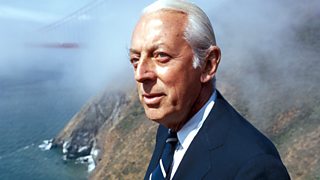
Senator Sam Ervin
A great man has died and when the news came through the other evening, a friend, sitting with me, said, 'If ever there was a case of the right man at the right time...'
Now, I'm not, myself, of a mystical turn of mind but in the old days I used to find myself saying or writing once every four years that although the race for the presidency, at any given time, is a mad scramble of windbags, exhibitionists and mediocrities, somehow out of the scramble, at the right time, there usually emerged two first-rate men. I was thinking of Wendell Willkie up against Roosevelt. Later, we had Truman against Dewey and then Eisenhower against Stevenson.
In the past 30 years, it's been harder to maintain this wishful theory and to go on believing in it you have to turn away from the big guns, the presidential candidates, to, well, not... not to lesser men, but away from the political stars to one or two feature players in the political game. Certainly anyone who lived through one of the shabbiest times in recent American history, the insensate hunt for Communists with the late Senator Joseph McCarthy as the leader of the pack, the arrival at the centre of the stage of an old Boston lawyer seemed God-sent. His name was Joseph Welch, a balding, stooped, Dickensian character, precise and whimsical, maintaining an icy courtesy towards McCarthy that could be a devastating kind of sarcasm.
By the time Mr Welch appeared, McCarthy had terrified the Congress, was holding that the State Department was riddled with Communists and now he took on the army, on the basis of two suspected officers. Mr Welch was hired by the army as its counsel. So all-powerful was McCarthy at the time – and we're talking about the spring of 1954 – that a mere sub-committee of the Senate became McCarthy's kangaroo court and the hearings against the army became known as 'the Army-McCarthy hearings'. Twenty million Americans stayed home or dawdled over the work or feigned sickness to watch the hearings on television.
Incidentally, what was the great President Eisenhower doing, who was known to loathe McCarthy? He was closeted in the White House and saying nothing.
Well, after weeks of McCarthy's almost brutal domination of the hearings and the incidental humiliation of the army, there came a day when McCarthy shook down from his sleeve the name of a very young man who had once been employed in Mr Welch's law firm. McCarthy had discovered that this young man had once joined a liberal law group. What McCarthy didn't say was that the group was too radical for the young man and he'd quit after some weeks. He had absolutely nothing to do with the army case but Senator McCarthy thought he was cleverly showing that, even in the law office of the impeccable old Bostonian, there was one subversive worm.
For the first time in the whole performance, Mr Welch was outraged, but though he fumed, he did not explode. He filtered his outrage through the channel of his courtly manner. He turned to McCarthy and said, 'Until this moment, senator, I think I had never gauged your cruelty or your recklessness. If it were in my power to forgive you for your reckless cruelty, I would do so. I like to think that I am a gentle man, but your forgiveness will have to come from some other than me.'
That was the turning point. Mr Welch had discredited McCarthy, not on a point of order, but on a point of decency and, before the year was out, a select committee of the Senate voted to censure McCarthy for conduct unbecoming a member of the United States' Senate. It was the end of him.
Among the signers of that motion was a first-term senator from North Carolina. Well, that first-term Southerner is the man we mourn today. Not too grievously, for he was 88, was only briefly ill and, though he had delighted and convulsed the Senate down the years with his anecdotes, his shafts of biblical wisdom, 12 years ago he achieved his finest hour and it was a fine and lucky hour for the Republican.
His name was Sam Ervin – a big man, with a face like a giant friendly turnip. In a nutshell, he was the chairman of a special Senate committee set up to look into the campaign activities of one Richards Milhous Nixon. It became known everywhere as the Senate Watergate committee.
Although its brief was to see if there had been any wrongdoing in the solicitation and collecting of funds for Nixon's re-election campaign in 1972 – and there was plenty – Senator Ervin suspected early on that the clumsy break-in of paid agents into a Democratic office in the Watergate apartment building, he suspected that the agents had been employed in the first place by presidential aides in the White House.
A half-dozen of them were called to testify. The first who came up was one John Dean and he told a horrendous story of bribery and telephone tapping and laundering of campaign money and even went so far as to implicate the president himself in the plot. As we all know, President Nixon first declared that everybody in the White House was spotless and, as the hunt closed in on his own office, protested time and again that he had no knowledge of the break-in or of any of the dirty tricks connected with running his presidential campaign.
Senator Ervin then called on the president's closest top advisers to appear. The president said they could not. They were protected, as he constitutionally is, by executive privilege. Senator Ervin immediately called a press conference and began with a line from Julius Caesar, 'What meat doth this Caesar eat that he grows so great? And I say to you, what meat do these White House aides eat that they grow so great? We abolished titles of nobility in the long ago and if these men refuse to come down here, I shall instruct the sergeant-at-arms in the Senate to go to the White House and fetch 'em. They are as subject to questioning as any other citizens. The president calls it executive privilege. I call it executive poppycock.'
Well, they were called and they gave the lie in everything to John Dean. The man was a liar and a fantasist. However, under the committee's probing, it came out that they had planned the break-in. Now, how did the knowledge of this come about?
Well, quite casually, one day, a witness who'd been a minor official in the White House happened to mention that a particular conversation with the president was, of course, recorded on tape. What? The committee, its lawyers were stunned. 'Oh sure,' said the witness, 'almost every conversation in the president's Oval Office was taped without the knowledge of the other participants.'
Well, many of you will remember in hair-raising recall that eventually the committee went to the courts and got the tapes released and played and, in the end, one damning tape had the president's voice urging the FBI and the CIA to bottle up any investigation of the Watergate break-in. That tape was recorded only six days after the break-in itself, so that the president had lied boldly and steadily for over two years. Well, most of the aides subsequently went to jail, the president faced certain impeachment in the Senate for high crimes and misdemeanours and resigned.
So, the heyday of Sam Ervin's career was, of course, those six months during which he presided over the Watergate committee. He was, in a way, Joseph Welch reborn as a jolly, genial, sharp, delightfully courteous, old Southern country lawyer. He would say, from time to time, 'You have to explain that to me a little further. I'm just an old country boy from Morganton, North Carolina.'
One of his colleagues smilingly reminded the committee that Senator Ervin was also a graduate of Harvard Law School and the Senate's expert on constitutional law.
Ervin's best and, as it turned out, devastating, weapon was that of a rapier disguised as a knobby old walking stick. Facing the formidable White House counsel, John Ehrlichman, and going into a Nixon-approved raid on a psychiatrist's office in the interests of national security, Ervin said, with some heat, 'But foreign intelligence activities have nothin' in the world to do with a psychiatrist's opinion of his patient's psychological state.' Ehrlichman fired back, 'How do you know that, Mr Chairman?' Without a second's pause, Ervin shouted, 'Because I understand the English language. It's my mother tongue.'
And another time, he flatly announced, about Ehrlichman and the then, Attorney-General Mitchell, 'I don't think either of 'em would recognise the Bill of Rights if they met it in broad daylight under a cloudless sky.' And about Nixon, he said, 'He certainly did obey Mark Twain's injunction, the truth is very precious, use it sparingly.'
Sam Ervin was an old-time conservative Democrat. He opposed almost all the civil rights legislation of the Fifties and Sixties. He was against equal rights for women on the dubiously gallant ground that he wanted to protect women from their fool friends and themselves, but he was not dependably doctrinaire. You could never be sure which side he'd come down on. He was a conservative hero for his opposition to integration of the blacks, then he was a liberal hero for fighting, successfully, a Nixon administration plan to institute a national surveillance system, including telephone tapping, of government employees.
Whatever the issue, he never wobbled. Sam Ervin believed passionately in the Bill of Rights and was the first to raise the alarm when he saw it threatened.
An early, a great, moment came when he was in his late twenties, when he saw freedom of the press threatened by a bill before the North Carolina legislature which followed the redneck campaign in Tennessee to ban the teaching of Darwin's theory of evolution in the public schools.
Old Sam, young Sam, declared that if the bill passed, 'only one good thing can come out of it. The monkeys in the jungle will be pleased to know that the North Carolina legislature has absolved them from any responsibility for humanity in general and for the North Carolina legislature in particular.'
This transcript was typed from a recording of the original BBC broadcast (© BBC) and not copied from an original script. Because of the risk of mishearing, the BBC cannot vouch for its complete accuracy.
Letter from America audio recordings of broadcasts ©BBC
Letter from America scripts © Cooke Americas, RLLP. All rights reserved.
![]()
Senator Sam Ervin
Listen to the programme