Object of the Week
Each week we'll introduce you to one of the many intriguing objects found in the museums we visit...
Week 8: Professor Kate Williams
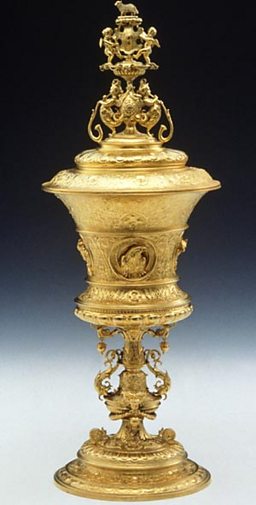
You’re Henry VIII and you've turned the world upside down for a son. You divorced one wife, beheaded another – and you need a wedding present for your new wife, Jane Seymour, the woman you feel sure will give you the heir you desire. But what on earth can you give her? Why, a great cup made of solid gold, of course.

This cup isn’t actually the one a grateful Henry gave to Jane on their wedding day on 30 May, 1536, eleven days after Anne Boleyn had been executed. That was a splendid thing, studded with diamonds and pearls and designed by Hans Holbein - and Jane received it along with 104 houses and some hunting grounds. She didn't get to enjoy it for long however as she died 12 days after giving birth to her son, the future Edward VI, in the following year.
The cup rather languished - Charles I sold it in the 1620s when he was in need of a few pennies.
This one is a Victorian copy made in 1867, based on the Holbein designs for the original. It was made for Sir Watkin Williams-Wynn, who was at the time, MP for Denbighshire and the richest man in Wales.
The cup is ornamental - I'm not sure that even Sir Watkin would have dared use it to drink! It is nearly 40 cm tall and beautifully decorated with ornaments of flowers and dolphins and tiny jingling bells. It also bears the family's rather - well - unique mottoes, including 'bwych yn unaf' - the ram is on top - and 'cwrw da yw allwed calon' - good beer is the key to the heart', fitting for Henry VIII certainly. The ram is actually on top of the lid, held up by a jolly pair of cherubs.
The Williams-Wynn family had been wealthy since the times of Henry VIII – through property – and by the nineteenth century, business as well. Our Sir Watkin's grandfather (also called Sir Watkin Williams-Wynn) was perhaps the biggest art patron in Wales apart from the ground-breaking Davies Sisters. In the early years of the twentieth century, Gwendoline and Margaret Davies collected impressionists and modern art. Sir Watkin collected Old Masters in the eighteenth century - and between them, they form the basis of the museum's collections.
The eighteenth century Sir Watkin liked Old Masters. His nineteenth century grandson liked gold. In the mid nineteenth century, Wales went mad for gold. It was long known to be there for the Romans had mined it but when some enterprising investigators found the mineral to be accessible in the 1860s, miners flocked to the country - particularly North Wales. Some 10,000 prospectors arrived to get rich.
The late Victorian era was truly a Welsh gold rush. The area from Barmouth to Snowdonia area had rich gold deposits and the late nineteenth century saw a rash of mines - one of the biggest was Gwynfynydd in Dolgellau.
Sir Watkin's mine was Castell Carn Dochan - and it was at its busiest from 1865 to 1873. Sir Watkin was paid a large royalty in the form of gold ingots for the gold being mined there. Being already extremely well off, he had no particular need for this gold and so he had some of it made into this ornate cup instead.
Welsh gold is mythical stuff, mined from the Snowdonia area and used in wedding rings for the Royal Family since the marriage in 1923 of the Duke of York and Elizabeth Bowes-Lyon (the future King George VI and Queen Elizabeth). As a Welsh girl, I’m probably a bit biased, but I think it’s the most beautiful gold you can get – with a brightness I'm positive you can't get in other golds. And so I chose this astonishing cup from our final Quizeum visit, to the wonderful Museum of Wales. It’s the largest item in existence of Welsh gold and worth an unimaginable sum.
Sadly, however, the last of the Welsh gold mines closed at the end of the twentieth century. As there is no more mining, it's set to be the world's rarest gold and soon will be impossible for us mere mortals to get our hands on. For me, the cup is a reminder of how power and riches never last - and those brief Victorian decades when men and women from all over the country crowded into Wales, following the lure of gold...