Drama queen: Agnieszka Holland on the TV revolution
18 April 2016
Scan the credits of some of the best US TV dramas of the last 10 years and there’s a good chance that Agnieszka Holland’s name will be on there somewhere. A go-to director for the likes of The Killing, The Wire, Treme and House of Cards, Holland made her name with a series of award-winning European films. With a new retrospective at the BFI, Lighting Fires: The Film and TV of Agnieszka Holland, ALASTAIR McKAY catches up with her to discuss the effect of arthouse cinema on television and the ‘totalitarianism’ of Hollywood.
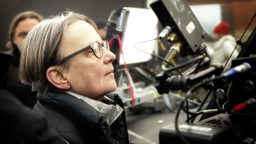
In 1965, when she was 16 years old, Agnieszka Holland made a list. “Waves of creative energy were coming from France, from Great Britain, from America,” she says.
“From Czechoslovakia, from the Soviet Union, from Hungary, Japan. I was making a list of the films I liked the most and it was 200 titles. Today if I find two or three I’m happy.”
Holland is drawn to exiles and outsiders... and the blunted morality of totalitarianism
As a director, Holland has made a significant contribution to cinema. She makes deeply human, morally complex films.
Her 2012 Holocaust-survivor’s tale, In Darkness, is a typical study of the human struggle against adversity, as is Europa Europa (1990), which tells the story of a young Polish Jew who joins the Hitler Youth.
As a political exile - she fled to Paris after the declaration of martial law in Poland in 1981 - Holland is drawn to exiles and outsiders, and explorations of the blunted morality of totalitarianism.
It’s a theme she returns to in her extraordinary HBO drama, Burning Bush, which tells the story of Jan Palach, the Czech activist who self-immolated in Wenceslas Square after the Prague Spring was crushed by Soviet troops.
Walter Iuzzolino, the curator of Channel 4’s Walter Presents foreign drama output, describes Burning Bush as “probably the most beautiful piece of television drama I’ve seen in my life”.
Austere and captivating, Burning Bush explores the compromised morality of what was known as “normalisation”.
“I thought Czech filmmakers would be dealing with this experience,” says Holland. “But they didn’t, for practically 20 years.
“They did some bitter sweet comedies, but the tragic dimension of the communist experience was neglected. That’s one of the reasons we are where we are.
“The past was never re-told and analysed and worked through in a psycho-therapeutic way. The silence, the guilt and bad conscience, made this past non-existent in some ways.
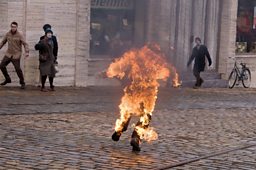
Trailer for HBO's Burning Bush
Related Links
“That leaves a deep wound and a kind of schizophrenia. On the one hand, we don’t want to see ourselves as collaborators with this regime, and on the other hand you cannot deny your life.
The logic of the big studios has been, and still is, not to make any decisionsAgnieszka Holland
“All the communist countries have this problem.
"How was it possible that most of the population was living in a kind of schizophrenic lie, and being happy somehow?
“How is it possible that those who were responsible have never been punished?”
Holland suggests, only half-joking, that her experience of totalitarian regimes was useful when she turned her attention to Hollywood.
“When I started to have meetings with studio executives, I understood that the system was in some ways similar. It is run by fear. The logic of the big studios has been, and still is, not to make any decisions.
“Any decision can be dangerous. You make the wrong decision, so you can be fired, but when you are not making a decision you can keep things in play.
“So if it wasn’t necessary to release something for the summer, the Christmas season, and something for the Oscars, they would not be green-lighting anything. This huge, well-paid structure would be just standing.
“So you have to play with that. In some ways it was easier for me to communicate with the executives than it was for my French or German colleagues who came from normal democratic countries and wanted to make something in Hollywood.
“It was very difficult for them to understand the rules and submit to them. I understand the power of bureaucratic ambush.”
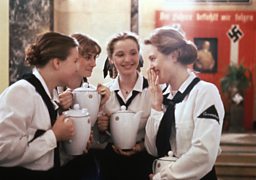

Of course, Hollywood has undergone its own revolution.
For the audiovisual generation, television was more courageous, new and excitingAgnieszka Holland
“It was a consequence of the global success of American cinema, where they understood that they were making much more money from abroad than domestically, and started to avoid the subjects that were purely American.
“Social and political drama practically disappeared, replaced by romantic comedies, which is a universal genre. The western disappeared for a while, and film noir, the typical American thriller.”
Fortunately, television has filled the gap. The trend can be traced back through Twin Peaks (1990) to (in a Euro-context) the German epic Heimat (1984), which demonstrated the potential of long-form drama. But Holland first noticed it in the US with ER.
“The first season of ER was much more social and political and complex in terms of character - not black and white. And it was very well shot. So I thought, ‘Wow, television can be so exciting,’ and then it was The West Wing, which was great political fiction.
“Television became much more innovative on the level of storytelling. For the audiovisual generation, television was more courageous, new and exciting.
“Technically speaking, it’s not so different. When I am the director I am waking up, going to the set and telling how to stage the scene, putting the camera here, and working with the actors.
“Visually, now it’s quite similar. Some television shows are more visually stunning than some movies.
“The storytelling has rules which are more conventional on television; even non-conventional television, is episodic, and you need to tell the story in that way.
“So that people want to see what happens next, and that is a little tiring after a while. It pushes you into conventional choices. But the impact is great - if it’s successful television.”
Holland contributed to Krzysztof Kieślowski’s Dekalog (1989), which brought cinematic intensity to the small screen.
Since then, she has worked on several landmark TV dramas, directing episodes of The Wire, the US version of The Killing, and House of Cards.
Her HBO pilot episode of the post-Katrina New Orleans drama, Treme, is a beautifully loose construction.
“It was very energetic,” Holland says, “and at the same time tragic. You are seeing this life and trauma after destruction, but at the same time you feel the power of the music. It was a very enriching experience.”
Holland downplays her experience on The Wire (she directed three episodes) but says she was energised by working with the show’s creator David Simon.
“The Wire was one of the most inspiring and inspired television works - it was like the Great American Novel, something really very important”.
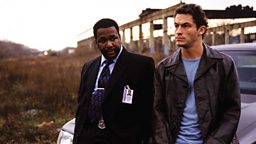
Recapping HBO's Treme
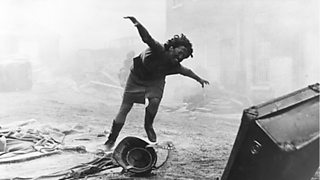
Lighting Fires: The Film and TV of Agnieszka Hollan is on at the BFI Southbank as part of the 14th KINOTEKA Polish Film Festival until Tuesday 19 April. Holland's HBO series Burning Bush is scheduled to appear later in the year on Channel 4 as part of its Walter Presents foreign language strand.
More from BBC Arts
![]()
Picasso’s ex-factor
Who are the six women who shaped his life and work?
![]()
Quiz: Picasso or pixel?
Can you separate the AI fakes from genuine paintings by Pablo Picasso?
![]()
Frida: Fiery, fierce and passionate
The extraordinary life of Mexican artist Frida Kahlo, in her own words
![]()
Proms 2023: The best bits
From Yuja Wang to Northern Soul, handpicked stand-out moments from this year's Proms