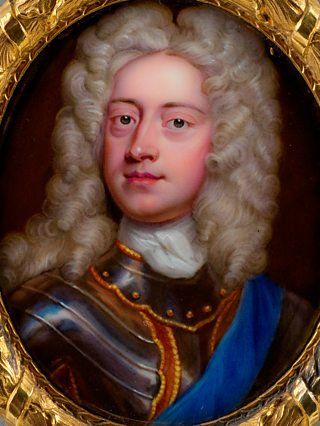
King George II
By Dr. Andrew Thompson, the series consultant and biographer of George II
A colleague once asked me whether there was anything worth knowing about George II, a figure who does not even feature in that immortal guide to British history 1066 and All That other than that he had died on the toilet?
George’s skills as a political operator were subtle but nevertheless impressive.Dr Andrew Thompson
George’s skills as a political operator were subtle but nevertheless impressive. Born, like his father, in Hanover, he had been brought up within a completely different political system. Through the foresight of his grandmother, the Electress Sophia, he had learnt English from a young age, so found it easier to communicate with his new subjects than his predecessor. Nevertheless, learning the cultural and political conventions of a new land was a demanding task. Like many migrants, George was determined to succeed.
The role which George inherited was that of a constitutional monarch. Given the famously unwritten nature of the British constitution, there was no manual for the new king to consult. Hence, he had to tread a careful path, finding out for himself what the limits of his power were. He quickly realised that grand building projects on the scale of some of his continental counterparts would not be possible. Finding out how much influence he could exert over the appointment of ministers was harder and involved a degree of trial and error but, generally, ministers and monarch avoided serious and protracted confrontation.
The 18th Century was one in which conflicts over monarchical succession occurred with alarming frequency. George I had defeated a Jacobite rebellion in 1715 and George II had to do the same in 1745. Despite this, George was able to fulfil the primary task of any king and pass on his realms securely to his heirs. His own longevity and his ability, with his wife, to produce children were key. A secure government and monarchy helped Britain to grow and prosper.
Although he was to be the last British monarch to take personal command of his troops on the battlefield, at Dettingen in 1743 his reign witnessed a continuing British engagement with continental politics and burgeoning activity outside Europe. Britain was now undoubtedly a global player. His, relatively peaceful, death in Kensington Palace was actually a mark of success.
Dr. Andrew Thompson is a consultant to the series The First Georgians: The German Kings Who Made Britain, and author of the biography George II: King and Elector
The moment George found he was to be King
The King is dead
Lucy describes the embarrassing moment when George II found out he was king.