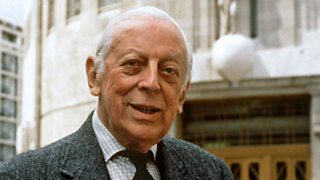
Jerome Murray, inventor (1912-1998) - 27 February 1998
During the past two months we've been caught bouncing on a see-saw of doubt – which of two pressing topics must we talk about?
Every weekend the Washington wiseacres told us that tomorrow, the next day, the United States and Britain would attack the chemical, biological or delivery sites of Iraq and every Sunday morning the best of the round-table talk shows would produce some former close adviser to President Clinton, who'd tell us that sooner or later the president would tell us at long last, exactly what was his special relationship with Miss Monica Lewinsky, who must by now be the most famous 24 year old in the world.
But the weekends come and go and no bombing, and no confession. Surely there must be other things happening, other things, people, to talk about, in all that time, and so there are. This time a life to applaud, two lives. One a man you've never heard of, yet to whom we all owe a daily debt of gratitude and another man, the gentlest and simplest and best of stand-up comics who died this week, at 91.
But before we come to these far more gripping, though perhaps less vital, matters, we'd better pay the passing tribute of a bow to the Secretary General Kofi Annan, President Clinton, Prime Minister Blair, Secretary Albright and a Russian and a Frenchman who warned Saddam at the last minute, that he could not specify a deadline for the inspection teams poking around. With a shrug, they say, Saddam consequently signed.
We now flash forward to the huge lobby of the United Nations headquarters overlooking the East River in New York. It's Tuesday morning and hundreds of the permanent staff of the United Nations are pressed together there, chatting and bubbling and smiling as for the arrival of a bride and bridegroom.
A shout from outside, a car swishes to the central entrance and in comes the slender, dapper, smiling Mr Kofi Annan, to waves of clappings and well dones. He did not have a piece of paper to hold high in response to the radiant audience, but for those who were there 59 years ago, the picture came painfully to mind of another smiling statesman, entering Parliament to a joyously cheering House, with only one voice spoiling the scene and the fun, with the tasteless remark, "we have sustained a total and unmitigated defeat".
The euphoria of the United Nations staff was at once rousing and pathetic in that it expressed, more than anything, a fervent hope that perhaps, after all these years, the United Nations can be a visible force for saving peace in a crisis.
I have to say there was no euphoria, no discernable smiles on the faces of the Americans who matter – the President, Secretary Albright, Secretary of Defense Cohen, Mr Richardson, the ambassador to the United Nations. Nobody could have been more wary, more, you might say, threatening, than Mr Clinton.
He alone, I think, pointed out that for seven years, a dozen or more similar solemn agreements had been cruelly flouted. If Saddam reneges this time, then, said the president, everyone would understand that the United States and all our allies would have the right to respond at a time, place and manner of our own choosing. Meanwhile the 35,000 American troops and the 365 battleships and planes will remain in the Gulf on the alert.
Mr Annan admitted there were details to be made clear. The leading Republican senator and some old diplomats called these details rather loopholes, to be plugged. Secretary Albright was worried about what she called ambiguities and before the week was out, two pervading anxieties came steaming up from the text of the so-called agreement.
What is the role and point of the special diplomats, commissioners, whom the Secretary General will appoint to go along with the inspection team and will it be the UN, the United States or Saddam who will interpret the potentially explosive clause which promises that the inspectors and the accompanying commissioners will at all times "respect the sovereignty, national security and dignity of Iraq".
Saddam could call almost any search into any palace or cellar undignified and the work of the inspectors themselves is a sure threat to national security. However, as the president says, the crisis is not over until the agreement has been tested and the test must come soon. Let us hope that if things are to go badly for this agreement, the anxious interval will not be as long as the year, restless with anxiety and false pride between Munich and the invasion of Poland.
Now, I promised a happy thing, a small tribute to a life we all have cause to be grateful. The name is Jerome Murray, born in New York City 85 years ago, who spent most of his life across the Hudson River in New Jersey where he pursued his ingenious hobby till the moment of his death a month ago.
The formal account of his life and career is very impressive but has no surprises. In the school years young Jerome's best education was performed by himself on himself. He was one of the first young men to get an aeronautical engineering degree from the already renowned Massachusetts Institute of Technology, a test pilot throughout the Second World War and soon afterwards made a notable contribution to medicine with the invention of a pump, the Murray pump, the first of its kind that could pump blood in steady wave-like motions without damage to the cells, a true breakthrough for open heart surgery.
But what's so ingenious about this eminent career in well-known fields, his hobby. From the age of 15 he noticed some of the petty but chronic annoyances of daily life and, unlike us, he was moved to do something about them. In the middle, late, 1920s, many thousands of farmers across this vast continental farmland, did not have electricity.
At 15 he invented a compact and inexpensive windmill to power the radio sets of these deprived farmers. A little later on, when Americans were discovering the superior flavour of vegetables – still true – done in a pressure cooker, there was one snag that nobody seemed to have thought of. The whistle that tells you when they're done exactly right, a small thing, but his own.
He went on from there to notice how raggedly all but the most skilful pair of hands carved the great cuts of meat. He invented, bless him, the electric carving knife. And when television came in and every other little house had an antenna, Jerome Murray invented the TV antenna rotator which saved you crawling on the roof to improve the picture.
After an uncomfortable visit to his dentist, he invented the gently-hissing high-speed dental drill, that has made those periodic ordeals no ordeal at all, except to what we used to call the very high strung and what my dentist mow calls the mild paranoiacs.
And when I think of flying in the 1940s and '50s, the tottering down rope ladders, the bundling across the tarmac into a knifing Arctic wind, the climbing up flights of stairs and finally being wafted into the warmth of the airport, I bless Jerome Murray most, for the invention of the covered walkway between the airplane entrance door and the terminal itself.
Even so, I'm sorry to say Mr Murray died too soon. Thanks to such a man we have at last got stamps and envelopes you don't have to lick but while we boast of settling colonies of humans on the moon and other planets, will somebody tell me why airplanes still have to land at 150 miles an hour, on bouncing, burning circles of rubber?
There's another life just over, a long and happy one that for five or six decades was the cause of happiness in others. Henry, Henny, Youngman, known rather grandiosely as the King of the One Liners, which gives a false image of a fast-talking rat-a-tat Broadway comedian.
Youngman was, on the contrary tall, gentle, courtly, soft-spoken, more like an ambassador than a three-a-day vaudevillian. His early days followed the well-worn path of an immigrant Jewish family, an immigrant from Russia through London into a Brooklyn tenement.
For some reason, young Henny, like many men who actually look distinguished, didn't like his looks. "I was so ugly when I was born," he said, "the doctor slapped my mother." A broken round of odd jobs, till he met a comedian he admired, spent all his time in the vaudeville and burlesque houses and decided that was for him.
The distinguishing thing about Henny Youngman was his fashion for simplicity and brevity. He spent most of his life off-stage bemoaning the inability of stand-up comics to tell a joke in a sentence or two. A raconteur who took three minutes was a bumbler. A joke, he said, is a cartoon, it must give you at once a picture. "A man stops a man and says, 'Can you tell me how to get to Central Park?' 'No, I'm sorry.' 'That's all right,' says the first man, 'I'll mug you here'."
Every comedian has his target and for Henny Youngman it was his wife of 58 years, a quiet, almost anonymous woman. He stumbled on his favourite line, what he called the ideal story, one night when he faced an audience and was about to tell a story about his wife and he began, "Now, take my wife. Please."
He called it the ideal story and from then he was able to enlarge the idea and the surprise. "A man comes on, 'How's your wife?' 'Compared to what?' " And, being congratulated on the length and happiness of his marriage. "Yes," he sighed proudly, "I take her everywhere and she always finds her way home."
You can't run these things together without leaving the impression of a gag man, but he filtered the jokes into a quiet, running account of passages in his life. The best story, he said, takes no more than 25 seconds. A warning to all comics and after-dinner speakers.
THIS TRANSCRIPT WAS TYPED FROM A RECORDING OF THE ORIGINAL BBC BROADCAST (© BBC) AND NOT COPIED FROM AN ORIGINAL SCRIPT. BECAUSE OF THE RISK OF MISHEARING, THE BBC CANNOT VOUCH FOR ITS COMPLETE ACCURACY.
Letter from America audio recordings of broadcasts ©BBC. Letter from America scripts © Cooke Americas, RLLP. All rights reserved.
![]()
Jerome Murray, inventor (1912-1998)
Listen to the programme