Professor Green reveals 7 tips for budding documentary makers

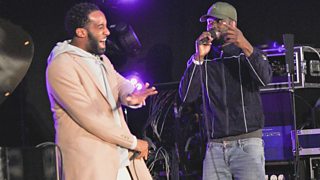
Charlie Sloth hosted a Q&A with Professor Green at the Radio 1 Academy in Hull, where the rapper and documentary maker had plenty of brilliant advice for aspiring programme makers.
1. What gave you the confidence to go from making music to making documentaries?
"With Suicide and Me, although it was a documentary and there were parts of it which I had to present, because it was my story it wasn’t like me jumping into the world of journalism with both feet. The second programme Hidden and Homeless was my first real step into becoming a documentarian I suppose, and I guess it was just a progression with each one.
But I’m not going to lie - when I was doing the homelessness documentary I was scared because I was like… “How can I hold this programme? It’s not my job, I’m a rapper.” I never even know how to pronounce my ’t's and ‘h’s and I’ve got this pressure on me to speak properly when I’m doing a documentary. It’s why I don’t watch myself back."
2. Are there any parallels with making music? Is it as simple as storytelling?

Professor Green - Glastonbury highlights
Highlights of Professor Green's Pyramid stage set at Glastonbury 2013.
"No because it’s someone else’s story, and the funny thing is, I’m shy. As inquisitive as I am in life, I don’t really like prying in other people’s lives, so it’s a difficult thing for me to have to do at times when I know I have to ask the hard question.
They’re two completely different things. I’m still a work in progress when it comes to making documentaries.
As much as I enjoy making documentaries, it’s me spending time in other people’s lives, it’s not me concentrating on my own - which is why I’m going to take a little break from documentaries and get back into the music. That’s my release, I need it."
3. What made you want to make your BBC 3 documentary Professor Green: Suicide and Me?
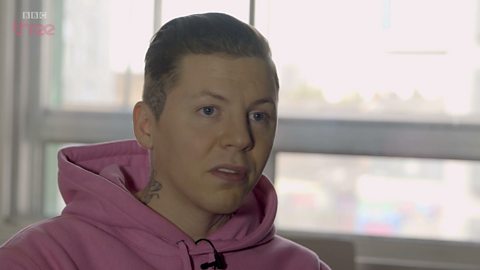
The Three Brief: Professor Green
Professor Green opens up about his father's suicide and his own battles with depression.
"Do you know what, Radio 1 kicked that off in a sense. They asked me if I’d do a documentary on Radio 1 Stories called Suicide Survivors.
The response was quite bittersweet, because it’s not necessarily something you can enjoy the success of. On one hand you’ve got all of these people saying they’re so grateful to hear someone in my position speak out about it. But on the other, the only reason so many people identified was because they were suffering.
Then I was approached about doing a TV documentary on male suicide. It wasn’t meant to be my story, but that’s what it became. Having been aware of the response to the first documentary, and how important it was to use my voice for something other than just my own benefit, when I was asked I said yes. I kind of blindly walked into it."
4. You’ve never shied away from talking about tough issues and things that have affected you personally. How do you deal with it?
"Making Suicide and Me was one of the hardest things that I’ve ever done because of what it brought to the surface. My Dad had taken his own life years ago and as far as I was aware I’d dealt with it, but…
I still haven’t watched it, I can’t man. I think if I have children I would watch it."
5. From your music to your documentaries to Lip Sync Battle, how do you find that balance between light and dark?
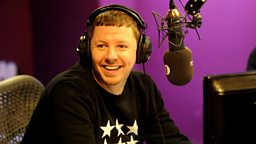
"Probably by making light of the dark in some instances, that’s definitely what I’ve done in my music. I may have got that through Biggie (The Notorious B.I.G) or just from being British. That’s what we’re best known for, our dark sense of humour.
I don’t know, I’ve never thought about it - but maybe that plays a part in it. Not over thinking it. Just being myself."
6. What advice would you give anyone trying to get into the world of documentaries?
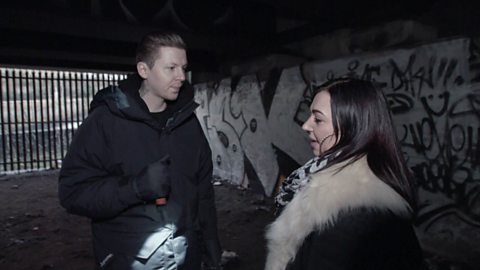
"Everyone's got a breaking point"
Kirsty takes Professor Green to a site underneath a carpark where she used to sleep rough.
"Be human. I think one of the most important parts about making programmes like that is being able to empathise.
Walk into situations with an open mind, and just listen. It’s really easy to have a set of questions but the best stuff that I’ve got has just come from having conversations.
You’ve got to be decent, it’s a privilege really. The amount people have trusted me with is incredible and I think that just comes from not throwing people under the bus."
7. You’ve got two documentaries dropping this year on the BBC, one on cannabis and one on child poverty. What can you tell us about those?
"The child poverty one is heartbreaking. I think people are going to be shocked and upset by what they see.
Then the cannabis documentary, people think it’s just going to be me smoking weed having a giggle, but that’s going to surprise people in a different way.
We discuss whether we should legalise it and what the positives and negatives are. And there are negatives, they’re plentiful. It’s not as straightforward as people might think."
What's New At The Academy?
![]()
Ali Plumb's Guide to Becoming a Film Critic
Love watching films but hate the idea of being in front of the camera? Grimmy looks at other ways you can get involved in TV and Movies
![]()
Radio 1's Piano Sessions at the Radio 1 Academy
Huw Stephens and Greg James host a series of very special Piano Session gigs
![]()
Get Paid For Your Social Media Skills
Turn your posts into pounds with advice from some of the biggest profiles in the world