Back from the Arctic
I had almost forgotten that the moon existed. On our last night on the ship, the clouds finally lifted, the sky was just dark enough, and there it was, our rocky travelling companion on our journey round the sun.
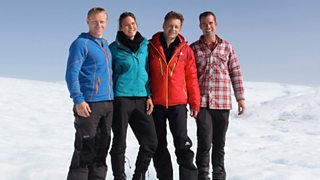
Four presenters: Andy, Helen, Chris and Chris.
I hadn’t thought about it at all during the six weeks of continuous daylight, and it was weird to see that it was still there.
The past six weeks have been fascinating, hard work, sometimes frustrating, always an enormous privilege. We all know that glaciers and icebergs exist, and that they operate on a much slower timescale than our own, but it was truly special to spend long enough with them to glimpse and feel their rhythm. I’m back in the UK now, in the thick of a busy lifestyle, but up there in the north, these vast mountains of frozen water are still slowly shifting, creaking and rumbling along in the peace and quiet of the Arctic. The polar bears are probably still snoozing on the cliffs, occasionally distracted by something moving out at sea but mostly just waiting for the return of the sea ice. I’m going to print out a large copy of one of the pictures of those ice cliffs for my office, and when the to-do list starts to snarl I’ll be able to look up and remember the peace of the ice.
We had a fantastic team of people, and I miss them already after spending six continuous weeks in their company. The people you’ll see on screen are only some of those who were there – we had two cameramen, two sound recordists, an editor, people doing rope, dive and more general safety, as well as the production team and camp helpers. Don’t forget about them when you watch the programme!
The whole experience also reminded me how fragile an environment the Arctic is. We have all read the statistics on sea ice retreat and the changing state of our glaciers, but it all means something more to me now that I’ve seen that region for myself. It’s a huge part of our planet, mostly uninhabited by humans, but that will change as the North West Passage becomes a normal freight route and as the ice barrier to the Arctic ocean melts away. If we don’t protect it, the rapid changes in the north will have a significant effect on humans further south (especially those who live on the coast), as well as on the Arctic ecosystem itself.
Operation Iceberg was a fantastic adventure for all of us who took part. Genuine scientific progress came from the work we supported while we were there, and I think it’s very important that the programmes will show the process of science, with all its drama and creativity laid bare. Most of all, I hope that these shows give the audience a feel for this one part of how our planet works. We should all have an idea about what makes a planet tick – what could be more important than understanding your life support system? Ice is one of the five great components of the Earth system, along with the atmosphere, the oceans, the biosphere and our geology. It’s amazing stuff. I’ve loved exploring the ice, and I hope that you enjoy sharing the experience of our journey.

