BBC Fresh Profile: George Haydock, Alex Mannion-Jones and Matthew Rowlands
Film-makers George Haydock, Matthew Rowlands and Alex Mannion-Jones talk about what inspired their film Concrete Sleep.
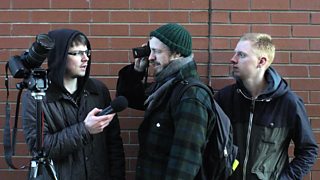
The Concrete Sleep Crew
Concrete Sleep began as a project at university and offers a haunting reflection on the relationship between the inner and outer lives of the film's subjects.
Why did you pick this subject for Fresh?
Alex, Matthew, George: We all feel that this is the best project we've all created so far, and the one we're most proud of – so we've put a lot of energy in promoting it.
George: BBC Fresh seemed like an amazing platform – the outline of what Fresh aimed to do rang in my ears when I read it – I knew that I had to enter Concrete Sleep.
Matthew: Fresh presented an opportunity to promote the film to a different audience outside of the spheres we'd been promoting it within. We also recognised that fresh was something new, an exciting approach to supporting new filmmakers and it’s great to be a part of it.
What motivated you to make this film?
Matthew: The motivation for making ‘Concrete Sleep’ started as a University Assignment. The course we were all attending was very much directed at producing TV friendly type content, which is fine, but it felt a little stifling. We wanted to experiment and seek other approaches reflecting our interests at the time.
George: We wanted to really use the opportunities you have as a student (advice, free time and a lot of resources) to really experiment and try to make something a little unique. The main idea behind the film was to merge two opposing themes ‘Cities’ and ‘Dreams’ and develop an interesting way in which to do that.
Alex: Ultimately, we wanted to create a film that would blend aspects of documentary and fiction production. A practice based in documentary research that maintained the aesthetics of a fiction film.
What camera did you use to shoot your film?
Mathew: We used two cameras, A Canon 7D and a Canon 5D. The 5D’s full frame sensor is far superior to the 7D’s cropped sensor. It has a better image quality but also performs better in darker environments; it was this capability in low light performance that was the biggest factor. Our budget and locations meant we were always working with natural light. The 5D gave us the freedom to work in the manner we did.
We had a great selection of lenses. The workhorse lens was the Canon 17 - 55mm F2.8. It’s an incredibly versatile lens, particularly as it features a stabiliser and a nice constant F Stop of 2.8. We also managed to source a Canon 50mm F1.2, which was a joy to work with, if not a little tricky to focus using the tiny DSLR screens. For our wide shots we used the Sigma 10 - 20mm F3.5 EX.
Who/what inspires you?
Alex: Inspiration, for me, comes from everyday encounters, literature, travel, the elderly, my contemporaries and established filmmakers - Herzog has been a long standing favourite of mine and I love the playfulness of Gondry.
George: In documentary form I’m a huge Jon Ronson and Nick Broomfield fan. Regarding cinema, I’d say Kubrick, Fellini and Bergman are my top 3. Most recently Shane Carruth’s ‘Upstream Color’ – I love his whole approach to filmmaking, very involved and personal. He acted in, wrote, directed, shot, edited, created sound, and composed the music! Apparently on set he was very particular - and I think it shows.
Matthew: The cinematography and pace of ‘Samsara’ blew us all away. We were also following various online film communities – one film in particular was A short directed by Emily Kai Bock entitled: 'Spit Gold Under The Empire' - it really got us excited about developing our aesthetic approach during Pre - Production.
George: On a personal level, seeing wonder in the everyday inspires me! Everything and everyone is fascinating – and I think film is the perfect tool to show this.
Matthew: I was excited to introduce themes I had explored through my Fine Art degree - I'd been exploring the relationships between people and place - the city conglomerate - the countryside.
What are your plans for the future?
Alex: I plan to continue producing films. My next work, a short drama (which like Concrete Sleep is also based on interview transcripts) that was shot in Baja California, over the summer, is currently in postproduction.
Matthew: Having returned from Filming in Mexico with Alex, Myself and George have registered a Production Company weareinvite / Invite LTD, we intend to use the income from this commercial venture to continue in the pursuit of making the films we want to make.
I’ve also been working alongside George on his current film. I’m happy behind the camera at the moment and recently I’ve been applying myself towards a DOP role, but we’ll see. Film/ Cinema, it’s such a vast medium. I feel incredibly fortunate to have the like-minded friends and resources to explore it with.
George: As mentioned, I’ve started a production company with Matt. We’re young and don’t have much to lose!
I’m currently directing a documentary film about a confusing piece of land – Pomona Island – a huge derelict space between Manchester and Salford which has been left to it’s own devices since 1973. I'm exploring how urban nature exists and thrives within the ebb and flow or urban development in cities. It should be out at festivals in 2014!
What is the most important thing you have learned so far?
Alex: That comradeship, communication and chance can be just as effective as large budgets, in the production of short film projects.
Matthew: Learning to shoot to edit is a must, the more I learn about editing, the more I learn to cover my back when shooting or Directing. That way, when it comes to post, you're not banging your head in frustration about continuity or coverage. More generally I'd say preparation but also the ability to be flexible as a filmmaker. Surround yourself with quick thinkers!
George: Just to have the courage to try out new styles, to go against the norm, to break conventions – I think by doing this you keep things fresh! But the balancing act is to not do that as a rogue - always take advice and constantly self-reflect. Another crucial thing I’ve learned is to take a real initiative, ignore naysayers, be positive and ambitious!
Related links
![]()
Concrete Sleep
A diverse mix of characters contemplate dreams and the city in the haunting Concrete Sleep.
![]()
Hijabi Girls by Nada Abdulla
Nada Abdulla’s film profiles Muslim fashion designer Barjis Chohan.
![]()
Above All Heights by James Barnes
Young mountain biker Ben Carter features in James Barnes' action-packed film.
![]()
Sequences: what are they?
Fran Baker and Zoe Callan talk about the importance of documentary sequences.