Hinduism - Rama and Sita
Themes: The festival of Diwali; the story of Rama and Sita; light vs dark, good vs evil; good deeds shining like lights in the darkness.
Summary: This assembly is suitable as an act of collective worship. Your assembly space will need to be as dark as possible, before using candles to create a very special atmosphere.
Resources: Candles - or use the gallery of diva lights. The candles/gallery will also be needed during the reflection as a visual focus.
Key links
![]()
Assembly framework (pdf)
Print out the assembly framework ready for use
![]()
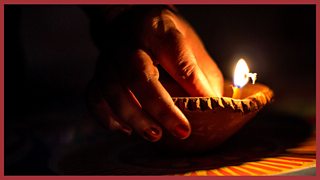
Gallery of diva lights
Click to display a gallery of six images of diva lights
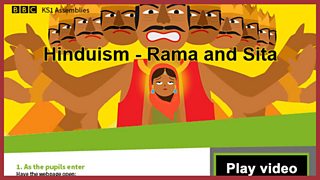
The video:
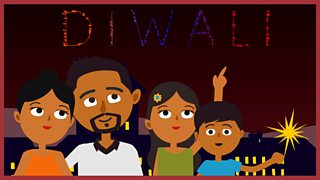
...more lamps than stars in the sky!
Ravi and his family are Hindus. On the way to school. Aunty Sheema tells Ravi the story of Rama and Sita to explain why Diwali is an important Hindu festival. She then tells the story. Rama and Sita are married but one day the demon king, Ravanna, kidnaps Sita and takes her to his palace. Rama searches for her with the help of the Monkey King, Hanuman. They find her on Ravana's island and a great battle begins, with the demon finally defeated by Rama's magic arrow. People light small lamps - called divas - in their windows to help light the couple's journey home.
Duration: 4' 53"
End of speech: '...Ravi hurried into school, excited to tell his friends the story of Rama and Sita'.
Story questions
What religion do Ravi and his family follow?
They are a Hindu family living in Leicester - they follow the Hindu religion
What story does Aunty Sheema tell Ravi?
The story of Rama and Sita
What is the name of the demon king and how many arms / heads does he have?
The demon king is Ravana - he has 20 arms and 10 heads!
How does Ravana trick Sita?
Ravana appears in disguise as a wounded deer. Rama follows the wounded deer, having first placed Sita inside a magic circle. Ravana then returns to Sita in the guise of a thirsty beggar. Sita steps outside the circle to help the beggar and when she does Ravana returns to his normal form and kidnaps Sita.
How does Rama defeat Ravana?
Rama makes friends with Hanuman, the monkey king. Hanuman flies over the land until he finds Sita imprisoned on Ravana's island of Lanka. The monkeys make a bridge to Lanka of themselves and a ten-day battle begins. Rama finally defeats Ravana by shooting him with a magic arrow.
Why do the people place oil lamps in their windows?
To help Rama and Sita by lighting their journey home
Suggested framework
| Content | Guidance |
|---|---|
| 1. Entry music | Atmospheric Indian music - for example music played on the sitar. |
| 2. Introduction | Make your assembly space as dark as possible, then light as many LED candles as you can - or real if you're allowed - and place them at the front of the hall. You're aiming for a 'Wow!' moment as children enter. In addition to the candles - or instead of them - you can display the images of diva lights from the gallery (see 'Key links' above). Ask the children to see how many different sorts of lights they can spot as they watch the video. |
| 3. The video | Play the video. The duration is 4' 53". It ends with the words '...Ravi hurried into school, excited to tell his friends the story of Rama and Sita'. |
| 4. After the video | Use the story questions to consolidate the children's recall of the events: 1. What religion do Ravi and his family follow? 2. What story does Aunty Sheema tell? 3. What is the name of the demon king? 4. How does Ravana trick Sita? 5. How does Rama defeat Ravana? 6. Why do the people place oil lamps in their windows? |
| 5. Time to talk | Gather ideas about the different lights that were present in the video [in windows, sparkler, fireworks, the magic circle, oil lamps, stars, sun and moon, the magic arrow - you could also include Rama and Sita glowing!] Talk about why light and dark are an important part of the celebration of Diwali - and think about how our lives can often feel 'light' or 'dark'. What do the children think we can learn from the story. There may be opportunities to link the story to RE back in class. |
| 6. Opportunity to sing | An opportunity to sing your chosen song. Suggestions from BBC collections below. |
| 7. Opportunity for reflection | 'We've been thinking today about the Hindu story of Diwali... How it's a celebration of Rama and Sita... Of good triumphing over evil... And light over darkness... The good deeds that people do in our world shine out like lights in the darkness... What good deed might you do today that will shine out of the darkness..?' |
| 8. Opportunity for prayer | 'As you look again at the candles, think about what good deed that might be. Use the stillness to ask God to help you if you'd like to...' |
Suggested songs
| Song | Collection | Significant words |
|---|---|---|
| 'Let's sing and dance' | Come and Praise: Beginning, no 58 | 'Let's sing and dance for it's festival time' |
| 'There's a light' | Come and Praise: Beginning, no 49 | 'There's a light that's shining / A flame that's flickering / Making the world seem warm and bright' |