Is Carmen the most powerful (and empowered) heroine in opera?
She's one of the most famous femme fatales on the Western stage: a beautiful, impulsive gypsy who bewitches every man she comes across, and whose songs remain as captivating now as they were 140 years ago. Yet Carmen's story is not one of love, but of lust, betrayal and murder.
Audiences at the 1875 premiere of Bizet's opera reacted with a mixture of shock, horror, and guilty delight – emotions that still ring true today. So why does the figure of Carmen continue to both inspire and provoke such strong reactions?
Warning: contains spoilers
She’s a fighter
Carmen is not only a poor woman in a rich man’s world, but a gypsy – one of the most marginalised groups of any society, in any era.

Yet seemingly oblivious of the poor hand that life has dealt her, she’s also a confident, powerful and resourceful hustler who not only works for a living in the local cigarette factory, but smokes its products.
She rejects society’s norms
It’s hard to overstate how impactful Carmen’s smoking would have been at the time of the opera’s premiere. Cigarette smoking in the late 19th century was widespread, but mostly among men; for females, it was a habit almost exclusively associated in the public eye with “loose” or “fallen” women.
So when Célestine Galli-Marié – the singer who first played Carmen – smoked a cigarette on stage in 1875, she may as well have been announcing her character’s sideline in prostitution. No wonder audiences were shocked: one critic, Léon Escudier, described the performance as “a very incarnation of vice”.
She’s confident in her sexual identity
Being “ladylike” is the very least of Carmen’s concerns. She’s so secure in her sexuality that it makes other people actively uncomfortable. Not only does she smoke but she drinks, dances provocatively and – gasp! – shames men by flirting with them in public.
Unlike the girlish, naive Micaëla (whose childhood sweetheart, Don José, Carmen steals), Carmen is entirely aware of the power of her sexuality. As the opera unfolds, we see her use it again and again as a bargaining chip in a game where the odds are already stacked against her. Even more shockingly, she’s seen to enioy herself, too.

She simply doesn’t care what other people think
Carmen is prepared to deploy her sexuality as a weapon against the men who seek to control her. As far as she’s concerned, love, like her, is “a rebellious bird that no-one can tame”. And what’s more – she doesn’t care a fig for what anyone thinks of her choices.
When she’s in full-on seduction mode, her only serious rival for our attention is Bizet’s incredible music, which reflects all the colour, passion, exuberance, voodoo and darkness of the story. There simply isn’t a dud bar of music in the entire opera.
She’s a feminist icon (maybe)
It’s hard to say how feminist an opera can really be when its heroine is brutally murdered at the finale. But it’s clear why both singers and directors might be drawn to cast Carmen in a light of female empowerment.
In Richard Eyre’s production, for example – set in the Spanish Civil War and broadcast live from New York’s Metropolitan Opera on Radio 3 – you can almost see Carmen as a leading member of Mujeres Libres (Free Women). This was a 30,000-strong anarchist organisation that aimed to empower and liberate working class women in 1930s Spain.
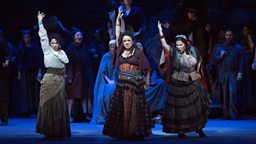
Having said that, Carmen’s relationship with the sisterhood is tenuous at best. Not only does she pinch Micaëla’s sweetheart, but she also gets into a brawl with one of her fellow workers in the opera’s very first act.
These actions suggest that she’s not so much for women’s lib as woman’s (singular) lib. Carmen is looking after number one.
She defies stereotypes of female sexual propriety
Whether or not you approve of her tactics, there’s no doubt that Carmen’s calculated seductions defy pretty much every cliché of feminine chastity and loyalty in the book.
It’s a recurring theme. After Don José gets out of prison (the same prison that Carmen got him into), she somehow contrives to goad him into a jealous fight with his own boss. Even after Don José is effectively forced into a life of crime for love of her, she still leaves him for the next pair of trousers to walk onto the stage – the handsome bullfighter Escamillo.
Because that’s what she wants.
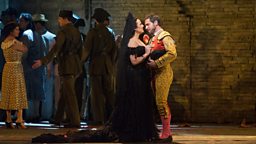
She knows that nice girls finish last
Meanwhile, the faithful, dutiful Micaëla does everything “right” and STILL ends up losing the man she loves: first to Carmen, then to prison, then to a life of crime – and ultimately, we must assume, to the hangman’s noose.
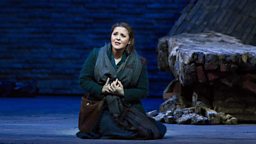
If you’ve seen the opera’s ending, you’ll know that in the world of Carmen, being a “bad girl” is punishable by death – but “good girls” lose, too.
She’s born free and she’ll die free
After she rejects him for the last time, Carmen is stabbed to death by the vengeful Don José – but only after informing him that she was born free, and will die free.
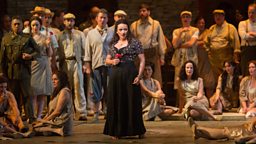
So is Carmen's tragic end a simple Victorian morality tale, designed to teach women a lesson about the natural consequences of “unnatural” behaviour?
Or is Bizet’s feisty, independent, life-loving, patriarchy-defying heroine simply too dangerous to be allowed to live?
You decide. Listen to Bizet's Carmen, live from the Met, via the Radio 3 website or on iPlayer Radio for 30 days.
![]()
Carmen, live from the Met
Listen to Georges Bizet's opera in full on the Radio 3 website.
![]()
Marschner's Der Vampyr
The original Grand Gothic opera: expect dramatic screams from the off.
![]()
The woman who loved too much
The story of Puccini's Madama Butterfly told in eight beautiful images.
![]()
Six ways you learned about Wagner's Ring Cycle without even noticing
From poetry to film via fantasy box sets, these four operas have left an indelible mark on Western culture.