Seven key works from the Golden Age of American art
21 February 2023
In Big Sky, Big Dreams, Big Art, critic and presenter Waldemar Januszczak takes on the major themes and stories of American art's Golden Age. Here he selects seven visual highlights from his exploration of the Wild West, the Great Metropolis and the American Small Town.
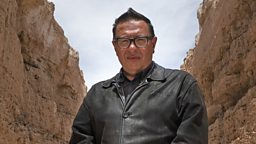
When cultures are young, they express themselves with a fierceness that later fades. And that is what this series is about - the Golden Age of American art.
We look at the undervalued artists who made American art great. The experimenters. The pioneers. The paint-slingers.
The end point of the series is Abstract Expressionism – the first purely American art movement. But to get to that independent art moment, American art needed to try out all kinds of styles and digressions. It’s like shopping for shoes. You need to try on a lot before you find the perfect pair!
Many of these early moments have been forgotten or ignored. But not in this series. In this series we look back generously at some of the undervalued artists who made American art great. The experimenters. The pioneers. The paint-slingers.
There’s another twist, too. The three films are split into three different American territories. As DH Lawrence observed while travelling across America, ‘the spirit of place’ always seeps into the art that is made there.
So in this series we look at The Wild West, The Great Metropolis and The American Small Town. Each one of these quintessential American locations contributed something crucial to the story of American art, and gets a film to itself.
Here are some of the things you will see in the series.
Big Sky, Big Art, Big Dreams
![]()
Made in the USA
A history of American art with Waldemar Januszczak.


Thomas Moran - The Chasm of the Colorado (1873-4)
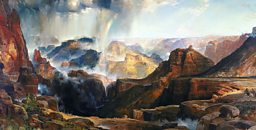
Thomas Moran - The Chasm of the Colorado (1873-4) | Smithsonian American Art Museum
Moran was from Bolton in Lancashire. His father took him to America in 1844, and he became the greatest landscape painter of the Wild West. This extraordinary view of the Grand Canyon was painted in 1874.
Jackson Pollock - Portrait and a Dream (1953)
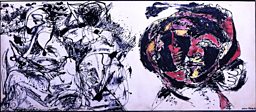
View of Jackson Pollock - Portrait and a Dream (1953) taken at Jackson Pollock: Blind Spots, Tate Liverpool, 2015 | Paul Ellis / AFP / Getty Images
Pollock was from Wyoming. He became famous for his dripped abstractions – Jack the Dripper they called him. But his pictures always started with a recognisable image that he would cover up with drips and splatters. Underneath, the image is still there…
Edward Hopper - Night Windows (1928)
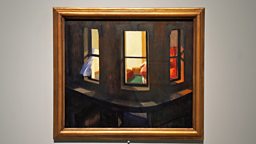
Edward Hopper - Night Windows (1928) as seen in the second episode of the series.
Hopper worked as an illustrator in New York. He would travel to work on the El – the elevated railway that ran up and down Manhattan. And as he travelled, he would stare voyeuristically into the passing windows.
Thomas Wilfred - Study in Depth, Op.152 (1959)
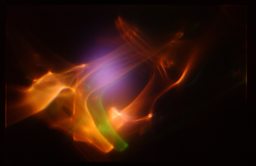
Thomas Wilfred - Study in Depth, Op.152 (1959) | Photography by Lee Stalsworth, Hirshhorn Museum and Sculpture Garden, Smithsonian Institution
Completely forgotten today, Thomas Wilfred began experimenting with art made of coloured lights in 1919! He built his own light-machines, and was crazily ahead of his times.
Jerry Bywaters - Sharecropper (1937)
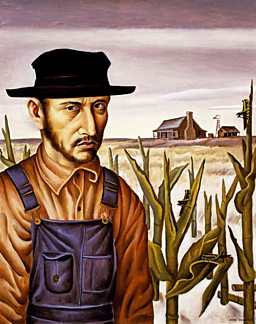
Jerry Bywaters - Sharecropper (1937) | Bridgeman Images
The Great Depression hit America at the same time as the Dust Bowl. Yet this terrible double whammy inspired some remarkable art. Bywaters was from Texas. This haunting portrait of a Sharecropper captures perfectly the grim determination of the Dust Bowl farmer.
Grant Wood - Shriners’ Quartet (1933)
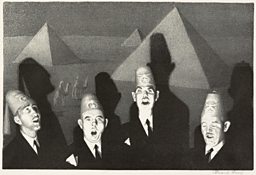
Grant Wood – Shriners’ Quartet (1933) | Bridgeman Images
Grant Wood is best known for American Gothic – his famous portrait of two gnarled farmers standing in front of their house. But he was an extremely versatile artist, and in his prints he spookily explores the mysteries of Small Town America.
(The Shriners are an offshoot of Freemasons established in 1870; its members are recognisable for wearing red fezzes and participating in civic parades driving miniature, motorized vehicles.)
David Smith - Hudson River Landscape (1951)
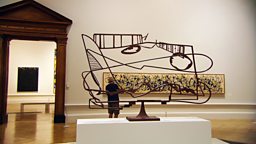
David Smith - Hudson River Landscape (1951) as seen in the third episode of the series.
Smith learnt his welding skills working in a factory making cars and trains. But he later turned those skills to art, and did it brilliantly. In this remarkably ambitious sculpture, he has set out to weld a landscape out of steel!
More from BBC Arts
![]()
Picasso’s ex-factor
Who are the six women who shaped his life and work?
![]()
Quiz: Picasso or pixel?
Can you separate the AI fakes from genuine paintings by Pablo Picasso?
![]()
Frida: Fiery, fierce and passionate
The extraordinary life of Mexican artist Frida Kahlo, in her own words
![]()
Proms 2023: The best bits
From Yuja Wang to Northern Soul, handpicked stand-out moments from this year's Proms