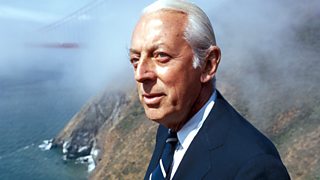
Fred Astaire
Movie stars don't make it, nor statesmen, not prime ministers or dictators – unless they die in office – not even a world famous rock star, unless he's assassinated. But last Monday, none of the three national television networks hesitated about the story that would lead the evening news.
On millions of little screens in this country and I don't doubt in many other countries around the world, the first shots were of an imp, a graceful wraith, a firefly in impeccable white tie and tails and, for much longer than the lead story usually runs, for a full five minutes on NBC, we were given a loving retrospective of the dead man, ending with the firm declaration by Nureyev that he was not just the best ballroom dancer or tap dancer, he was simply the greatest, most imaginative dancer of our time.
And the newsmen were right, I think, to remind us of the immortal comment of the Hollywood mogul who, with the no-nonsense directness of an expert, reported on Fred Astaire's film test, 'Has enormous ears, can't act, can't sing, dances a little'.
Well, that Hollywood mogul, long gone, spent his life ducking round corners to avoid being identified as the oaf who looked in the sky and never saw the brightest star. However that expert opinion was, as the lawyers say, controlling at the time and in Astaire's first movies there was no thought of allowing him to act or sing. But not for long. And thanks to the invention of television and the need to fill vast stretches of the afternoon and night with old movies, it has been possible for my daughter, for instance, to claim Fred Astaire as her favourite film star from the evidence of all the movies he made three years, five, ten, fifteen years before she was born.
When I got the news on Monday evening here and realised, with immediate professional satisfaction, that the BBC had smartly on hand a musical obituary tribute to him I put together eight years ago, I couldn't help recalling the casual, comic way this and similar radio obituaries came about.
I was in London at the end of 1979 and Richard Rogers, one of the two or three greatest of American songwriters, had just died, I believe on New Year's Eve or the night before. Britons, by that time, were getting accustomed without pain to making what used to be a two-day Christmas holiday into a ten-day much needed rest and for all laborious research purposes, the BBC was shut up and there was no retrospective programme on the life and music of Richard Rogers in the BBC's archives.
Of course, in a gramophone library that looks like an annexe to the Pentagon, there were hundreds, perhaps thousands of recordings of his songs. The SOS went out to a writer, a producer, and I presume a man who had the key to the gramophone library. The silent place was unlocked and the three of them laboured through the day to put together an hour's tribute to Richard Rogers. It was done. It was competent enough, but rushed to an impossible deadline.
Well, this hasty improvisation happened just when my own music producer and I, who had come to enjoy working together for six years or so on American popular music, we were wondering what we could offer next. We'd done a sketch history of jazz through individuals. We'd gone through all the popular music of the Twenties, Thirties and Forties and were stumped for a new series, at which point I asked if we mightn't go and talk to the head of the channel network or whatever. We went in and the genial boss asked me what we had in mind. 'A morgue,' I said. 'A what?' 'Where,' I asked, 'is your morgue?' He was not familiar with the word, a newspaper term.
'Well,' I said, 'all newspapers have them.' 'How do you mean?' 'If,' I explained, 'Mrs Thatcher died tonight and you woke up and read a two-sentence obituary, you'd be rightly outraged. But if you saw a two-page obituary, you'd take it for granted. When do you suppose it was written?' 'Ah, that's right!' he said, thoughtfully.
What I was proposing was a morgue of the Americans eminent in popular music and jazz so they'd not get caught short again. 'A splendid idea,' the man said, 'pick your stars!' We made a list and were commissioned to return to America and finish all of them. Naturally, we looked at a calendar and birth dates. Hoagy Carmichael, Earl Hines, Harold Arlen, Ethel Merman, Stéphane Grappelli, Ella Fitzgerald. But then, in a spasm of panic, we thought of two giants, if the word can be used about two comparative midgets – Irving Berlin and Fred Astaire.
Berlin was then 91 and Fred Astaire was just crowding 80. The boss man, to whom the idea of a morgue had been only a few minutes before quaint, if not morbid, he wondered what we were waiting for. 'Get busy at once on Berlin and then on Astaire!'
I remember doing the Astaire obit then and there while I was still in London. Meanwhile, we'd simply pray every night that the Lord would keep Irving Berlin breathing until I could get home and get busy. I remember being picked up in a car by a charming girl to get to the BBC and record my Astaire narration – there wasn't a moment to lose – and she asked me in the car what the script was that I was clutching. 'It's an obituary,' I said, 'of Fred Astaire.' 'Fred Astaire?!' she shrieked, 'Dead?!' Almost swerved into a bus. 'Of course he's not dead,' I said, 'but he's going to be one day.'
She, too, was new to the institution of a morgue. I recalled that when I was a correspondent for a British paper in the United States and when, for example, Dean Acheson was appointed secretary of state, the first cable I had from my editor said, 'Welcome Acheson obituary soonest'. 'How ghoulish', she said.
Well, need I say that all the great ones, then in their sixties, have gone by now except Grappelli and Ella Fitzgerald and until this week, I'd come to assume that the last of these obituaries to be played would be the immortal Astaire and the immortal Berlin.
Well, now we are left with Irving Berlin. I should guess he will outlive all the others, this wispy, immigrant boy, sickly, weedy from birth, one of nine children of a rabbi who fled from a Russian pogrom to land in the slums of New York. This sliver of a youth, who always looked as if he wouldn't make it through his twenties, he will be 100 years old next May.
I imagine that for two generations at least, it's assumed that Fred Astaire, this slim, pop-eyed newcomer to Hollywood who couldn't act, couldn't sing, danced a little, only made a fool of the mogul through the movies he made with Ginger Rogers in the mid and late Thirties. But, long before then, from the mid-Twenties on, he was already an incomparable star as a dancer to theatre audiences, both in New York and in London – perhaps in London more than anywhere. Certainly in the 1920s with the early Gershwin hits, 'Funny Face' and 'Lady Be Good'. And lastly, in 1933 in Cole Porter's, 'Gay Divorce'. That was the title of the theatre show. Hollywood would not then allow so shocking a title and called the movie version, 'The Gay Divorcee'.
Of all the thousands of words that have been written this week and will be written, there's a passage I recalled and went back to on Tuesday night, which I think, as well as anything I know, sums up Astaire's overall appeal, the appeal that takes in but transcends one's admiration for his dancing and for his inimitably intimate singing style. This was written in November 1933 by a theatre critic who had so little feel for dancing that he marvelled why London should go on about Mr Astaire's doing well enough what the Tiller Girls at Blackpool do superbly.
The critic, the writer, was James Agate – the irascible, dogmatic, opinionated but brilliant journalist and, I believe, the best critic of acting we've had this century. He is writing his review of 'Gay Divorce' and after declaring, yet again, his contempt for musical comedy as an entertainment for idiots and deploring the pace, plot and the acting and hoping, Micawberishly for something to turn up: 'Presently', he wrote, 'Mr Fred Astaire obliged and there is really no more to be said, except a very distinguished colleague began his criticism of this show by asking what is Mr Astaire's secret. May I suggest that the solution hangs on a little word of three letters. Mr Astaire's secret is that of the late Rudolph Valentino and of Mr Maurice Chevalier. Sex, but sex so bejewelled and betwixt that the weaker vessels who fall for it can pretend that it isn't sex at all, but a sublimated projection of the little fellow with the knuckles in his eyes. You'd have thought by the look of the first night foyer that it was Mothering Thursday in London, since every woman in the place was urgent to take to her bosom this waif with the sad eyes and the twinkling feet.'
As for the unique quality of Astaire's dancing, something impossible to put into words, I think the near impossible has been achieved by an American critic of films and jazz, the late Otis Ferguson.
He wrote, in reviewing the movie, 'Top Hat', 'He has given the best visual expression that has been generally seen of what is called "the jazz" as a man who can create figures intricate, unpredictable, constantly varied and yet simple, seemingly effortless. Whenever the band gathers its brasses and rhythm section and begins to beat it out, he is unequalled anywhere with his soft-shoe sandman number.
'And when, before the line of men with top hats, he swings up the steps, Fred Astaire, whatever he may do, in whatever picture he's in, has the beat, the swing, the debonair and damn-your-eyes violence of rhythm, all the gay contradiction and irresponsibility of the best thing this country can contribute to musical history, which is the best American jazz.'
There is no more to say.
This transcript was typed from a recording of the original BBC broadcast (© BBC) and not copied from an original script. Because of the risk of mishearing, the BBC cannot vouch for its complete accuracy.
Letter from America audio recordings of broadcasts ©BBC
Letter from America scripts © Cooke Americas, RLLP. All rights reserved.
![]()
Fred Astaire
Listen to the programme