Naomi the Penguin Keeper
How did you become a Penguin Keeper?
I love how individual their characters are.Naomi Bird
After school I worked in a mixture of customer service and administration roles, which paid the bills, but weren’t fulfilling my lifelong passion for nature and animals. After going backpacking in Australasia and South East Asia, my mind was made up that I wanted to pursue animal care as a career. When I got home I started a degree in Animal Biology. In my third year, I was volunteering at the National Sea Life Centre at the weekends, so when a full-time aquarist position came up I applied, and fortunately I got the job!
Tell us about a typical day in the life of a Penguin Keeper.
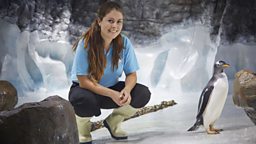
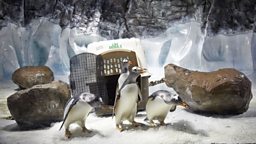
The first part of the day is getting their breakfast ready at 8am, which involves defrosting herring and enriching them with vitamins so the birds all stay in peak health. I feed the birds twice during the morning and in-between clean the enclosure thoroughly. The penguins love to follow us around while we cleaning, particularly a cheeky young female called Rocky, who is very fond of grabbing the scrubbing brush and trying to run off with it! I regularly check up on the penguins throughout the day and feed them again in the afternoon. While we are feeding them we get a good close-up look at each penguin to check their health. At around 4pm, I hose down their sleeping area and put out a layer of ice for them to sleep on or play with. Once the penguins are settled down for the night I fill in records and behaviour diaries.
What is it about penguins that you love so much?
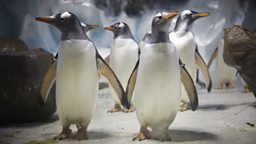
I love how individual their characters are. Although they looked very similar at first, as I have spent more time with them I have learned how different they all are. The three youngest are only two, so they are often the funniest to watch. One of the two year old females, Grub, is notorious for attempting to peck everything and is sometimes sent to the ‘naughty corner’ by the leader, Cecil when she gets a little carried away. Our youngest male, Buzz has also taken a liking to two of the young females including Grub, and can often be seen bowing to both of them at the same time!
Have you ever seen penguins in the wild?
I have seen little penguins in the wild on a trip to New Zealand. I was swimming with Hector’s dolphins off the coast of Akaroa in the south island, which are a small dolphin species found only in New Zealand. While we were in the water, a penguin chick swam up close to us. It was a very special experience, made even better because the animals were approaching us out of curiosity, not the other way around.
What is your favourite type of penguin and why?
I am very fond of Adelie penguins, which are in the brush-tailed category along with gentoos, and live in similar territories along the Antarctic mainland and surrounding coastal islands. Unlike the Gentoo, Adelie penguins have been recorded travelling several hundreds of kilometres south of open water away from the breeding season. They are very beautiful and fascinating to watch. Sadly their numbers are predicted to diminish rapidly due to climate change altering their habitats. I would love to work with them, and I think it is important we have captive breeding populations in zoos and aquariums to help protect the species in the future.
What would we be most surprised to learn about penguins?
Most people are surprised to learn that penguins don’t just live in cold, snowy environments. Various species of penguin live along the southern coast of Australia, the shores of South Africa, and even on the equator where endangered Galapagos penguin has a small population.
What does the future hold for the world’s penguins?
At the moment the future looks bleak for many of the world’s penguins. Overfishing is reducing available food and boats are creating pollution such as rubbish and oil spills. Climate change is also a major threat, as only the most adaptable species will be able to find suitable territories. This is precisely why captive populations are vital for protecting their wild counterparts.