Wire tapper: Clarke Peters uncovers the struggles of tap dance's black innovators
17 May 2018
In 1930s America, the Nicholas Brothers' modern, supercharged dance style should have made them Hollywood stars like Fred Astaire. Instead their brief film appearances were often cut for Southern audiences. Wire star Clarke Peters' documentary uncovers the battle faced by tap's black innovators in America's segregated film industry.

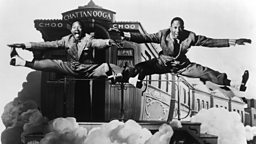
The Nicholas Brothers were among the best dancers of their era, and certainly the top duo during tap's golden age. Fred Astaire called their Jump Jive sequence in 1943's all-black film musical Stormy Weather, " the greatest movie musical number I've ever seen".
We were tap-dancers, but we put more style into it, more bodywork, instead of just footwork.Harold Nicholas
Compared to the majority of black entertainers of the time, the Nicholas Brothers were lucky and privileged. They appeared on Broadway and in a dozen movie musicals during the 1930s and '40s.
But, despite their relative status, industry segregation still relegated them to non-speaking parts and their dance sequences were often cut to mollify audiences in the American South. African American performers were routinely isolated from film plots to make this practice easier.
When African Americans were given speaking parts in films, it was in non-threatening roles like children, uncles or servants. The highest-earning black entertainer of the era was the great tap dancer Bill 'Bojangles' Robinson, whose four films as Shirley Temple's butler started when he was 56.
Another innovator, John Bubbles, the "father of rhythm tap", gave dance lessons to Fred Astaire and created the character Sportin' Life on Broadway in Gershwin's Porgy and Bess. In Hollywood, his act Buck and Bubbles would play college janitors in Varsity Show (1937).
The Nicholas Brothers were handsome, athletic young men who displayed a level of glamour and sex appeal that couldn't be tolerated in lead actor roles.
Clarke Peters' Tap America
![]()
How a Nation Found Its Feet
The Wire star explores the origins and modern significance of a great American art form.
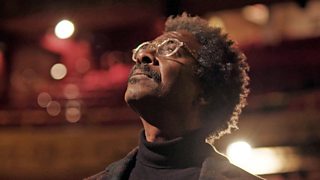

The hub of the tap revolution was Harlem. The best of the performers appeared at the Cotton Club – where the performers were exclusively black and the audience exclusively white. 142nd Street: Like so much of America, it’s gone. Not a plaque, not a golden shoe. It’s a crying shame. It’s not just the loss of a building, it’s a whole culture.Clarke Peters in Tap America
Already child stars in Philadelphia vaudeville, Harold and Fayard Nicholas were aged 11 and 18 when their career took the next step at famed New York cabaret the Cotton Club. The pair were famous for their airborne splits and acrobatics, with a style known as 'flash dancing'.
The Down Argentine Way routine is extraordinary every time, it makes you glad to be alive... it's the best thing in the movie and the only thing we want to watch now.Tap historian Brian Seibert
The Cotton Club showcased black performers, and in 1932 the Nicholas Brothers became the club's featured act. The club regularly featured music from Duke Ellington, Billie Holiday, Fats Waller and Louis Armstrong, and dancers such as Bill Robinson. Away from the stage it was a whites-only establishment.
The brothers found themselves in Hollywood after being spotted at the Cotton Club by studio boss Samuel Goldwyn, and first appeared in Kid Millions in 1934.
In 20th Century Fox's Down Argentine Way (1940) the duo (skirting the race issue by pretending to be 'Latin American') perform more or less their stage routine from the Cotton Club. Watching the sequence, Brian Seibert, author of What the Eye Hears: A History of Tap Dancing, tells Clarke Peters, "It's extraordinary every time, it makes you glad to be alive."
The BBC is not responsible for the content of YouTube embeds
That was one take, coming down those stairs ... jumping over each other's heads.Fayard Nicholas on Stormy Weather
This is the only time the Nicholas Brothers appear in the film, which starred Betty Grable and Don Ameche, and they have no lines of dialogue. "That's how things went, then," says Seibert, "even though it's the best thing in the movie and the only thing we want to watch now."
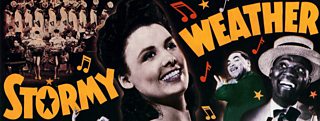
They would appear in several more musicals over the next few years, notably in Stormy Weather (1943) in an all-black cast of performers and actors including Lena Horne, Bill Robinson and Fats Waller. The production team were, however, all-white.
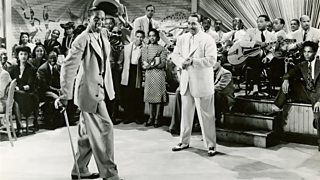
The brothers' show-stopping Jump Jive number with Cab Calloway and His Orchestra - the Cotton Club's house band throughout the 1930s - in Stormy Weather is set in a large cabaret. It has the brothers jumping up on tabletops and leaping off a grand piano onto the dance floor in full splits.
In the highlight of this breathtaking routine they leap over each other in splits while descending an oversized staircase. It was Fred Astaire's favourite dance number in the movies, and Miles Kreuger, president of the Institute of the American Musical, called it "easily the most exhilarating dance routine in all of cinema".
The BBC is not responsible for the content of YouTube embeds
They are probably the most amazing dancers I've seen. Those guys are perfect examples of pure genius.Mikhail Baryshnikov
Stormy Weather and another all-black musical from 1943, Cabin in the Sky, were part of a conscious effort by movie studios to attract African American audiences, who had more disposable cash than previously. These films were a chance for black performers to take lead roles.
Theatres in many cities refused to show the films. In Mt. Pleasant, Tennessee, Cabin in the Sky was pulled 30 minutes into the film - on orders from the local sheriff - after a hostile crowd gathered outside the theatre.
Stormy Weather marked the end of the Nicholas Brothers' contract with 20th Century Fox, which had been in place for two years - since Down Argentine Way. As tap expert Dr Constance Valis Hill tells Clarke Peters, "they were too mature, too dangerous, too threatening.”
The duo belatedly danced with a white star, Gene Kelly, when they reunited for their last Hollywood film together, The Pirate (1948), at Kelly's insistence. Their dialogue was cut by the studio from the final film, and their performance with Kelly was omitted from the reels shown in many southern theatres, for example in Memphis, Tennessee. At this stage in their career, essentially blackballed from major stardom, the brothers moved to Europe and toured there extensively as well as in Latin America and Africa.
It should have been a golden age for tap's most talented performers - when music, dance acts and the talkies met head-on in the movie theatres of America, and the tap dancing craze dominated Hollywood studio output. But tap's African American roots were sidelined, and a whole generation of performers saw their opportunities curtailed.
In the 1960s, aside from touring, the duo also taught master classes in tap as teachers-in-residence at Harvard University, and as Visiting Artists at Chicago dance school The Ruth Page Center for the Arts. Both Michael and Janet Jackson were later students of the brothers.
As well as Kelly and Astaire, the great ballet soloist Mikhail Baryshnikov was a huge fan, saying "they are probably the most amazing dancers I've seen. Those guys are perfect examples of pure genius".
As they are watching the Stormy Weather routine for the documentary, Dr Constance Valis Hill says to Clarke Peters , "we call this ‘class act dancing’ – they’re the epitome of the class act. Really bringing tap up from its shuffle roots, its slave roots, to the highest octave of sophistication and precision. They’re making the dance form modern, and a modern art form. I think that is really what pleases audiences."
Clarke responds, "What would have happened if they’d been allowed to continue in film, what kind of archive would they have had?" Hill: "Can you imagine!?"
Origins of Tap
- Tap dance as we know it emerged in the 1920s when taps became popular - they were nailed or screwed into shoe soles at the toes and heels.
- It had its origins in several styles: buck dancing and clog dancing; soft-shoe - a relaxed, graceful dance made popular in vaudeville; and buck-and-wing dancing - combining clogging styles, high kicks, and complex African rhythms and steps such as the shuffle and slide - which would eventually become modern rhythm tap.
- These styles themselves were descendents of several ethnic percussive dances, primarily African tribal dances and Scottish, Irish, and English clog dances and jigs.
- In the big cities of the North, such as in New York's Five Points district, a variety of ethnic groups lived cheek-by-jowl. From the mid- to late 1800s, dance-offs and competitions between Irish and African American dancers became commonplace.
- These intense challenges, also called 'cutting contests', were ideal for developing new talent and dance styles and were the antecedent of the 1970s breakdancing explosion.
Dance Season
![]()
Dancer's swansong
Star ballerina Zenaida Yanowsky on heartache at end of her long career.
![]()
Flesh and bone
Choreography and on-stage chemistry in Kenneth MacMillan’s ballets.
![]()
About Dance Season
With Michael Clark, Zenaida Yanowsky, Dickson Mbi, Clarke Peters and more.
![]()
Dancing Bowie
Michael Clark Company dance to Chant of the Ever Circling Skeletal Family by David Bowie.