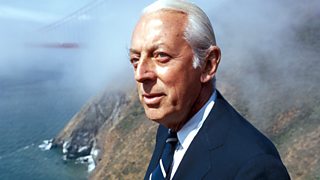
Kingman Brewster
Programme recording incomplete
...spread to England or, so far as I know, to any other country of the English-speaking world, except, I'm told, Dublin.
It's the closing ceremony of the college year when the graduates troop on to a leafy campus or, if it's raining, into an auditorium, and hear the president of the university call off the roster of graduating students and then, in this country anyway, bestow honorary degrees on eminent people from various walks of life.
It's Speech Day, in English schools. Degree Day at the universities. It may well be one of those Americanisms like... like 'sidewalk' and 'I guess' which were old Englishisms that were brought over to this country and retained here while they faded and vanished in the mother country. For 'Commencement', in its now exclusively American sense, was first used, first used in print anyway, so long ago as 1643, over 130 years before there was such a nation as the United States of America. A book called 'New England First Fruits' is the original source with a note that says, 'So have the students lately kept two solemn acts for their commencement.' And, ever since, Americans have talked about where they'd stay 'for' commencement, who spoke 'at' commencement, and getting things tied up 'by' commencement.
Mostly universities and colleges hold their Commencement Day exercises during the fist week in June but Yale, founded by a Welshman, I ought to mention, held it this year in mid-May, the idea being, I shouldn't wonder, to enable their graduates to get to jump on their rivals in the matter of going out and snapping up a job.
When the time came for the university president, Mr Kingman Brewster, sometimes known as 'the king' to award the honorary degrees, everybody turned and looked at the magnificos sitting side by side who'd been trying and failing to look as if their normal occupation required them to wear black gowns and mortar boards. This is always a faintly comic sight. It was more ribald than usual at Yale since two of the recipients of honorary degrees were B B Young, a black blues singer, and 'Scotty' James Reston, the eminent political pundit of the New York Times who, however, is most at home and most inconspicuous anywhere out on the road since he dresses like an unmade bed and passes without notice in a stew of politicians, a factory floor, a hoboes camp, or any other place he has in the past 40 years gone looking for a story.
The big chief of this ceremony was the former President, Gerald Ford and he responded to President Brewster's remark that 'he had rescued the dignity of the country in a bad time' by ducking modestly, taking his scroll and retreating to his seat as the crowd gave him a heart-warming clap and a sitting ovation. But after the heart-warming came the heart-rending scene when Presidenet Brewster called on two Irishwomen, Mairead Corrigan and Betty Williams. They were, they are, you surely recall, the two brave ladies who walked out on the streets of a terrified city to beg for the goodwill of all Irish people in starting a peace movement. Now 15,000 people anywyhere can make a noisy rustle, if only from shifting feet and programmes and clearing their throats, but the huge crowd came to its feet and roared a mighty sound that brought tears to some people's eyes and quick swallows to the throats of hard-bitten men. There was warm applause, also, for the genial and modest man, Sir Peter Ramsbotham, who is the retiring British ambassador. And then there was the surprise, and another impromptu standing ovation.
Somebody had not told President Brewster about it, for the good reason that he was to be the surprised beneficiary. It was an honorary degree for him and, since he's leaving the university which he has presided over for 15 years, that's a pretty perfunctory, tight-lipped mention of his service for at Yale, at that time, he has performed two enormously valuable services. One could have been done by any other man of superior intelligence and organisational ability. He recongised early on that, in some fields, in some of the sciences notably, Yale had been slumping on her laurels. So he went out and got money and he recruited gifted men and women and restored Yale in those fields to the eminence you would expect of one of the three oldest universities in the country.
But his other service required more than intelligence and a sharp eye for superior talent. It required intestinal stamina and steady courage. In the black decade, from the 1960s, from the time of John Kennedy's assassination through to the murder of his brother, and the obscenity of the police gone berserk at the Democratic Convention in Chicago in 1968, it is no news to any adult who lived through it, the universities and colleges of this country went into a stampede of protest and violence.
The starting gun was, of course, the drafting of men for Vietnam. Many colleges fell apart, many campuses looked like town squares under martial law, with soldiers on the patrol. Many of them were about as civilised in their dissent as trainloads of cattle pouring into one of the old Chicago stockyards. College presidents were no longer eminent scholars, bowed to on the streets and applauded by congregations of students. They were men beseiged, sometimes literally so, sending out SOSs or proclamations or peace offers from the ruined libraries of bombed-out buildings.
Yale acquired an unenviable reputation among the Johnson and Nixon establishments because its president was against the war, stood at the side of the protesting students and gave them about as much leeway, by way of public show, as the constitutional amendment about freedom of speech will allow. It was very tough to stand in the middle of a storm with many of the protestors carrying their defiance beyond any decent limit and yet defend their civil rights.
Kingman Brewster during those years was a hero to some students, a menace to others and regarded by the White House as a powerful nuisance. And yet in the end he held the university together. He withstood a blizzard of abuse from the hawks, including many of his own trustees and faculty. And he came through with the satisfaction, if ever he cared to look back on the bad times, the satisfaction of knowing that he had never been arbitrary or pulled rank or damned the extremists who, as always, threatened the safety of the society they pretended to be saving.
It was for the memory of this service that the Yale campus rose at Kingman Brewster, the students more than anybody, and gave him a full-throated roar and the chanted salute, 'Long live the king!' It was a splendid and happy farewell to this bulky, handsome, comfortable bear of a man. And from our point of view, he's leaving for the happiest reason. He's the new ambassador to Great Britain. By a pleasant coincidence, one of the... one of the fathers, who, like him, was watching a son graduate, was Mr Cyrus Vance, the Secretary of State. Since he's empowered by his office to stand in for the President of the United States and swear in ambassadors, Mr Vance and Mr Brewster retired to the Brewster house when all the cheering was over and there Kingman Brewster took the oath, in that moment ceasing to be President Brewster and becoming Ambassador Brewster.
There are a couple of things I'd like to say about that post, which is considered both among career diplomats and politicians as the number one diplomatic appointment. Too often, from the Roosevelt years through the Nixon years, it is a post that has been given to men who fulfilled what, for a long time, seemed the only qualification for representing the world's largest democracy – the need to be a multi-millionaire. This irony developed out of the disproportionate power of two men, one in the Senate, one in the house. More to the point, you could fairly say that able men who lacked a fortune were debarred from the big embassy posts because of the power of a little-known house committee, a sub-committee, the house sub-committee on appropriations for state.
Now this sub-committee decides how much or how little the United States government shall pay its ambassadors, consuls and other offices abroad, by way of expenses, entertainment and the 'front' that the United States puts up. For many years, the sub-committee was ruled with an iron hand by a congressman from Brooklyn who called the necessary appropriations 'booze allowance'.
He and his equally puritantical colleague in the Senate would allow the American ambassador to Great Britain no more than a few thousand dollars for his entire annual entertainment, enough for a fruit punch party on Independence Day. These two acted on the conviction that any adequate expense account would tempt American ambassadors into sponsoring, on foreign soil, orgies unbecoming a simple republic. President Kennedy had to beg them, successfully, to yield a decent sum for two men, neither of whom had any private resources, to go to France and India.
Well, both these puritans are dead and gone. The absurdity they spawned has, at least, withered. There is a young scholar in Rome, there are bright men of modest means in other high posts. Best of all, there is now Kingman Brewster in London. When he presents his credentials to the Queen, we may, with all respect, echo the roar of the Yale sturdents last Monday and cry, 'Long live the Queen! Love live the King!'
This transcript was typed from a recording of the original BBC broadcast (© BBC) and not copied from an original script. Because of the risk of mishearing, the BBC cannot vouch for its complete accuracy.
Letter from America audio recordings of broadcasts ©BBC
Letter from America scripts © Cooke Americas, RLLP. All rights reserved.
![]()
Kingman Brewster
Listen to the programme