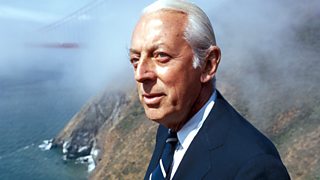
James Mason remembered
It is not with foolish boast that I recall, with almost frightening clarity, how a young man, more than half a century ago, came walking across a common in Cambridge, his neck swathed in a college scarf, his body leaning against one of those perishing winter winds that sweep across the damp Fen country.
He was on his way to an appointment with the high muckamuck of an acting society, not long established, called the Cambridge University Mummers and, as the president of that society, it was one of my jobs to hold auditions for aspiring members. And, since I lived in rooms on an upper floor of a house in Chesterton Road, I looked out across the common that dank day and saw this neat young man leaning into the wind.
He was coming for an audition and during that winter I used the script of one play for the men's auditions. It was called 'Journey's End' – the first honest play about the First World War. It was played entirely in a dugout. It was put on originally for a private society in London but when the critic James Agate wrote at glowing length about it and said it was a scandal that this noble play could not get backing to be seen in the West End, a sponsor was found and 'Journey's End' became the theatrical sensation, first of London and then of New York.
There were two parts in it that were so far apart in character and style that anybody reading first one and then the other could not help revealing some glimmer of talent. One part was that of Lieutenant Raleigh, a blue-eyed public school infant. The other was a whisky-sodden cynic, Captain Stanhope. So, when the intense young man swathed in the Peterhouse scarf knocked on my door and came in, we exchanged howdedoos and I told him we would, together, read a passage of dialogue, each of us taking one part and then the other.
He had a ruddy, a pink, face, a finely modelled head and, I remember, large piercing brown eyes. He was painfully shy and his eyes had a wary look, as of a fine fox expecting any minute to hear the huntsman's horn. I'm sorry to say that he gave no sign of any acting talent whatsoever. We had some coffee and though my normal cowardly practice with duds was to suggest that we'd call them, I felt there was no point in delaying the agony. I asked him what he was studying. 'Architecture,' he said. To my shame, which embarrassed me for years to come, I said, 'Stick to it!' And he was on his way.
Twenty-two years later I met him again and we became firm friends through the Fifties and the Sixties. His name was James Mason. The only other auditor I turned down flat as a young man so devoid of talent that it would have been cruel to encourage him, even at that early age, was a youngster from St John's College who subsequently became Sir John Clements. It only goes to show what a marvellous talent scout I would have made.
James Mason was a man who, as an actor and especially as an actor in Hollywood, suffered from a lifelong allergy to social fuss and pretension, so he bridled against the whole studio system of wild-eyed promotion, of recomposing a chosen actor as some sort of demigod. He was a private man caught in the spinning wheels of publicity and he hated it. Like Katharine Hepburn, he spurned all the requirements of the tinsel factory – the glamour interviews, the endorsing of cigarettes or automobiles – and, like Katharine Hepburn, he earned an early reputation for being uppity, arrogant and, by the press agents' sleazy definition, uncooperative. He often said acting was a ridiculous profession.
What he meant was that it was a profession he enjoyed practising but his character was embarrassed by the publicity requirements and his temperament was driven to despair by the occupational need to sit around for hours and hours doing nothing between takes, when he might better have been reading or painting, for which he had more than an average gift.
We once went down to stay with him at Harpers Ferry, West Virginia, where he was on location – the actual location where John Brown, the one whose soul at least goes marching on, set up a farmhouse garrison of whites and Negroes and from there raided a federal arsenal with the intention of arming black slaves. He was captured by a marine colonel, one Robert E. Lee, and subsequently hanged for murder, insurrection and treason to the commonwealth of Virginia.
Mason played this crazed missionary and gave it the intensity of a demon, but what I remember most of that little safari was a conversation we had about General William Tecumseh Sherman. Sherman is known to American schoolboys, or was, as the Union general who, during the Civil War, marched with 90,000 men from inland Georgia, from Atlanta, 250 miles to the sea at Savannah, plundering, burning and ravaging the towns and the landscape as he went. The most ruthless, you might say, of the generals on either side.
Yet Sherman became a soldier who developed a loathing of war more profound than that which eventually overtook General Douglas MacArthur. Sherman was haunted for the rest of his life by the systematic atrocity of his march to the sea and, 15 years after it was over, he addressed the graduating class of a Midwest military academy and it was to these astonished students that he wound up his speech: 'I am tired and sick of war. Its glory is all moonshine. It is only those who have neither fired a shot nor heard the shrieks and groans of the wounded who cry aloud for blood, more vengeance, more desolation. War is hell.'
I read that speech once to Mason and he didn't forget it. A year or so later there arrived at my house a package containing a wooden statuette of General Sherman which stands on the bookshelf behind me. I think Mason saw in him a kindred spirit – a good man in, for him, a bad trade. Most successful actors, sooner or later, get caught up in publicly expounding the subtleties and the magic of their trade. James Mason had no truck with this moonshine. He looked on acting as a first-rate carpenter looks on carpentry – it is a craft to learn, to be scrupulous about the performance of it. Not, though, to pretend to laymen that it's some sort of necromancy or holy witchcraft which God has called on you to perform.
In other words, he was a pro – a man capable of doing his best work when he didn't feel like it and, away from the set, the studio, the greasepaint, an intelligent and sensitive and humorous man, willing to talk about anything but the theatrical mumbo jumbo. He accepted with due grace the fact that he could not forever go on getting the girl and remained to the end a fine character actor. He lived a long life and, for the last 13 years of it, a very happy one with his Australian wife.
The only consolation of his going is the certainty that we shall now be getting a flock of reruns of his best pictures, of 'Odd Man Out' and 'Rommel' and 'Five Fingers'.
W. H. Auden once instructed us, 'Honour the vertical man!' Very well. Let us now praise another famous man who is vertical and full of sap at 84 on 10 August. Many of you must have glimpsed him – or the actor who played him – in 'Chariots of Fire'. He was, in life and in the movie, the sprinter who came in third, next but one behind Harold Abrahams in the 100 metres in Paris in the Olympics in 1924. A man of much fame in his native New Zealand but not much known outside that country, except among surgeons the world over.
'My hobby,' he was saying the other day in Los Angeles, 'was athletics. My life was surgery.' Arthur Porritt, now a pink, outsize Micawber in appearance, went from the firefly fame of bronze medal in the Olympics to a career of great distinction winding up in the 1950s and Sixties as Sergeant-Surgeon to the Queen, a title which reminds us that in its original sense the role of sergeant was a very grand one, being reserved for men of knightly rank who were in immediate attendance on the king's person. So, of course, Arthur Porritt was knighted. He was honoured by the surgical academies of France, the United States, Scotland and, when his days with the knife were over, appointed Governor-General of his native land, New Zealand.
Lord Porritt now, he was recalling the other day the long-lost days when the Olympics brought together the best athletes in the world who were, in that innocent time, also amateur athletes. He remembers with special poignancy an episode that never came into 'Chariots of Fire'. When the race was over, Abrahams' Cockney trainer cheerfully remarked that 'Porritt was the worst runner I've ever seen in my life, but', he added, 'let me train you and I'll make you the best!' Porritt took the ridiculous gamble and trained as he never even thought of training. The first result – he took a tenth of a second off his time. The end result – he beat Abrahams.
Looking now at the Los Angeles' Olympics, Lord Porritt watched the young and the eager, their muscles trained to bursting point. For what? For the gold medal, if possible, of course, but it now comes out, also planning long before the Olympics for the fortunes that can come later from wearing this firm's shoes, that firm's shirts and shorts. The great Moses made half a million last year. Asked if he would compete in 1988, he said, 'Unfortunately, I might have to' – meaning his contract with the sportswear manufacturer runs so long.
'They tell me', said one old star, 'that my gold will be close to a million bucks in commercial endorsements.' And now, the new star, the adorable little 16-year-old gymnast, Mary Lou Retton, who trained eight hours a day for 12 years, is probably going to find it was worth it because the advertising agencies are beating a hot path to her door. As one writer put it, 'The Gold Rush begins after the Games are over'.
The last word on this Roman circus belongs, I think, to Lord Porritt. 'There are', he said, 'no amateurs left'. There is no way to change the farce of the Games. They suffer from giantism, commercialism, nationalism, racism and drugs. It's sad. I still believe in the Games but I doubt they can be resuscitated. They're trying to do an impossible thing. To keep an Olympic ideal in a modern world.
This transcript was typed from a recording of the original BBC broadcast (© BBC) and not copied from an original script. Because of the risk of mishearing, the BBC cannot vouch for its complete accuracy.
Letter from America audio recordings of broadcasts ©BBC
Letter from America scripts © Cooke Americas, RLLP. All rights reserved.
![]()
James Mason remembered
Listen to the programme