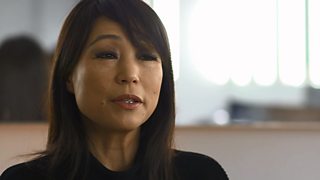
Unsuk Chin
This season the BBC SSO will focus on three concertos by the South Korean composer Unsuk Chin. Jessica Duchen profiles one of the major composers of our time…

Unsuk Chin holds a unique place among prominent composers who have established powerful individual voices at the start of a new century: balanced between East and West, possibly transcending both. Her music stands out from the crowd for its freedom and individuality. Refusing to be restricted by matters of roots, national cultures or stylistic fads, she never compromises on the rigour of her technique, the vividness of her imagination or the intense self-questioning that underpins her work.
Born in South Korea in 1961, Chin is the daughter of a Presbyterian minister; as a child she took her first steps in music in his church, playing the piano for hymns, weddings and more. She dreamed of becoming a concert pianist, but has commented that the family lacked adequate finance for the necessary studies. As a composer she was largely self-taught before going to university, setting herself tasks such as copying out Tchaikovsky symphonies to better understand their workings.




After studying composition at Seoul National University, she went to Hamburg to become a pupil of the great Hungarian composer György Ligeti at the Hochschüle für Musik und Theater. In a recent interview with the New York Times, she recalled that she had, until then, attempted to imitate the avant-garde style that dominated western contemporary music, but that Ligeti told her this was “verboten” (forbidden).
After studying composition at Seoul National University, she went to Hamburg to become a pupil of the great Hungarian composer György Ligeti
“At that time I already had had success in two important international competitions,” Chin has said (in an interview for US Asians). “But when I showed him these prize-winning pieces, he would only shake his head and say: ‘Throw all this away. There is nothing original in these pieces.’ This was very hard, though I somehow knew myself that I hadn't found my own voice...”
The experience seems to have brought on a compositional crisis – after which a move to Berlin to work at the electronic studio of the Technical University gradually sparked her creativity back into action. In 2004 she won the prestigious Grawemeyer Award for her Violin Concerto: it propelled her into the international limelight in earnest.
Chin’s earliest influences included, besides music in church, the traditional folk music of Korea, heard on the streets of Seoul, and the prevailing background of American pop music on the radio. More recent ones have been as varied as the Balinese gamelan and Conlon Nancarrow’s Studies for Player Piano. Such eclectic worlds give her music a base involving a huge breadth of references on which she often draws – for instance, to make ironic points or to highlight humorous strands – but from which her own voice stands distinct. Her sense of humour is a vital component, from the dazzling hilarity of her opera Alice in Wonderland to the way she uses the solo instrument plus greatly expanded percussion section in her Piano Concerto.
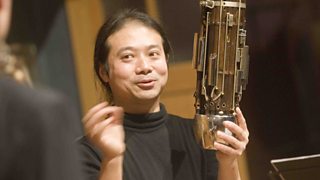
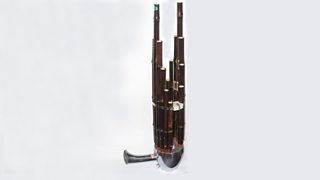
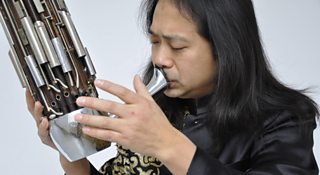
Šu for Sheng and Orchestra is a particularly fine example of Chin’s ability to meld many different influences into a unique and quirky creation that goes far beyond the sum of its parts. The Sheng is a type of Chinese mouth-organ that can produce many strands of sound at the same time. Chin uses it to evoke – on acoustic instruments – the type of effects that the European avant-garde often sought with electronic instruments. Elements of this beautifully sculpted 21-minute piece represent virtually a double mirror between electronic and traditional means of making music.
The Clarinet Concerto, too, finds Chin exploring the far realms of musical potential, both for herself and for her soloist. She has said (in the New York Times interview) that she is “attracted by virtuosity…the enthusiasm and virtuosity of a player trying to go beyond his or her boundaries. I like that. It’s a situation I experience all the time as a composer: pushing the limits of your possibilities, not knowing whether you can do it – and then somehow succeeding.”
Colour, humour and lightness of touch, virtuosity of imagination and the unfailing adherence to artistic integrity remain Chin’s exemplary hallmarks. Her numerous international awards, recordings and commissions – and the enthusiasm her works spark among audience and critics alike – offer ample proof that she has become one of the most exciting and appealing composers of our day.
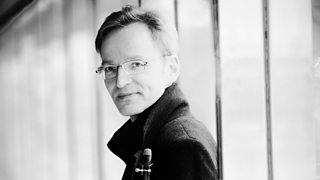
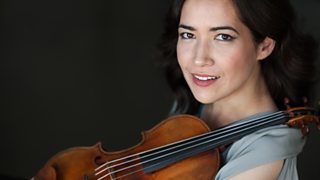
Wu Wei will play Šu on Thursday 5 November, Kari Kriikku plays the Clarinet Concerto on 14 January and Vivian Hagner plays the Violin Concerto on 7 April 2016.
Jessica Duchen writes for The Independent and is a freelance journalist and author.
![]()
Clarinet Concerto at City Halls
Kari Kriikku performs the Clarinet Concerto on 14 January 2016
![]()
Violin Concerto at City Halls
Viviane Hagner performs the Violin Concerto on 7 April 2016